


Summary
Ear and hearing health is vital for overall health and quality of life. Ear disease and associated hearing loss can have long-lasting impacts on education, wellbeing and employment.
Aboriginal and Torres Strait Islander (First Nations) children are more likely than non-Indigenous children to experience ear and hearing problems. Several factors contribute to the poorer ear and hearing health of First Nations children, including lack of access to health services, household overcrowding and second-hand smoke exposure.
Since 2012, the Australian Government has funded the Northern Territory Government to deliver hearing health outreach services to First Nations children and young people aged under 21 in the Northern Territory–mainly through the National Partnership on Northern Territory Remote Aboriginal Investment (for children aged under 16); and through the Healthy Ears–Better Hearing, Better Listening Program (for children and young people aged under 21). These outreach services include audiology services, ear, nose and throat (ENT) services, and Clinical Nurse Specialist (CNS) services.
This report presents new data for hearing health outreach services provided in 2023, through Northern Territory Remote Aboriginal Investment, the Healthy Ears–Better Hearing, Better Listening Program (until 30 June 2022) and other Australian Government funded programs and includes time trends for the period July 2012 to December 2023.
How many children received services?
- In 2023, 171 training sessions for hearing health education, promotion and prevention activities were provided to health-care staff.
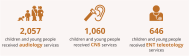
- A total of 2,067 First Nations children and young people received at least 1 audiology, Clinical Nurse Specialist (CNS), or ear, nose and throat (ENT) teleotology service in 2023. From July 2012 to December 2023, a total of 45,491 CNS, audiology and teleotology services were provided to more than 11,000 children and young people.
- In 2023, 2,343 outreach audiology services were provided to 2,057 First Nations children and young people. From July 2012 to December 2023, a total of 25,139 audiology services were provided to 10,900 children and young people.
- 724 ENT teleotology services were provided to 646 First Nations children and young people in 2023. From July 2012 to December 2023, a total of 9,538 teleotology services were provided to 4,560 children and young people.
- In 2023, CNSs conducted 1,165 visits to 1,060 children. From July 2012 to December 2023, a total of 10,814 CNS services were provided to about 6,600 First Nations children.
Figure 1: Number of First Nations children and young people who received audiology, CNS or ENT teleotology service in 2023
Sources: Tables S2.1, S2.3 and S2.5
Hearing health is improving among children and young people who received outreach services between 2012 and 2023
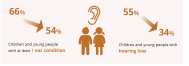
The percentage of First Nations children and young people with at least 1 ear condition decreased by 13 percentage points, from 66% (483 of 727 children and young people) to 54% (1,108 of 2,067 children and young people).
Among children and young people who received audiology services, the proportion with hearing loss decreased by 20 percentage points, from 55% (388 of 710 children and young people) to 34% (707 of 2,057 children and young people).
Figure 2: Ear and hearing health improvements between 2012 and 2023
Sources: Tables S3.1 and S3.6.
Among 5,191 First Nations children and young people who received at least 2 audiology services between 2012 and 2023, 3,525 had hearing loss at their first service, and of those, 2,350 (67%) had improved–this is a change from bilateral to unilateral hearing loss or from unilateral hearing loss to no hearing loss.
Between 2012 and 2023, among 2,233 First Nations children who received at least 2 audiology services and had hearing impairment at their first service, 1,685 (76%) had improved–moving to a lower degree of hearing impairment or to no hearing impairment.
Many children and young people are still waiting for hearing health services
At December 2023, there were 3,118 First Nations children and young people on the audiology waiting list. Among them, 1,681 were new referrals and 1,437 were recalled for further follow-up after receiving an initial audiology service. There were 2,128 children and young people on the waiting list for ENT teleotology services. Among them, 797 were new referrals and 1,331 were recalled for further follow-up after receiving initial ENT teleotology services.
Is the Hearing Health Program meeting its benchmarks?
Service delivery benchmarks for hearing health are set in the Northern Territory Remote Aboriginal Investment (NTRAI) Health Implementation Plan for audiology, CNS and health promotion and training activities. These are measured by the number of services per year. In 2023, all 3 service delivery targets were exceeded.
Progress against benchmarks is presented in Table 1.
| Service delivery targets | Outcome |
|---|---|
At least 1,700 audiology services per year | 2,343 audiology services provided in 2023 |
At least 700 children receiving CNS services per year | 1,060 children received CNS services in 2023 |
At least 15 hearing health promotion or training services/activities per quarter (60 per year) | 171 hearing health promotion or training services and activities provided in 2023 |
CNS = Clinical Nurse Specialist