



Summary
Oral health is an important part of overall health and quality of life. Poor oral health can affect adults and children alike, causing pain, embarrassment, even social marginalisation. For children, the effects can be long-term and carry through to adulthood.
Aboriginal and Torres Strait Islander (First Nations) children are more likely than non-Indigenous children to experience tooth decay. Several factors contribute to the poorer oral health of First Nations children, including social disadvantage and lack of access to appropriate diet and dental services.
Since 2007, the Australian Government has helped fund oral health services for First Nations children aged under 16 in the Northern Territory. The Northern Territory Remote Aboriginal Investment Oral Health Program (NTRAI OHP) complements the Northern Territory Government Child Oral Health Program by providing preventive (application of full-mouth fluoride varnish and fissure sealants) and clinical (tooth extractions, diagnostics, restorations and examinations) services.
This report presents data from the NTRAI OHP from July 2012 to December 2023.
How many First Nations children received services in the NTRAI OHP?
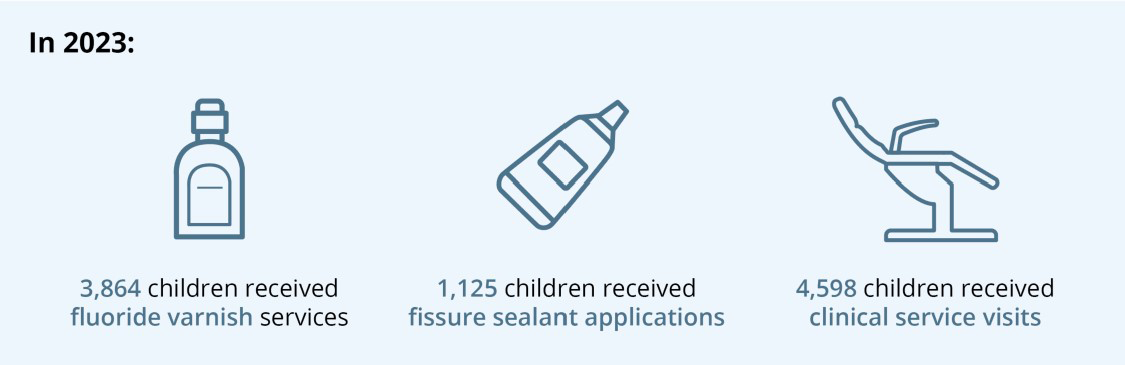
In 2023, full-mouth fluoride varnish services, fissure sealant applications and clinical service visits were provided to First Nations children in the Northern Territory under the NTRAI OHP. Of those children:
- 3,864 received 6,262 full-mouth fluoride varnish services, a decrease of 341 services from 2022
- 1,125 received fissure sealant applications to 5,161 teeth during 1,189 services, a decrease of 337 teeth from 2022
- 4,598 received clinical services during 6,973 visits–such as dental assessments, fillings, extractions, or preventive services–a decrease of 532 visits from 2022. This excludes 1,427 visits where only full-mouth fluoride varnish and/or fissure sealant services were provided.
Source: Tables S2.1, S2.3 and S2.6.
How many First Nations children experienced tooth decay in the NTRAI OHP?
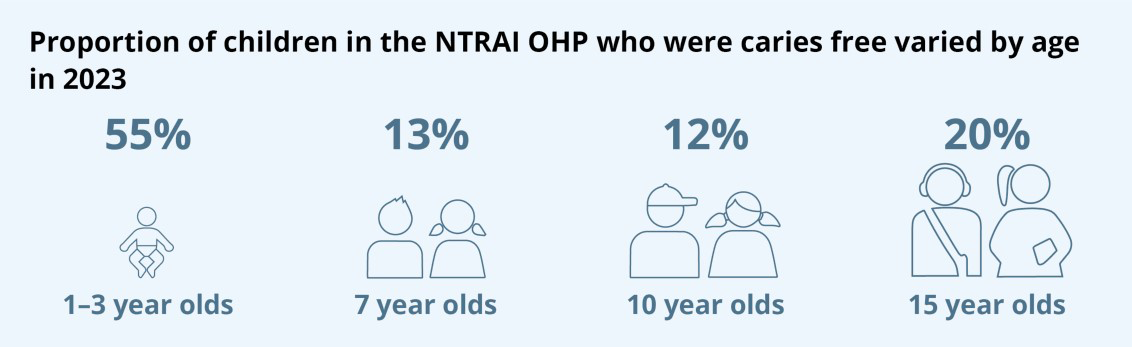
Tooth decay varied by age, and in 2023, children aged 10 experienced the highest rate of tooth decay (173 children or 88%). In comparison, children aged 1–3 experienced the lowest rates of tooth decay (117 children or 45%).
Source: Table S3.1.
How many decayed, missing or filled teeth did First Nations children have?
In addition to tooth decay, a widely used indicator to measure oral health status is a count of the number of decayed, missing or filled teeth.
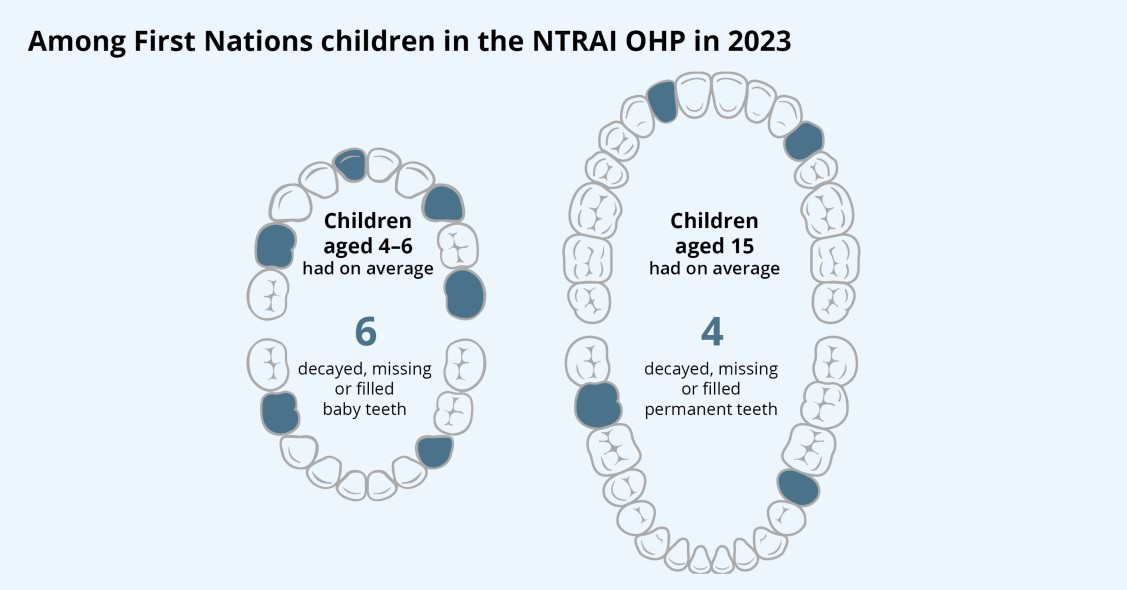
On average, in 2023, children in the NTRAI OHP aged 4–6 had the highest average number of decayed, missing or filled baby teeth (dmft), at 6 teeth, while children aged 15 had the highest average number of decayed, missing or filled permanent teeth (DMFT), at 4 teeth.
Source: Table S3.1.
Is the program meeting its benchmarks?
Outcomes for the NTRAI OHP are monitored through performance indicators and benchmarks. The service delivery targets for all three service types were met or exceeded (Table S1).
Targets | Outcomes |
|---|---|
Service delivery target: At least 3,600 clinical service visits in 2023 | 6,973 clinical service visitsa,b |
Service delivery target: At least 5,750 fluoride varnish applications in 2023 | 6,262 fluoride varnish applications provided |
Service delivery target: Fissure sealant applications to at least 1,500 teeth in 2023 | Fissure sealant applications to 5,161 teeth |
Health outcome target: At least 50% of total service items are preventive services | 60% of total service items were preventive in 2023 |
- For the 1 January 2023 – 31 December 2023 reporting period, there were two additional payor codes.
- For the 1 January 2023 – 31 December 2023 reporting period, visits where only full-mouth fluoride varnish and/or fissure sealant services were provided were not included in reporting. These services were included in the 2020 and 2021 reporting periods.