


Summary
Older Australians are more likely to be admitted to hospital than younger Australians. In 2022–23, 17% of Australians were aged 65 and over, yet they accounted for 44% of hospitalisations (ABS 2024, AIHW 2024a).
Older people admitted to hospital are at greater risk of experiencing functional decline; a reduction in their ability to perform day-to-day tasks, as well as cognitive decline (Chen et al 2022). This is not only the result of the illness or injury that led to being admitted to hospital, but also the hospital environment itself (SA Health 2024).
As a result, leaving hospital is a particularly vulnerable time for older people. An older person may need more support after leaving hospital if they have difficulty doing day-to-day tasks safely and on their own. If they receive assistance during this time, it can help them regain their functional independence and avoid the need for longer term care and support services.
The national Transition Care Programme (transition care) provides funding for short-term specialised support to help older people to regain their functional independence after a hospital stay. An earlier report found that transition care enabled older people to leave hospital earlier and could also help delay or prevent entry into residential aged care (KPMG 2019).
This report provides a snapshot of the people using transition care within a 1-year period. It uses linked aged care data to explore who uses transition care, how they use it, and how this use fits into the broader aged care system. As this report includes only people who used transition care, we cannot see what would happen without this support in place. Even so, the results suggest positive outcomes for people using transition care.
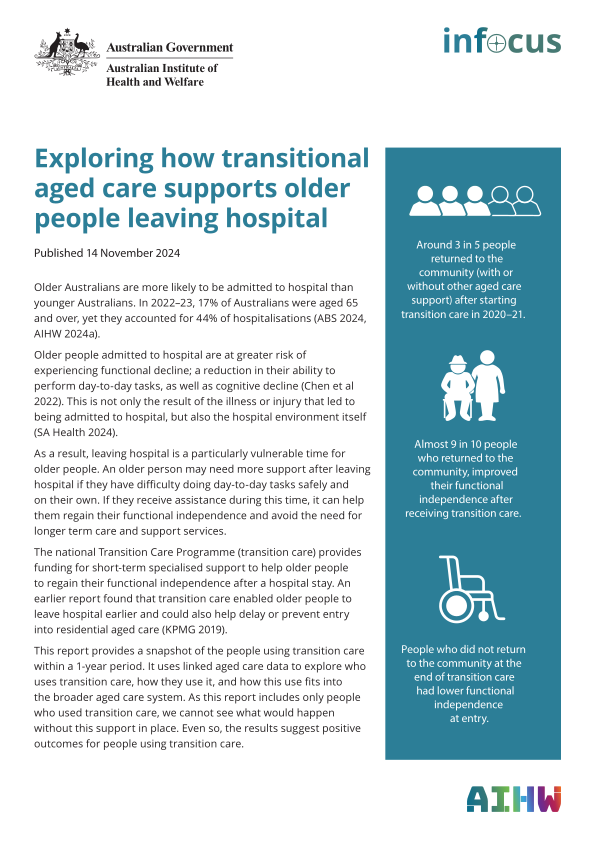
The analysis shows that 3 in 5 people who used transition care returned to the community, and almost all of these people (86%) experienced an increase in their functional independence on leaving the program. Fewer than 1 in 7 people who returned to the community, went on to enter permanent residential aged care by the end of the following year.
This highlights the importance of targeted interventions that help older people regain their independence after leaving hospital. Aside from the benefits to the individual and their families, there is also a community benefit if such intervention delays or prevents a person’s entry into residential aged care or readmission to hospital.
What data did we use?
This report focuses on people who started transition care services in 2020–21 and also follows their aged care service use from before and after they started transition care until the end of 2021–22. It describes people who have used transition care and episodes of transition care. A transition care episode refers to a single period of time that a person receives transition care services, based on one entry date and one exit date. A person can have multiple transition care episodes, and there is no limit to how many times a person can receive transition care within a year.
This report uses the Pathways in Aged Care (PIAC) link map. PIAC is a data asset derived by linking aged care activity data from the National Aged Care Data Clearinghouse (NACDC) and death records from the National Death Index (NDI). It includes activity data for aged care assessments, home support, home care, transition care and residential aged care. This information can be used to monitor, improve, and plan services.
Only people enrolled in Medicare are included in the PIAC data linkage. This means that some people using aged care may not be included, and data presented here may differ from other publications and sources.
Key findings
1. The Transition Care Programme (transition care) is a unique program in the Australian Aged Care system
2. Transition care provides support for older people leaving hospital
3. The number of people using transition care has remained mostly the same since 2012–13
4. Transition care supports a diverse group of older Australians
5. Older people in the Northern Territory have the highest rate of transition care service use
6. Three in 5 people return to living in the community straight after using transition care
7. People tend to use transition care once, for varying durations up to 12 weeks
8. People who start transition care with lower functional independence are less likely to return to living in the community
9. Most people who return to living in the community have improved functional independence when leaving transition care
10. Prior to transition care, most people have already used aged care services
11. Most people use other aged care services after transition care
12. Three in 10 people were living in permanent residential aged care by the end of 2021–22
13. Transition care is different to other forms of aged care and so is the data
End matter: More information; References.