

Patterns of multimorbidity
Page highlights:
Long-term health conditions commonly diagnosed in childhood (such as attention deficit hyperactive disorder (ADHD) and autism) tend to co-occur among people in younger age groups.
In contrast, conditions that develop over the life-course (such as back problems, osteoarthritis and deafness or hearing loss) tend to co-occur at older ages.
The most common comorbidities differ among individuals with different conditions.
Chronic conditions can occur together in an individual because they:
- are common – conditions that are more common are more likely to occur together than rare conditions
- share common risk factors or one condition is a risk factor for another
- are commonly diagnosed together – for example where screening tests are designed to identify multiple conditions.
These factors influence the patterns of multimorbidity. For more information, see Factors contributing to multimorbidity in the section Variation by condition group.
Patterns of multimorbidity on this page are identified through analysis of conditions that commonly occur together (co-occurring conditions), and conditions that are common among people with a specific condition of interest (common comorbidities).
Understanding which conditions commonly occur together can help identify associations between conditions and could be used to inform approaches to management and treatment.
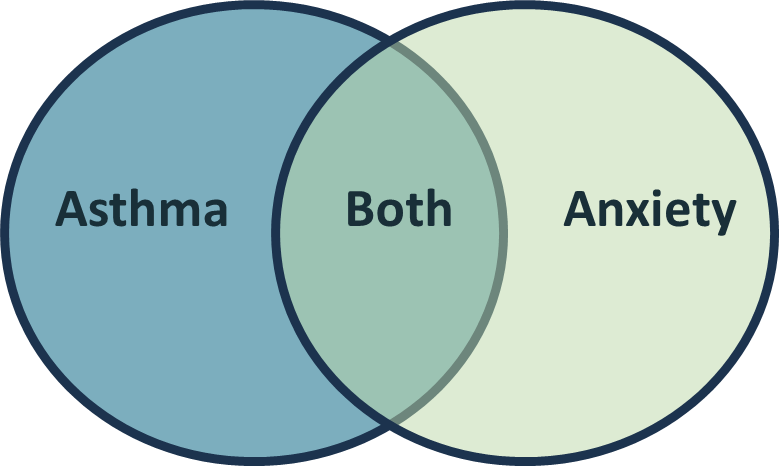
Figure 7 shows an image of 2 overlapping circles. The circle on the left represents people of all ages with asthma while the circle on the right represents all people with anxiety. The overlapping area in the middle labelled ‘Both’ represents people living with both asthma and anxiety.
Figure 7: Visual representation of the overlap between asthma and anxiety

Analysis of co-occurring conditions on this page describes the estimated overlap (co-occurrence) of pairs of conditions. In analysis, the proportion of people with co-occurring asthma and anxiety is calculated as the number of people in the overlapping section ‘Both’ divided by the total population of interest (in this example the population of interest is people of all ages).
‘Comorbidity’ refers to additional conditions (comorbidities) experienced by a person who has a specific condition of interest. The condition of interest can change depending on the focus of the study. Comorbidity analysis can tell us, for example, how many people living with asthma were also living with anxiety. In this example, asthma is the condition of interest and anxiety is the comorbidity. The proportion of people with asthma also living with anxiety is calculated as the number of people in the overlapping area labelled ‘Both’ divided by the total number of people with asthma (the condition of interest).
These two interrelated concepts provide complementary ways to understand associations between chronic conditions.
Estimates on this page are from AIHW analysis of the Australian Bureau of Statistics (ABS) 2022 National Health Survey (NHS) (ABS 2023). Analysis is of 72 selected long-term health conditions self-reported to the NHS.
The NHS is a community-based survey and does not include information from people living in residential aged care facilities, hospitals or prisons. This will exclude people likely to experience certain long-term health conditions such as dementia, cardiovascular disease and chronic obstructive pulmonary disease (COPD). This will influence the estimated proportions of people living with co-occurring conditions, particularly in older age groups.
For more information on the data source, factors that will influence disease estimates and conditions included in analysis, see Technical notes.
Co-occurring conditions
In 2022, anxiety, back problems and depression were the most common of the selected long-term health conditions (AIHW 2024). These conditions feature among the most common co-occurring conditions among people of all ages in 2022 with:
- anxiety and depression affecting an estimated 2.4 million people (9.3%)
- anxiety and back problems affecting an estimated 1.3 million people (5.3%)
- back problems and depression affecting an estimated 1.0 million people (4.0%) (Figure 8).
Figure 8: Prevalence of the most common pairs of co-occurring conditions among people of all ages, 2022
This figure shows that among people of all ages, additional commonly co-occurring conditions include anxiety with asthma (3.5%), osteoarthritis with back problems (3.3%), and back problems with deafness or hearing loss (3.2%).
Notes:
- MSK: musculoskeletal condition, ADHD: attention deficit hyperactivity disorder
- Prevalence estimates are ordered but are not always significantly different to each other.
- For the list of long-term health conditions included in analysis, see Table 1 in the Technical notes.
- For data and footnotes, see Table MM06 in the Data tables.
Variation by age and sex
In 2022, the most commonly co-occurring long-term health conditions varied by age and sex (Figure 9).
While depression and anxiety co-occur prominently across all age groups, long-term health conditions most commonly diagnosed in childhood (such as ADHD and autism) tend to feature in multimorbidity among younger age groups.
In contrast, conditions that develop over the life-course (such as back problems, osteoarthritis and deafness or hearing loss) feature more with increasing age.
Figure 9: The most common pairs of co-occurring conditions, by sex and age group, 2022
This figure shows how the most common co-occurring conditions vary by sex. Among people of all ages anxiety and depression were the most commonly co-occurring conditions for both males and females although living with both of these conditions was more common among females (11%) than males (7.6%).
Notes:
- MSK: musculoskeletal condition, ADHD: attention deficit hyperactivity disorder.
- Prevalence estimates are ordered but are not always significantly different to each other.
- For the list of long-term health conditions included in analysis, see Table 1 in the Technical notes.
- For data and footnotes, see Table MM06 in the Data tables.
In 2022, an estimated 4.8 million people (19%) were living with anxiety (Data table MM03). Anxiety commonly occurred together with other conditions among people aged under 65. For example, anxiety and depression were estimated to co-occur among:
- 197,000 males (4.9%) and 323,000 females (8.5%) aged 0–24
- 311,000 males (8.7%) and 483,000 females (13%) aged 25–44
- 331,000 males (11%) and 367,000 females (12%) aged 45–64 (Figure 9).
An estimated 4.0 million people (16%) were living with back problems (including sciatica, disc disorders and curvature of the spine) in 2022 (Data table MM03). Back problems commonly occurred with other conditions among people aged 45–64 and those aged 65 and over. For example, in 2022 an estimated:
- 169,000 males aged 45–64 (5.6%) and 289,000 males aged 65 and over (15%) were living with back problems and deafness or hearing loss
- 173,000 females aged 45–64 (5.5%) and 272,000 females aged 65 and over (12%) were living with back problems and osteoarthritis (Figure 9).
Common comorbidities
A ‘comorbidity’ refers to an additional condition experienced by a person who has a specific condition of interest.
The most common comorbidities differ among individuals with different conditions.
For example, Figure 10 shows that in 2022, based on self-reported information an estimated:
- 32% of people living with asthma were also living with anxiety – this is higher than the proportion of Australian’s of all ages living with anxiety (19%) (Data table MM03)
- 43% of people with COPD were also living with asthma – evidence suggests asthma is a risk factor for developing COPD (GOLD 2025).
Use the drop-down list in Figure 10 to select conditions and view their 10 most common associated comorbidities.
Figure 10: Common comorbidities among people with selected long-term health conditions, people of all ages, 2022
This figure shows that back problems were common among people with asthma and COPD. Among people of all ages, 25% of those with asthma were also living with back problems compared with 41% of those living with COPD.
Notes:
- ADHD: attention deficit hyperactivity disorder, COPD: chronic obstructive pulmonary disease, GORD: gastro-oesophageal reflux disease, Other HSVD: Other heart, stroke and vascular disease, MSK: musculoskeletal condition. Vision conditions exclude vision conditions corrected by glasses.
- Prevalence estimates are ordered but are not always significantly different to each other.
- Not all condition combinations can be shown due to small numbers.
- For data and footnotes, see Table MM07 in the Data tables.
The prevalence of comorbid conditions also varies between the selected conditions.
For example, based on self-reported information, in 2022 type 2 diabetes was a common comorbidity among people of all ages with:
- coronary heart disease (CHD) – an estimated 25% of people with CHD were living with diabetes
- heart failure – an estimated 24% of people with heart failure were living with diabetes
- chronic kidney disease (CKD) – an estimated 24% of people with chronic kidney disease were living with diabetes (Figure 11).
In contrast, 13% of people with osteoarthritis were also living with diabetes.
CHD, heart failure and CKD have known associations with diabetes and between each other. For more information, including on the prevalence of comorbid cardiovascular disease, diabetes and chronic kidney disease based on biomedical data, see Comorbidity of heart, stroke and vascular disease.
Figure 11 allows you to select a comorbidity and view the 10 conditions it most commonly occurs with.
Figure 11: Proportion of people with a selected comorbidity among those with a condition of interest, people of all ages, 2022
This figure shows that diabetes was also a common comorbidity among people living with the effects of stroke, cataracts, gout and glaucoma. Among people of all ages, 21% of those living with the effects of stroke, 20% of those with cataracts, 16% of those with gout and 15% of those with glaucoma were also living with diabetes.
Notes:
- ADHD: attention deficit hyperactivity disorder, COPD: chronic obstructive pulmonary disease, GORD: gastro-oesophageal reflux disease, Other HSVD: Other heart, stroke and vascular disease, MSK: musculoskeletal condition. Vision conditions exclude vision conditions corrected by glasses.
- Prevalence estimates are ordered but are not always significantly different to each other.
- Not all condition combinations can be shown due to small numbers.
- For data and footnotes, see Table MM07 in the Data tables.
ABS (Australian Bureau of Statistics) (2023) Microdata: National Health Survey, 2022, AIHW analysis of detailed microdata, accessed 15 February 2025.
AIHW (Australian Institute of Health and Welfare) (2024) Chronic conditions, AIHW, Australian Government, accessed 1 July 2024.
GOLD (Global Initiative for Chronic Obstructive Lung Disease) (2025) Global strategy for the diagnosis, management, and prevention of chronic obstructive pulmonary disease 2025 report’, GOLD, accessed 3 March 2025.