


Introduction
Achieving one or more of the above goals would greatly improve the data available to effectively deliver and evaluate policies and services aimed at improving the lives of people with dementia, their carers and families.
There are 3 short-term goals aimed to build toward the overarching goals of the plan:
- new data linkages
- new data analysis methods
- baseline data from new data collections.
These are 2-year goals which aim to develop the foundations of data development to achieve the 10-year goals of the plan.
What are the data gaps identified in this plan?
The objectives of the plan are to fill data gaps across 14 identified areas to meet the needs of the AIHW National Centre for Monitoring Dementia (NCMD) and data development required to support the National Dementia Action Plan (NDAP). These objectives will be met through performing several identified activities which will be updated over time and prioritised based on the ability to fill data gaps, provide foundational data, manage dependencies, and improve data on priority populations.
The key data gaps and activities cover the following areas:
- Risk and protective factors for dementia
- Dementia awareness and stigma
- Dementia prevalence and incidence
- Timeliness of dementia diagnosis
- Dementia type
- Dementia severity and progression
- Dementia diagnosis and management
- Collection and reporting of dementia and other health conditions in aged care data
- First Nations people-specific health care data on dementia
- Other care and support services used by people with dementia and their carers
- The workforce treating and caring for people with dementia
- Comorbidities in people with dementia
- Informal carers of people with dementia, including their needs and outcomes
- Direct and indirect costs of dementia to the Australian economy.
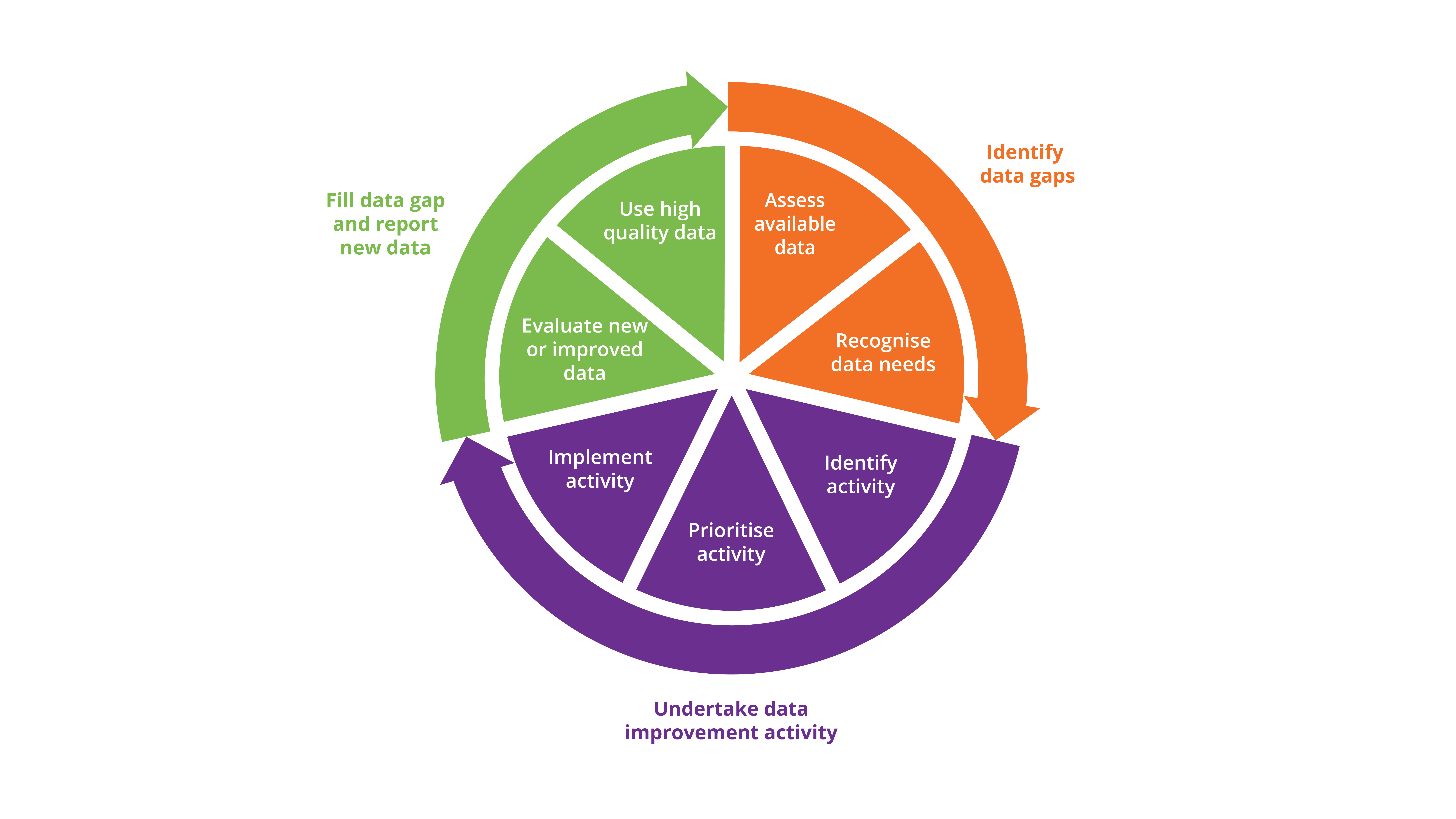
The overarching elements of a data improvement cycle are shown in Figure 2.1. The first step is identifying data gaps, which has been undertaken already for dementia in the AIHW report: Dementia data gaps and opportunities (AIHW 2020). This improvement plan addresses the next step in the improvement cycle, by identifying and undertaking data improvement activities. The ability of new data stemming from activities proposed in this plan to meet the goals of the plan will be reviewed and evaluated over the next 10 years. See Future reviews for more detail.
Figure 2.1: Data improvement cycle
The data improvement activities outlined in the plan should improve the reliability, accuracy, validity, availability and/or timeliness of dementia data. Improvements may involve the scope, coverage, collection tools, methods, integration, accessibility and/or harmonisation of data, and provide measures needed for monitoring the NDAP.
The plan builds on recommendations made in the 2020 AIHW report Dementia data gaps and opportunities, and incorporates anticipated data needs for:
- measuring dementia system improvements, based on the National Dementia Action Plan 2024–2034 (Department of Health, Disability and Ageing (DHDA) 2025a)
- the government response (Department of Health 2021) to findings of the Royal Commission into Aged Care Quality and Safety (Royal Commission 2021)
- health, aged care and disability reforms such as from the National Health Reform Agreement (2020–25) (DHDA 2025b), the Aged Care Data and Digital Strategy 2024–2029 (Department of Health, Disability and Ageing 2024) and Australia’s Disability Strategy 2021-2031 (DSS 2021)
- contributing to the Closing the Gap data priority
- filling gaps in Australia’s international dementia reporting, in particular reporting for the World Health Organization Global Dementia Observatory (WHO 2023)
- developments in the dementia data landscape, including data linkage
- addressing additional data gaps and initiatives identified through consultation with key stakeholders.
Many of these data needs have occurred in response to aged care reforms and government strategies across health, welfare and best practice use of data, and can be considered as enablers for this plan.
What is the scope of the data improvement activities?
This plan describes a broad scope of national dementia data improvement activities for the purposes of population-level monitoring, research, and reporting. It includes the following types of data improvement activities:
- create new, ongoing data sources – including collecting new administrative data or electronic health data, or conducting new surveys
- expand existing data collections – for example, by including dementia data items in an administrative collection or survey, or by increasing the sample size of an existing survey to facilitate analysis and reporting on people with dementia
- perform one-off studies to provide data to fill a key data gap or quality issue
- link data across existing data sets to expand and enhance dementia data resources and facilitate validation of dementia estimates
- harmonise data to improve dementia data coherence across data sets by implementing standard concepts and classifications
- develop and implement methods to improve dementia monitoring and reporting, especially for the NDAP.
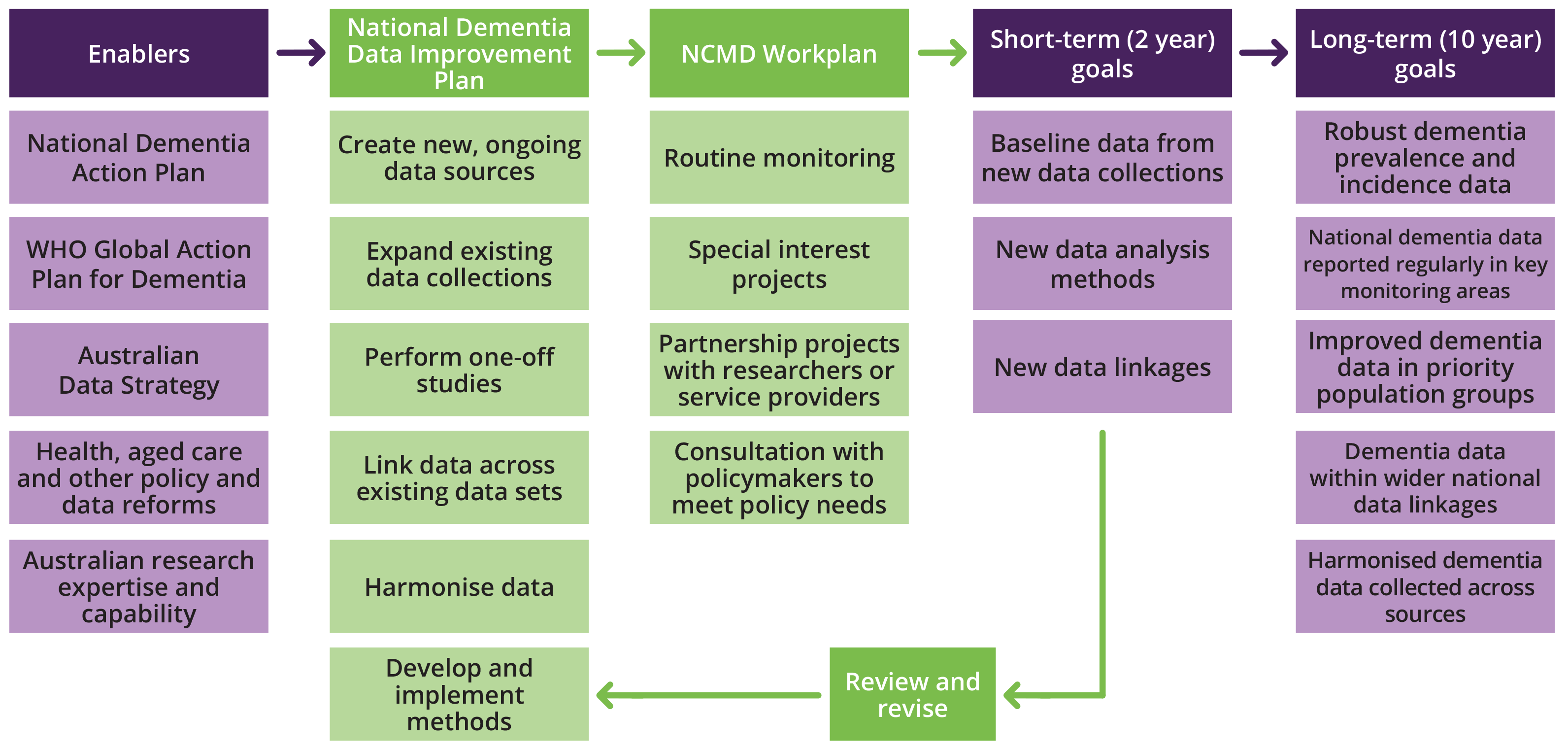
The scope may change over the 10-year plan and include learnings from dementia research and consultation, the evolution of new data sources and methods, the NDAP, the National Aged Care Data Strategy, the National Disability Strategy, the National Preventive Health Strategy and the National Health Reform Agreement. Figure 2.2 shows the relationship of these strategies to this plan, the NCMD and short- (2-year) and long-term (10-year) goals.
Figure 2.2: Relationship of enablers, this National Dementia Data Improvement Plan, and the NCMD with the short- and long-term goals of the plan
Who is the intended audience for the plan?
This plan is for policy makers, researchers, health, disability, aged care and social support service providers, and national data custodians who play a key role in the collection, management and/or reporting of data on dementia in Australia and who use data to inform dementia policy, service provision and planning.
How has the plan been developed?
The AIHW has developed this plan in consultation with the Australian Government Department of Health, Disability and Ageing (the department), the AIHW Dementia Expert Advisory Group and the department's Dementia Expert Reference Group (DHDA 2025c). These groups include dementia researchers, clinicians, peak bodies for dementia, carers and First Nations aged care, key providers for health, aged care and dementia-specific support services, people with lived experience of dementia, data custodians and subject matter experts. The plan has also undergone wider consultation with a range of data custodians and expert advisors of individual sectors to inform the development of individual data improvement activities.
Future reviews
Plan reviews will occur following NDAP and broader data evaluations. Proposed dates for release and/or evaluation of the NDAP and the NCMD are outlined in Table 2.1.
| Key milestones | Data improvement plan |
|---|---|
2024 | This plan was updated in 2024 to reflect changes in data sources, data development progress, and to align with and incorporate new activities required for monitoring the National Dementia Action Plan 2024–2034. |
2025 | In December 2025, this plan was updated to report on the progress of activities, reflect data developments, incorporate new activities, and report achievement of the 2-year goals. |
2029 | Review of data gaps and priorities following the mid-term review of the NDAP to ensure the plan is aligned to meet new NDAP data reporting needs. Review of progress towards achieving the mid-term goals and adjust milestones to meet the 10-year goals. |
2034 | Review of data gaps and priorities to meet policy, program and reporting needs. Review of progress towards achieving the 10-year goals. |
Plan reviews will reflect improvements in data access and integration and dementia knowledge to update the data gaps and activities, list any new dementia data improvement activities required and progress to date in improving dementia data to meet the plan goals.
It should be noted that the data gaps and the proposed activities will evolve over time as new data or data needs arise. The understanding of the most appropriate activities to obtain data from different populations, sources or data types may also evolve and require changes to the proposed activities.