

Ear and hearing health system
On this page:
A broad range of policies and programs provides ear and hearing services for First Nations people, with the provision of these services being complex and fragmented. This section describes the broad policy context. It also provides an overview of ear and hearing health services across the continuum of care from awareness, prevention, screening, diagnosis, treatment and rehabilitation.
Broad policy context
The following initiatives form part of the broader policy context for ear and hearing health among First Nations people:
- the National Agreement on Closing the Gap was developed in partnership between Australian governments and the Coalition of Aboriginal and Torres Strait Islander Peak Organisations. It has been built around four Priority Reforms which will change the way governments work with First Nations people and communities and includes 17 outcome areas over the life course. One outcome area, closely related to ear and hearing health, is to ensure that ‘Children thrive in their early years’
- the Roadmap for Hearing Health – which identifies priority areas and actions to improve hearing health and its impacts for First Nations people
- the Aboriginal and Torres Strait Islander Ear and Hearing Health Partnership Committee (a partnership between the Australian Government, states and territories and First Nations representatives in the hearing health sector) – which aims to transition ear health promotion, community engagement functions and training and workforce development coordination to community-controlled organisations. The committee has provided input to the Aboriginal and Torres Strait Islander Ear and Hearing Health National Strategy, led by the National Aboriginal Community Controlled Health Organisation (NACCHO).
Policies and programs
A broad range of policies and programs provides ear and hearing services for First Nations people, with the provision of these services being complex and fragmented. A preliminary mapping of the policy and program landscape is provided below and in Table 3. This policy and program landscape includes programs and services for all Australians, not just those specifically for First Nations people. The Australian Institute of Health and Welfare (AIHW) will continue to work with the Ear and Hearing Advisory Group to develop a more comprehensive mapping of ear and hearing health policies and programs for First Nations people in Australia.
First Nations ear or hearing related services, policies and programs in Australia
- Health Ministers Form
- National Cabinet
- Roadmap for Hearing Health
- Department of Health Disability and Ageing
- House of Representatives Inquiry
- Aboriginal and Torres Strait Islander Ear and Hearing Health Partnership Committee
Department of Education
- Connected Beginnings Program
- Classroom sound amplification
National Indigenous Australians Agency
- Indigenous advancement strategy
- Pharmaceutical Benefits Scheme (PBS)
- Medicare
- Hearing Services Program
- National Disability Insurance Scheme (NDIS)
- Tackling Indigenous Smoking
- Connected Beginnings (joint with the Department of Education)
- Reported on Australian Government funded ear health programs (Siggins Miller 2018)
- Otitis Media guidelines
- Care for Kid's Ears
- Ear health coordinators
- Parents Evaluated Listening and Understand Measure, and Hear and Talk Scale (PLUM and HATS)
- Workforce training (EarTrain)
- Hearing Assessment Program – Early Ears (HAPEE)
- Healthy Ears, Better Listening
- Surgical Support
- Aboriginal Community Controlled Health Organisation (ACCHO) sector primary health care*
- Northern Territory Remote Aboriginal Investment
- New Directions Mothers and Babies Services
- Australian Nurse and Family Partnership Program
*As well as the Indigenous Australian Health Program, ACCHOs may access other funding sources to support service delivery.
- Surgeries
- Newborn Hearing Screening Program
- Emergency department and hospital care
- Specialist outpatients
Travel Subsidy Scheme
New South Wales
- Aboriginal Maternal and Infant Health Strategy
- Hearing and ear health language and speech services
Queensland
- Deadly Ears
- Deadly Kindies
South Australia
- Free hearing assessments through the Women and Children’s Health Network
Northern Territory
- Hearing Health Program
- Healthy Under 5 Kids program
- Hearing for Learning
Western Australia
- Child and Adolescent Community Health – Aboriginal Health Team
- Earbus foundation*
Tasmania
- Healthy kids check
* The Earbus Foundation is a non-profit sector organisation which accesses government and other funding sources to support service delivery.
- The Hearing Ear Health Language and Speech services initiative (HEALS) (NSW)
- Pathways For Aboriginal and Torres Strait Islander Hearing Health: The PATHWAY Project (SA)
- HearOut: Hearing health Outcomes for First Nations Children
- Earbus Foundation* (Western Australia)
- First Voice
- NextSense Institute
- Hear and Say (Queensland)
- Can:Do 4 Kids (South Australia)
- Hear Our Hearts Ear Bus Project (Dubbo, New South Wales)
- The Shepherd Centre (New South Wales & Australian Capital Territory)
- Telethon Speech & Hearing (Western Australia)
- Broad NDIS disability support service providers
* The Earbus Foundation is a non-profit sector organisation which accesses government and other funding sources to support service delivery.
Note: These are a selection of current First Nations ear or hearing related services, policies and programs in Australia; it is not a comprehensive overview of all services, policies, programs and organisations providing services.
National, state and territory governments share funding, operational and management responsibilities. Service provision – through private hospitals, medical practices, audiology services and rehabilitation services – is also spread across the private, for profit, and non‑profit sectors. As a result:
- the system (like the whole health system) is complex for consumers to access and navigate
- providers face challenges in resourcing, delivering and reporting on services
- it is difficult to maintain ongoing data collections and monitor change over time
- better data are needed to evaluate programs and inform decisions.
The Universal Neonatal Hearing Screening Program provides a model for integrated ear and hearing services as different service components are interconnected from the outset.
While not comprehensive, Table INTRODUCTION 2 highlights some of the ear and hearing health programs that exist around the country as well as their key sources of funding. This table does not include the many unnamed programs that provide important services to communities.
Table INTRODUCTION 2: First Nations ear or hearing related services, policies and programs in Australia
Table of ear and hearing health programs that exist around the country as well as their key sources of funding.
*If met additional eligibility criteria.
Notes:
- AG = Australian Government; ECE = early childhood educators; S/T = state/territory; PHC=Primary health care nurse.
- PLUM and HATS are not programs but tools that workers can use.
- ASOHNS = Australian Society of Otolaryngology Head and Neck Surgery
Service providers, services and settings
The diversity of ear and hearing health services, providers and settings and the connections between them illustrate the complexity of the ear and hearing health system. These are summarised in Table INTRODUCTION 3.
Providers
Ear and hearing health-care services are provided by various health-care professionals. These include Aboriginal Health Workers, general practitioners (GPs) and nurses (including audiometry nurses and maternal and child health nurses). Health services are also provided by First Nations health practitioners, community hearing health workers, ear health workers and coordinators, audiologists, audiometrists, clinical nurse specialists, ENT specialists, child ear and hearing health coordinators, occupational therapists, speech pathologists, paediatricians, other health practitioners, allied health workers and nurses. At any point along the continuum of care, a number of providers may need to work together as a team to support ear and hearing health outcomes. More complex health issues and related impacts – such as speech, language and behavioural development – are likely to require a larger and more diverse team of health professionals.
Ear health workers and coordinators work with communities and health-care providers to build skills and knowledge that help prevent and treat ear disease and hearing loss and identify pathways to ear and hearing health services. Other professionals, including support workers, interpreters and teachers, provide vital diagnosis, treatment and rehabilitation support for people with an ear disease or hearing loss.
Families, workplaces, and professionals not traditionally considered part of the health-care system – such as teachers, early childhood education and care professionals, teachers of the deaf, and support workers – also help to prevent, identify and manage ear and hearing problems, and to provide support and rehabilitation services.
Services
There are many challenges in identifying ear and hearing problems using screening and diagnostic tests, and a number of services may be involved in this process. Continuity of care is a particular challenge in identifying and managing ear and hearing health problems as conditions such as chronic and recurring middle ear infections require multiple screenings at the right times by the same provider or by a team of providers.
Once diagnosed, ear disease and conductive hearing loss can be managed or treated in various ways. ‘Watchful waiting’, which means monitoring a child’s hearing and ear examinations over time, is often used in preference to medical or surgical interventions when the hearing loss is minimal and there is access to a clinic to enable regular reviews. This model works well in the team environment where the behavioural, speech and language implications of hearing loss can be monitored in addition to the condition of the ear. Ear disease and conductive hearing loss can also be treated with medical and surgical interventions. Chronic or recurrent ear infections can be treated with antibiotics. Other procedures include cleaning ears and removing wax, incising the eardrum to remove fluid, inserting grommets (drainage tubes), and repairing perforations to the eardrum. Sensorineural hearing loss and other hearing problems such as tinnitus cannot usually be treated or reversed.
The impact of both temporary and permanent ear and hearing problems can be mitigated through rehabilitation. Rehabilitation reduces the impact of ear disease and hearing loss and helps to ensure ongoing access to communication through interventions such as:
- hearing aids or cochlear implants
- speech and/or occupational therapy
- counselling
- teaching and/or school assistance.
For example, the impacts of conductive or temporary hearing loss on speech and language development can be mitigated with the use of hearing aids and other rehabilitation services.
Settings
Most people enter the ear and hearing health system through primary health-care services delivered in settings such as Aboriginal Community Controlled Health Services, general practices, community health centres and allied health practices. Alternatively, people may attend screening programs, visit hospital emergency departments or present at an audiology clinic or hearing aid provider.
Accessibility and availability of culturally safe ear and hearing health specialist services are key to First Nations people receiving timely diagnosis and treatment.
| Services | Providers | Settings | Access | |
|---|---|---|---|---|
| Prevention |
|
|
| No referral required |
| Screening | Ear examinations Audiometric assessments (which may require complementary assessments, including hearing, tympanometry and/or pneumatic otoscopy) |
|
| No referral required |
| Diagnosis |
|
|
| Referral required for some subsidised audiology and ENT services |
|
|
|
| |
| Rehabilitation |
|
|
| Referral required to access subsidised supports |
Navigating ear and hearing health services
The ear and hearing health service system is extremely complex and navigating it can be challenging for patients and their families. The patient journey through the health system may require accessing numerous services from initial and follow-up screenings, diagnosis, medical interventions, through to rehabilitation services. Rehabilitation services include fitting of hearing aids or other hearing devices, early intervention services for children, speech pathology and occupational therapy. Educational, workplace and community supports may also be needed for patients to better communicate and to participate effectively at school, at work and in their community.
Multiple services and sectors are not typically joined up, and there are different challenges involved in accessing each of these services. This means it is difficult to navigate pathways through these services. This imposes a substantial burden on patients and their families, who need to advocate strongly to ensure the patient gets access to the right services at the right time.
There are critical points in the patient journey where delays in receiving care, and barriers to accessing care, may result in patients ‘falling out’ along the care pathway. As a result it can take substantial time to receive screening, diagnosis, treatment and rehabilitation services such as referrals, ear nose and throat specialist consultations and surgery (Hearing Australia 2021).
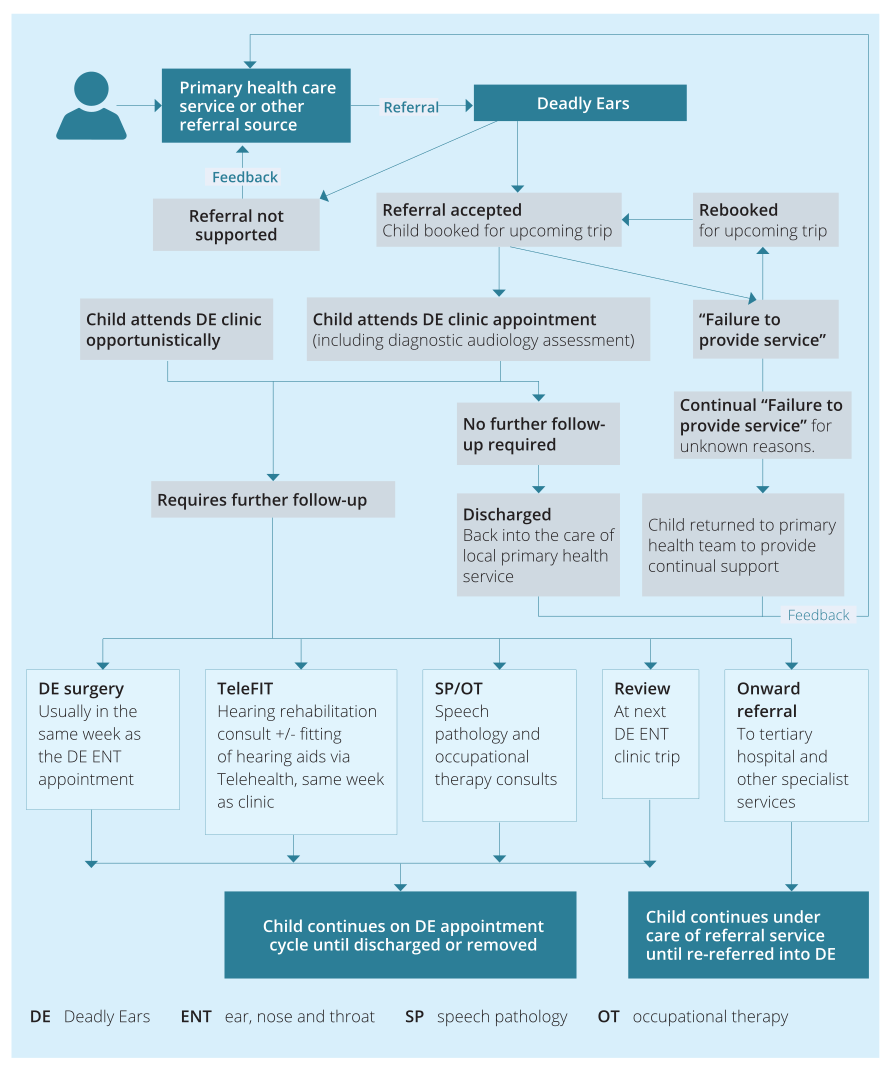
An example of the complexity of the patient journey for children and young people as they move through the Queensland Government’s Deadly Ears Program is presented below (Figure INTRODUCTION 1). The program aims to enhance coordination across health, early childhood development and education sectors.
Figure INTRODUCTION 1: Patient journey through the Deadly Ears Program
Hearing Australia 2021. Urban hearing pathways: the role of accessibility and availability of hearing and ear health services in avoidable hearing loss for urban Aboriginal and Torres Strait Islander children, report to the Australian Government Department of Health, Hearing Australia, accessed 10 September 2024.