


Technical notes
Data linkage, also known as data integration, is a process that brings together information relating to an individual from more than one data source.
Some sections in this report used deterministic and probabilistic linkage between two data sets: Defence Personnel data and the ABS 2021 Census of Population and Housing. These linked datasets have been integrated into the Person Level Integrated Data Asset (PLIDA) managed by the ABS.
The Department of Defence personnel data consists of an extract from current and historical personnel systems for ADF members who have served since 1 January 1985. This combines Personnel Management Key Solution (PMKeyS), Core HR system, D1, CENRESPAY (for reservists), ADFPAY (for permanent members) and other historical payment systems. Validation of the data extract was performed with other data sources. The Defence personnel data includes information on service characteristics. For ex-serving ADF members, service characteristics are reported as at date of separation from the ADF.
To allow linkage between these two datasets and the final analysis presented in this report, processing was first conducted on Defence Personnel data:
- Initial data checking and cleaning by AIHW
- Linking the Defence Personnel data set to an AIHW-ABS interoperable spine by AIHW using probabilistic linkage techniques. This AIHW-ABS interoperable spine allows data held by both organisations (Defence Personnel by the AIHW, and the 2021 Census by the ABS) to be linked without the need to share any identifiable information.
- Secure transfer of the Defence Personnel data set to the ABS.
- Linkage of the Defence Personnel data set to the PLIDA Person Linkage Spine by the ABS.
Strict separation of identifiable information and analytical content data was maintained within the Data Linkage Units at both AIHW and the ABS, so that no one person or organisation will ever have access to both. This ensures that no individual can be identified by any persons involved in the data linkage process, nor in any analysis or reporting conducted as part of the content in this report.
Figure 12 summarises the linkage process undertaken for this report.
Figure 12: Linkage process
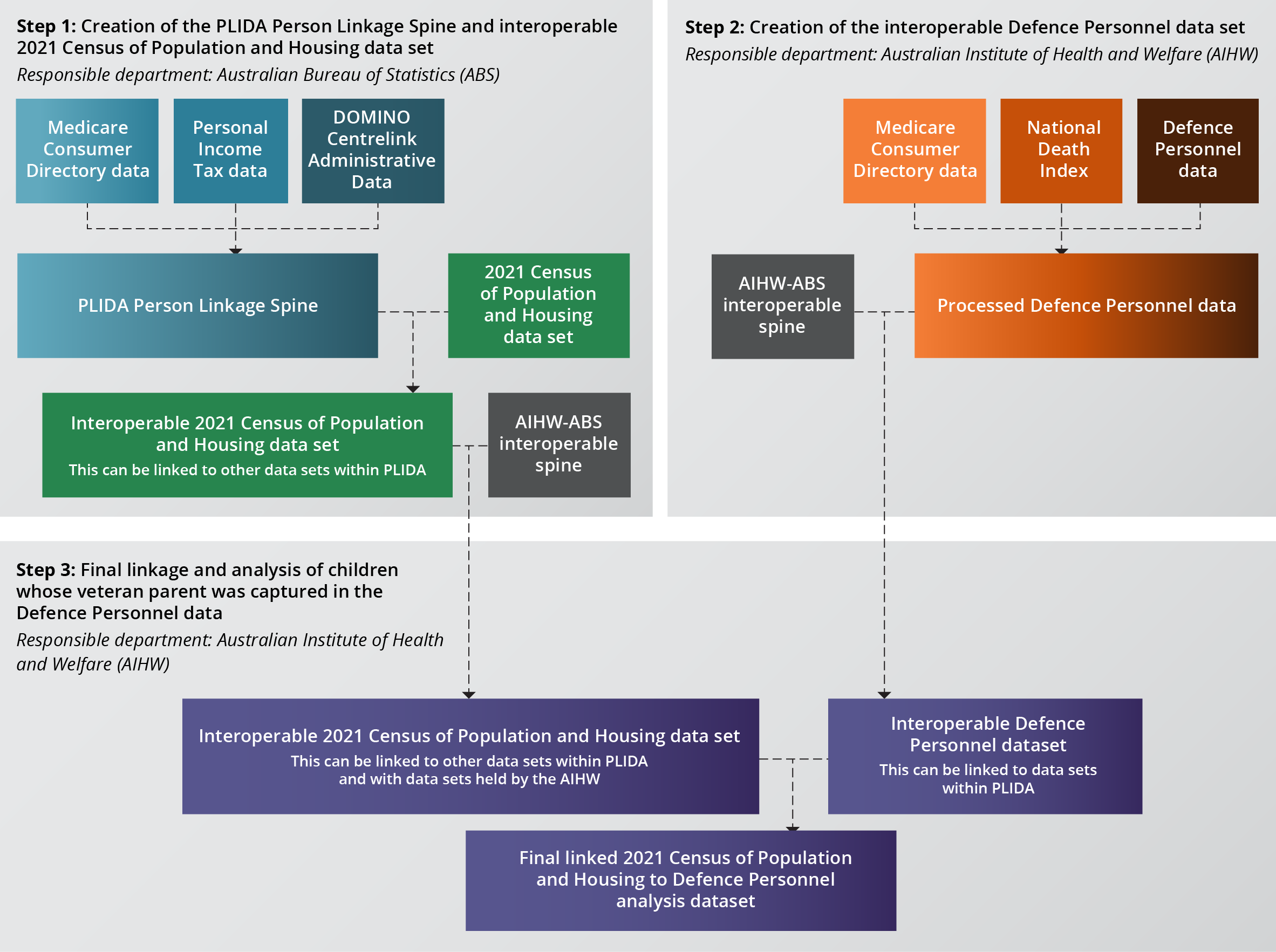
Where results in this report are created from the linked 2021 Census and Defence Personnel datasets, this is noted. Results are otherwise created from the interoperable 2021 Census of Population and Housing data set.
The veteran spouse linkage spine created as part of this report is the first of its kind and is a valuable foundation for future research. Notably, it could be used to explore other PLIDA data sources such as Medicare Benefits Schedule (MBS), Pharmaceutical Benefits Schedule (PBS), the National Health Survey (NHS), Deaths Registrations data and the Australian Early Development Census (AEDC). Analyses of these sources could provide insights into veterans’ civilian spouse’s mental health service use, prescriptions of mental-health related medications, suicide, and early education outcomes.
Base 2021 Census analysis
To increase the accuracy of identification and analysis of veterans’ civilian spouses in the 2021 Census of Population and Housing, some spouses were excluded based on their family characteristics. To be included in the base 2021 Census analysis, a civilian spouse must have been living in a family where:
- The family is a couple family
- Neither spouse was temporarily absent on Census night
- Both spouses had a recorded status for ADF service
- There were no spouses under the age of 17
- The family resided in a private dwelling.
Counts of civilian spouses are based on place of enumeration.
Linked 2021 Census to Defence Personnel analysis
For analysis involving linked data between the 2021 Census and Defence Personnel, further exclusionary criteria were applied. To be included in analyses using this data set, a civilian spouse must have also been living in a family where:
- their spouse was a veteran
- The veteran spouse’s sex matched between the 2021 Census and Defence Personnel
- The veteran spouse’s age matched between the 2021 Census and Defence Personnel (with a +/- 2-year leeway given to account for differing methods of reporting age in the two datasets).
The following limitations should be considered when interpreting the findings in this report.
1. Limitations of identifiable civilian spouses
Civilian spouses who were not living with their veteran spouse on Census night cannot be identified using 2021 Census of Population and Housing data, because relationships between spouses are not captured between households, and are therefore not included in this analysis.
2. Long-term health conditions are based on self-report data from the Census
The analysis of long-term physical and mental health conditions in this report is based on self-reported data from the 2021 Census. There are several limitations to using the Census as a data source on long-term health conditions:
- the data was collected for the first time in the 2021 Census so there is currently no time series data available
- the long-term health conditions data collected are based on a single question. ABS health surveys such as the NHS and NATSIHS have a detailed set of questions to capture prevalence of these conditions more accurately
- data relies on the respondent self-reporting health conditions, or in some cases reporting health conditions of other people in the household, in most cases without an interviewer present to help
- data is only available for the listed conditions above
- under-reporting may occur for some conditions compared with other ABS surveys. This is due to self-reporting and reporting on behalf of other members of the household, as well as potential sensitivities about individual health conditions.
Defence and DVA initiatives seek to make health care more affordable for the veteran populations examined. As such, differences in the proportion of people responding to a question about whether a doctor or nurse have provided advice about a long–term health condition may be influenced by potential differences in the affordability of health care in the populations examined.
The ABS recommends that the National Study of Mental Health and Wellbeing (NSMHW) be used as the main source of prevalence data as it uses diagnostic criteria rather than self-reporting. However, a limitation of the NSMHW is that it does not capture child-parent status.
For more information, see Comparing ABS long-term health conditions data sources.