


Scope and methodology
What data is included in this report?
The Alcohol and Other Drug Treatment Services National Minimum Data Set (AODTS NMDS) is a service based (not demand based) data set collected by the Australian Institute of Health and Welfare. The AODTS NMDS contains information about closed treatment episodes provided to clients by specialist alcohol and other drug (AOD) treatment services across Australia who receive funding through the commonwealth Drug and Alcohol Program or are solely funded via a Primary Health Network (including government and non-government services). Data is collected annually, with collection periods beginning 1 July and ending 30 June of the following year (financial years). This report includes data on:
- closed treatment episodes provided between 2018–19 and 2023–24
- valid Statistical Linkage Key 581 (SLK-581) data from 2018–19 to 2023–24.
For further information see Technical notes: AODTS NMDS coverage and data quality.
AODTS NMDS data can be counted using 2 measures: clients or closed treatment episodes provided to clients.
A typical AOD client can receive multiple treatment episodes. Based on the number and frequency of all episodes received between 2018–19 and 2023–24, clients were assigned to one of 2 cohorts reflecting their treatment pathway.
Data on both client cohorts and treatment episodes are included in this report to capture how clients interact with AOD services over multiple episodes, over the scope of this study. Due to changes in data quality over time, cohort-level and episode-level treatment data varies in coverage.
Table 1 and 2 summarises the differences for treatment cohort-level and treatment episode-level data. For further information see Defining ‘Assessment only’ treatment cohorts and Overview of analysis variables and inclusion criteria.
| Measure | Description |
|---|---|
| Treatment cohort | Includes all closed treatment episodes received by a client: a person who receives an AOD treatment episode for their own drug use. Most clients undergo multiple treatment episodes over the course of their treatment; each episode is matched to a client and counted towards the treatment cohort the client is assigned to. |
| Treatment episode | The period of contact between a client and treatment provider. Each closed treatment episode contains a single principal drug of concern and one main treatment type. |
Time coverage | Description |
|---|---|
Treatment cohort | Clients who received treatment between 2018–19 and 2023–24 |
Treatment episode | Closed treatment episodes provided between 2018–19 and 2023–24 |
Longitudinal ‘Assessment only’ client cohort data
This report presents longitudinal data from the AODTS NMDS between 2018–19 and 2023–24 to describe the characteristics of clients who at any point received a main treatment type of ‘Assessment only’, and their subsequent treatment episode. Clients can only receive treatment for one main treatment type per closed treatment episode, but clients may undergo multiple treatment episodes with different main treatment types.
In this report, clients are included if they received at least one closed treatment episode in at least one collection period (financial year) between 2018–19 and 2023–24, where ‘Assessment only’ was the main treatment type. The client enters the study from the first ‘Assessment only’ episode recorded within the study period.
Between, 2018–19 and 2023–24, a total of 157,108 clients received an ‘Assessment only’ episode at any point.
State/territory | Number of clients | Percentage of clients |
|---|---|---|
New South Wales | 22,138 | 14% |
Victoria | 62,689 | 40% |
Queensland | 42,741 | 27% |
Western Australia | 3,378 | 2.2% |
South Australia | 12,181 | 7.8% |
Tasmania | 2,546 | 1.6% |
Australian Capital Territory | 3,339 | 2.1% |
Northern Territory | 8,096 | 5.2% |
Australia | 157,108 | 100% |
Note: A client's state or territory is assigned at the start of their first assessment only treatment episode between 2018–19 and 2023–24. It is based on where the client receives treatment.
Methodology
This report uses data from the Alcohol and Other Drug Treatment Services National Minimum Data Set (AODTS NMDS), focusing on clients accessing AODTS who received an ‘Assessment only’ episode for their own drug use at any point between 1 July 2018 and 30 June 2024.
A client is captured in this analysis from the first ‘Assessment only’ treatment episode they received during the study period. This is not necessarily their first engagement (treatment episode) with specialist AOD services. The 3 analysis approaches used to examine this study population included:
- Descriptive analysis: was used to compare the client and treatment episode characteristics of clients who re-engaged within one year after an ‘Assessment only’ episode and those who did not.
- Statistical modelling methods: were used to examine the factors associated with receiving further treatment within one year (365 days) after an ‘Assessment only’ episode.
- Survival analysis: was used to estimate the time between an ‘Assessment only’ episode and any subsequent treatment episode received at any point between 2018–19 and 2023–24.
Defining ‘Assessment only’ treatment cohorts
‘Assessment only’ study population definitions
Clients who received a treatment episode of ‘Assessment only’ during the 6-year period 2018–19 to 2023–24, were identified as clients who have ‘ever’ received ‘Assessment only’ as a main treatment type. This group of clients were identified as the ‘Assessment only’ study population. For more information see Summary of study.
A 6-year study period of 2018–19 to 2023–24 was chosen to understand recent trends in the longitudinal dataset due to state and territory changes in policies, programs, service delivery and planning.
Clients were excluded from the ‘Assessment only’ study population analysis if they:
- Did not receive a treatment episode of ‘Assessment only’ within the study period.
- Received treatment for another person’s AOD use.
- Received their first recorded ‘Assessment only’ closed treatment episode for the study period between 1 July 2023 and 30 June 2024, since future episodes could not be examined for these clients.
Episodes which occurred before a client’s first ‘Assessment only’ episode or after the client’s subsequent treatment episode were also excluded.
These criteria ensure that the initial cohort received treatment for their own drug use and that there was enough time for clients to have received further treatment within one financial year. However, it is important to note that clients may have received treatment before 1 July 2018, and/or continued to receive treatment beyond 30 June 2024. Services accessed in these periods are outside the scope of this report.
‘Assessment only’ treatment cohort definitions
Two mutually exclusive cohorts were defined based on client’s treatment outcomes following their first ‘Assessment only’ episode within the 6-year defined study period.
To better understand the factors that led to further treatment after an ‘Assessment only’ episode, statistical modelling methods were used. ‘Assessment only’ clients were followed up for one year (365 days) from the time they first received their ‘Assessment only’ episode. The 2 cohorts were defined for the model based on whether they received an outcome of further treatment as followed:
- Clients who received further treatment within one year – this includes clients who received any subsequent treatment episode within one year after receiving their first ‘Assessment only’ episode.
- Clients who did not receive further treatment within one year – this includes clients who received a subsequent treatment episode, but this occurred more than a year after receiving their first ‘Assessment only’ episode, and those who did not receive further treatment within the study period
The criterion above was used to define the treatment cohorts for comparison in Table 4: Definition of AODTS NMDS treatment cohorts.
Treatment cohort | Study entry | Study exit |
|---|---|---|
Clients who received further treatment within one year | First treatment episode in the period is ‘Assessment only’. | At least one additional treatment episode recorded after the initial assessment within one year (365 days). |
Clients who did not receive further treatment within one year | First treatment episode in the period is ‘Assessment only’. | No further treatment episodes recorded after this initial assessment within one year (365 days). |
Counting methodology
Treatment episodes were ordered chronologically by episode start date. Each client was included in only one cohort, based on their first ‘Assessment only’ episode and subsequent treatment history. Only treatment episodes recorded within the 6-year window (1 July 2018 to 30 June 2024) were considered. Episodes outside this range were excluded from study population classification. For more information see Figure 7: Examples of client pathways through specialist AOD treatment, 2018–19 to 2023–24.
Summary of study
Figure 6: Analysis criteria of clients who received a main treatment type of ‘Assessment only’, between 2018–19 and 2023–24
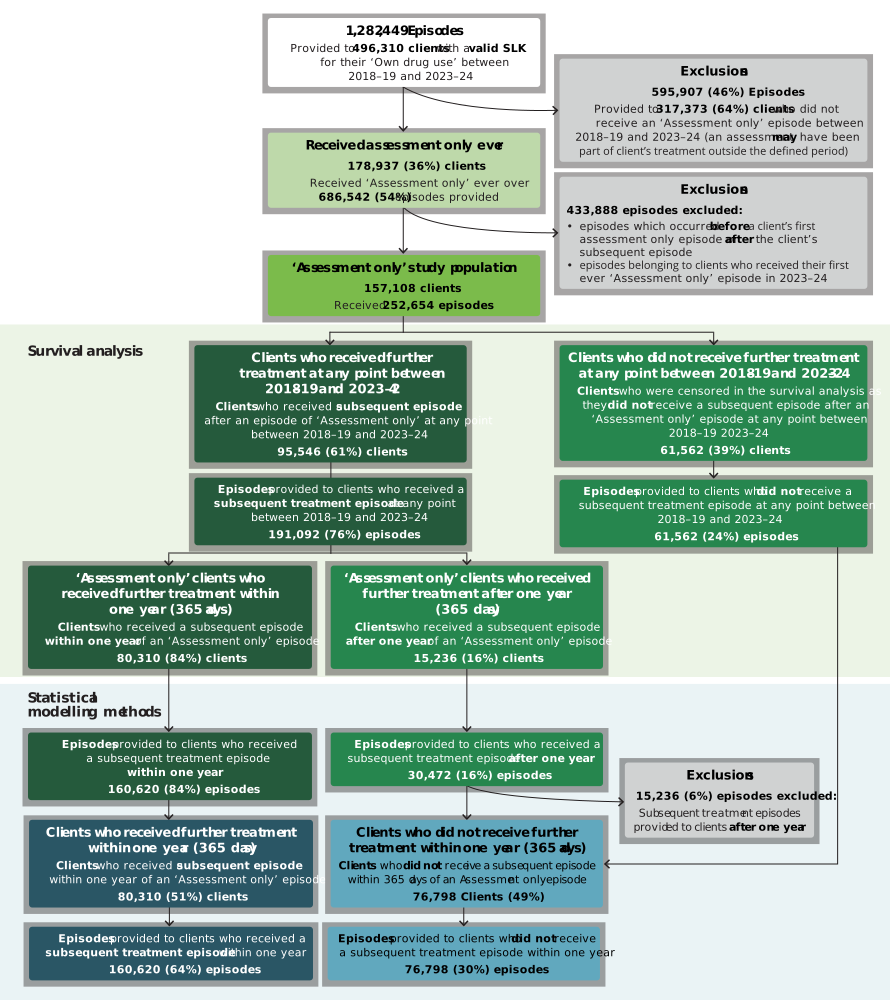
For more information, see Overview of analysis variables and inclusion criteria.
Figure 7: Examples of client pathways through specialist AOD treatment, by analysis techniques, 2018–19 to 2023–24
Dashboard of 2 interative charts navigated by tabs each showing client pathways through treatment by the analysis techniques used in this report.