Client interactions with AOD services
Previous AIHW analysis of the Alcohol and Other Drug Treatment Services National Minimum Data Set (AODTS NMDS) established criteria for defining client cohorts based on the nature of their use of alcohol and other drug (AOD) treatment services. AOD service use intensity includes both the number of episodes a client received and the number of years in which they received treatment (AIHW 2019).
The rationale for defining AOD treatment intensity was based on the understanding that treatment experiences vary among individuals, and there is a subset of clients that engages with AOD treatment services more frequently than others and therefore has a higher level of contact with the sector over time (AIHW 2019, Kelly & White 2011).
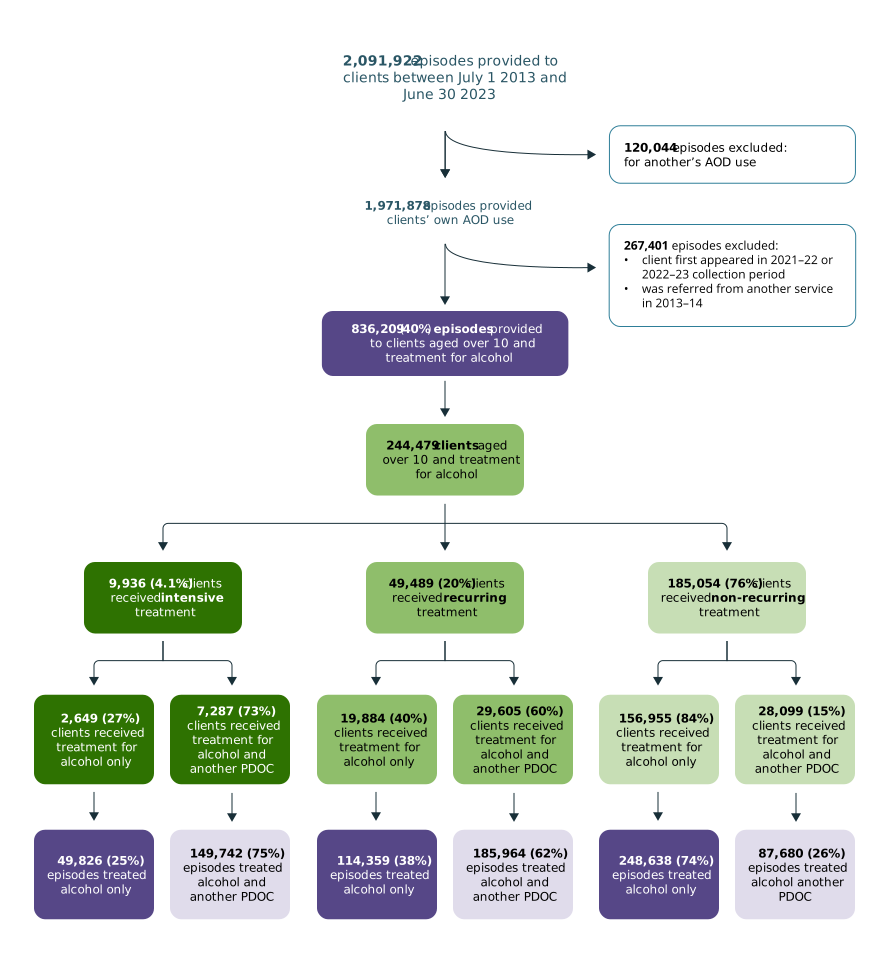
This report examines the characteristics of AOD clients who received treatment for alcohol at any point and describes variation in the treatment based on the nature of their AOD service use (treatment intensity). Analysis focused on 836,209 treatment episodes provided to 244,479 clients who received treatment for alcohol at any point as a principal drug of concern (PDOC) between 1 July 2013 and 30 June 2023 (see Figure treatment intensity 1).
Client cohorts
The three cohorts were defined as follows:
- non-recurring treatment – clients who received fewer than 13 treatment episodes for their own alcohol or other drug use in fewer than 3 years within the 10-year period between 2013–14 and 2022–23 (noting these do not have to be consecutive).
- recurring treatment – clients who received fewer than 13 treatment episodes across at least 3 years.
- intensive treatment – clients who received 13 or more treatment episodes across at least 3 years.
For further information on the methodology used to define these cohorts, see Technical notes: Defining treatment intensity using the AODTS NMDS, including diagrammatic examples of the treatment pathways for the three main client cohorts.
Figure treatment intensity 1: Analysis criteria of clients who at any point received treatment for alcohol, by intensity of service use and episodes, 2013–14 to 2022–23
This tree diagram illustrates a hierarchical structure of the process of selecting the cohorts presented in this analysis.
There are 4 colour schemes to highlight the different numbers displayed:
- Blue box: AODTS NMDS episodes between 1 July 2013 to 30 June 2023
- Grey box: episodes excluded from the analysis
- Purple box: episode treated for alcohol ever numbers
- Green box: client treated for alcohol ever numbers.
At the top of the diagram:
- Blue box 1: 2,091,922 closed treatment episodes were provided to clients between 1 July 2013 and 30 June 2023.
- Grey box 1: 120,044 episodes were excluded where clients received treatment for another person’s AOD use.
These boxes then flow down to the next level as follows:
- Blue box 1: 1,971,878 closed treatment episodes provided to clients for their own AOD use
- Grey box 1: 267,401 episodes were excluded where the client first appeared in 2021–22 or 2022–23 and the client was referred from another service in 2013–14.
After the exclusions clients who received treatment for alcohol is selected for, in Purple box 1, 836,209 (40%) episodes were provided to clients aged 10 and over for alcohol treatment. This is followed by Green box 1: 244,479 clients aged 10 and over received treatment for alcohol.
The green box then splits into 3 streams, that is, ‘clients received intensive treatment’, ‘clients received recurring treatment’, and ‘clients received non-recurring treatment’. In these green boxes:
- Green box 1: 9,936 (4.1%) clients received intensive treatment
- Green box 2: 49,489 (20%) clients received recurring treatment
- Green box 3: 185,054 (76%) clients received non-recurring treatment.
These 3 streams then each spilt into 2 streams, ‘clients received treatment for alcohol only’, and ‘clients received treatment for alcohol and another PDOC’.
For clients who received intensive treatment:
- Green box 1: 2,649 (27%) clients received treatment for alcohol only
- Followed by Purple box 1: 49,826 (25%) episodes treated alcohol only
- Green box 2: 7,287 (73%) clients received treatment for alcohol and another PDOC
- Followed by Purple box 2: 149,742 (75%) episodes treated alcohol and another PDOC
For clients who received recurring treatment:
- Green box 1: 19,844 (40%) clients received treatment for alcohol only
- Followed by Purple box 1: 114,359 (38%) episodes treated alcohol only
- Green box 2: 29,605 (60%) clients received treatment for alcohol and another PDOC
- Followed by Purple box 2: 185,964 (62%) episodes treated alcohol and another PDOC
For clients who received non-recurring treatment:
- Green box 1: 156,955 (84%) clients received treatment for alcohol only
- Followed by Purple box 1: 248,638 (74%) episodes treated alcohol only
- Green box 2: 28,099 (15%) clients received treatment for alcohol and another PDOC
- Followed by Purple box 2: 87,680 (26%) episodes treated alcohol and another PDOC
This report refers to clients in each cohort who received treatment for alcohol at any point as well as the treatment episodes provided to these clients. In examining the client and treatment characteristics of each cohort, all episodes provided to each client over the course of their treatment are considered.
For example, where a client receiving intensive treatment received 13 treatment episodes over the course of at least 3 years, each episode’s main treatment type and each principal drug of concern is counted separately when describing the characteristics of the intensive treatment cohort.
Figure treatment intensity 1 illustrates the numbers of clients who received treatment for alcohol at any point in each cohort, and treatment episodes provided to these clients treated for either alcohol only or alcohol and another PDOC (amphetamines, cannabis, heroin, pharmaceuticals or other drugs of concern):
- Most clients received non-recurring treatment for alcohol in fewer than 3 years between 1 July 2013 and 30 June 2023 (76%, or 185,054 clients).
- Most of this treatment was for alcohol only (30% of all treatment episodes for alcohol, and 74% (248,638) of treatment episodes for this non-recurring cohort). Clients received on average 1.6 treatment episodes during this period for alcohol only or 3.1 for alcohol and another PDOC.
- Clients in the recurring cohort represented the next largest client group, 1 in 5 clients (20%, 49,489 clients). Most treatment in this cohort was provided to clients for alcohol and another PDOC (60%, or 29,605 clients for this cohort).
- Recurring clients received on average, similar levels of treatment, irrespective of whether they were treated for alcohol only or alcohol and another PDOC (on average 6.3 or 5.8 treatment episodes per client between 2013–14 and 2022–23 for alcohol only or alcohol and another PDOC, respectively).
- Clients who received intensive treatment for alcohol represented less than 1 in 20 clients (4.1%, or 9,936 clients) but they received nearly 1 in 4 treatment episodes (24%, or 199,568 episodes). Most of the treatment in this cohort was provided for alcohol and another PDOC (75%, or 149,742 episodes for alcohol and another PDOC (such as amphetamines)) with these clients making up 73% (7,287 clients) of this cohort.
- Clients in the intensive treatment cohort received similar levels of treatment, irrespective of whether they were treated for alcohol only or alcohol and another PDOC (on average 18.8 or 20.1 treatment episodes per client between 2013–14 and 2022–23, respectively).
Australian Institute of Health and Welfare (AIHW) 2019. Patterns of alcohol and other drug treatment service use in Australia, 1 July 2014 to 30 June 2018 AIHW, Australian Government, accessed 9 September 2024.
Australian Institute of Health and Welfare (AIHW) (2024). Alcohol and other drug treatment services annual report AIHW, Australian Government, accessed 9 September 2024.
Kelly JF, Greene MC, Bergman BG, White WL & Hoeppner BB 2019. How many recovery attempts does it take to successfully resolve an alcohol or drug problem? Estimates and correlates from a national study of recovering U.S. adults. Alcoholism: Clinical & Experimental Research 43(7):1533–44