


Entries, exits and transfers
Key findings
- There were 32,400 households newly allocated social housing in 2024–25, fewer than the 33,600 new allocations in 2023–24.
- Around 14,100 new social housing allocations were to greatest need households who were experiencing homelessness.
- Almost two-thirds of newly allocated public housing households had special needs.
- Households in greatest need spent less time on waitlists than other households.
- Exits from public housing are lower in recent years compared with previous years.
During a financial year, people may be allocated social housing, exit a social housing program, or move from one social housing dwelling to another within the same program (Figure ENTRIES.1). This section presents key data on these entries, exits and transfers.
Data on entries, exits and transfers for Indigenous community housing were not available.
Figure ENTRIES.1: Entries, exits and ongoing households
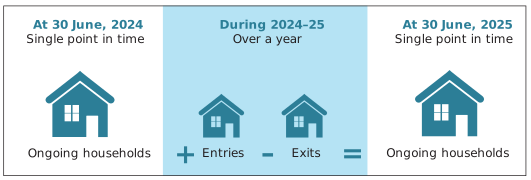
The diagram shows the relationship between ongoing households at a single point in time (at 30 June 2024), households entering and exiting social housing over a year (during 2023–24) and ongoing households at a single point in time (at 30 June 2025).
Households entering social housing
There were 32,400 households newly allocated social housing in 2024–25, fewer than the 33,600 new allocations in 2023–24.
The total number of newly allocated households (also referred to as new entries) in 2024–25 decreased to 32,400, compared with 33,600 in 2023–24, across public housing, community housing and SOMIH (Table HOUSEHOLDS.9).
Of the 32,400 new allocations, almost half were allocated public housing (49% or 16,000 households), 48% were allocated community housing (115,500 households) and 2.7% to SOMIH (890 households), similar to the relative stocks of each of the housing programs.
The number of new entries into public housing has been below 20,000 since 2018–19, mainly reflecting the declining dwelling stock in public housing, but may also reflect decreased flow of households exiting public housing. The number of new entries into community housing has fluctuated in recent years, in part due to dwelling transfers from public housing and SOMIH to community housing (Figure ENTRIES.2; Table HOUSEHOLDS.9).
There were 890 new allocations for SOMIH in 2024–25, broadly consistent with the numbers of new allocations since 2021–22 (Figure ENTRIES.2; Table HOUSEHOLDS.9).
Figure ENTRIES.2: Ongoing households, newly allocated households and exited households, by social housing program, 2011–12 to 2024–25
This line graph shows ongoing households in public housing decreased but SOMIH and community housing ongoing households increased from 2011–12 to 2024–25.
This line graph shows the changes in newly allocated households, ongoing households and households that exited a social housing program from 2011–12 to 2024–25 for public housing, SOMIH and community housing. Ongoing households in public housing decreased from 323,000 in 2011–12 to 285,000 in 2024–25 while SOMIH increased from 9,700 in 2011–12 to 16,100 in 2024–25. For public housing, newly allocated households declined from 21,400 in 2011–12 to 16,000 in 2024–25.
Characteristics of newly allocated households
Over half of newly allocated public housing households were single adult (58%) households during 2024–25. Other key characteristics of newly allocated households in public housing for 2024–25 included (Table HOUSEHOLDS.11):
- The main tenant was female in over half (58%) of households.
- About 1 in 4 (26%) households included a First Nations household member.
- For 1 in 3 (35%) households, the main tenant was aged 55 and over.
- Over a third (38%) of households had a member with disability.
For SOMIH, newly allocated households during 2024–25 were more likely to be a sole parent with dependent children (39%) followed by group and mixed composition households (31%). Only 14% of newly allocated households in SOMIH were single adults. In contrast, for public housing, most (55%) newly allocated households were single adults (Table HOUSEHOLDS.11).
While proportions for each measured characteristic did have some degree of variation between states and territories, all followed similar trends for both public housing and SOMIH.
Data on the characteristics of newly allocated households for community housing and Indigenous community housing were not available.
Housing features of new allocations
Housing features of new allocations differed between public housing and SOMIH. The different profiles of new allocations by housing features partly reflects the differences in the types of dwelling stock available within each program (see Dwelling attributes).
In 2024–25, newly allocated households in public housing were more likely to be dwellings with fewer bedrooms (40% were 1 bedroom, 33% were 2 bedrooms, 23% were 3 bedrooms and 3.9% were 4 or more bedrooms) compared with SOMIH (3.8% were 1 bedroom, 21% were 2 bedrooms, 53% were 3 bedrooms and 23% were 4 or more bedrooms) (Table HOUSEHOLDS.12).
Priority groups
Allocation of social housing to a household is determined by policies regarding eligibility, priority groups and entitlement (such as type and location of the property) (Powell et al. 2019). Although income remains the primary eligibility factor for social housing, allocations are also based on an applicant’s circumstances, that is, their need for social housing relative to others on the waitlist and their personal circumstances (Pawson et al. 2020).
While social housing allocations were historically targeted towards households with a lower income, over time, social housing policies have increasingly focused on supporting vulnerable and complex need applicants, such as applicants experiencing trauma, disadvantage and/or financial instability (Groenhart et al. 2014; Pawson et al. 2020; Taylor and Johnson, 2021).
As a result, social housing is allocated according to priority needs, with allocations made based on identifying those people with the greatest need (such as applicants experiencing homelessness) and those with special needs for housing assistance (such as applicants with disability).
Data on greatest need status for Indigenous community housing were not available.
Greatest need households
Public housing, SOMIH and community housing programs prioritise household allocations through priority waitlists, such as the greatest need waitlist. The criteria for priority needs varies between jurisdictions, so comparisons between states and territories must be exercised with caution.
Special needs households
Households seeking social housing often have members with special needs. Some households may have one or more members with multiple special needs. The definition of special needs differs across social housing programs and between jurisdictions.
For more information about how households are prioritised, see Technical notes.
New allocations for greatest need households
Around 14,100 new allocations for social housing were to greatest need households who were experiencing homelessness in 2024–25.
Greatest need households accounted for 84% (or 13,500 households) of all newly allocated public housing households in 2024–25. Similarly, 85% (or 410) of newly allocated SOMIH households were households with greatest need status in 2024–25 (excludes Tasmania and the Northern Territory, as greatest need data were not available) (Figure ENTRIES.3, Table HOUSEHOLDS.14).
Figure ENTRIES.3: Newly allocated households by greatest need status and social housing program, 2009–10 to 2024–25
The bar graph shows most new allocations from 2009–10 to 2024–25 were greatest need households, reaching 84% in public housing, 81% in SOMIH, and 80% in community housing in 2024–25.
This vertical stacked bar graph shows for public housing, community housing and SOMIH, there were more newly allocated greatest need households than other households, from 2009–10 to 2024–25. In 2024–25, most new social housing allocations were provided to households in greatest need, including 84% of public housing new allocations, 81% of SOMIH new allocations and 80% of community housing new allocations.
Main reason for greatest need
In 2024–25, of the 13,500 newly allocated public housing households in greatest need (Figure ENTRIES.4; Table HOUSEHOLDS.15):
- 60% (8,000 households) were experiencing homelessness at the time of allocation, similar to data from 10 years ago in 2014–15 (57%).
- 36% (4,900 households) were at risk of homelessness. Of those households:
- Almost 3,600 reported the main reason for their greatest need was because their life or safety was at risk in their accommodation.
- About 990 households reported a health condition aggravated by housing as their main reason for greatest need.
Data on the detailed main reason a household was in greatest need is not collected for community housing. Based on available data, in 2024–25, more newly allocated greatest need community housing households were experiencing homelessness (5,800) than were at risk of homelessness (5,000) (Figure ENTRIES.4; Table HOUSEHOLDS.15).
Figure ENTRIES.4: Newly allocated households in greatest need by main reason for greatest need and social housing program, 2011–12 to 2024–25
The line graph shows the most common main reason for newly allocated greatest need households in public housing was homelessness (60%).
This line graph shows the main reason for greatest need of newly allocated households. In 2024–25 the main reason for greatest need for new allocations in public housing was homelessness (60%). For the greatest need new allocations in public housing that were at risk of homelessness in 2011–12, the most common main reason for greatest need was a health condition aggravated by housing (15%); in 2024–25, the most common reason was their life or safety was at risk in accommodation (27%).
New allocations for special needs households
Almost two-thirds of newly allocated public housing households had special needs.
Data on special needs were available for public housing, SOMIH and community housing. A household may be classified as special needs status for one or more reasons. In 2024–25, there were 10,300 newly allocated public housing households with special needs, representing 64% of all newly allocated households. Of these (Table HOUSEHOLDS.17):
- 6,100 households had at least one member with disability
- 4,200 households had at least one First Nations member
- 1,500 households had a main tenant aged under 25
- 910 households had a main tenant aged 75 or over.
In 2024–25, of the 380 newly allocated SOMIH households with special needs:
- 200 households had a main tenant aged 50 and over
- 100 households had a main tenant aged under 25 years
- 150 households contained at least one member with disability.
Greatest and special needs households
Greatest and special needs categories are not mutually exclusive, as one or more household members may be eligible within each priority group and between priority groups. Households with members in both greatest and special needs groups may be some of the most vulnerable households and may require high levels of care and support.
In 2024–25, of the newly allocated households in public housing (Table HOUSEHOLDS.16):
- Over half (56% or 8,900 households) were both greatest need and special needs households
- 1 in 5 (21% or 3,400 households) were greatest need only (no special needs)
- 4.4% (700) were neither greatest need nor special needs households.
In 2024–25, of the newly allocated households in SOMIH:
- Around 1 in 5 (21% or 190 households) were both greatest need and special needs households
- 1 in 4 (25% or 220 households) were greatest need only (no special needs)
Note that greatest need information for SOMIH was unavailable for Tasmania and the Northern Territory.
Time waited for social housing allocation
Households in greatest need spend less time on waitlists than other households.
The time waited by applicants is influenced by dwelling availability (including the size of dwelling needed) and priority group status (greatest need or special needs) (Powell et al. 2019). Since households with priority status (such as people experiencing homelessness or with disability) are placed ahead of households without priority status, the number of households with priority status may influence the amount of time waited for social housing allocation. The time waited for social housing programs can vary both between and within jurisdictions, with the time waited for social housing in high demand city areas often far greater than other areas (NSW Government 2018; Powell et al. 2019).
Data on time waited for housing allocation were unavailable for both community housing and Indigenous community housing.
For more information on the method used to calculate time waited, see Technical notes.
In 2024–25 (Table HOUSEHOLDS.20):
- Of all newly allocated public housing households:
- 2 in 5 (43%) households were allocated housing within 1 year; 43% waited 1 to 5 years and 14% waited 5 years or more for housing allocation.
- Over one quarter of households without children were allocated housing in less than 6 months (30% for single adults and 26% for couple only households).
- Of all newly allocated SOMIH households:
- Just under half (46%) of newly allocated households received housing in less than 1 year; 39% waited 1 to 5 years and 15% waited 5 or more years for housing allocation.
- 2 in 5 (43%) of group and mixed composition households were allocated housing in less than 6 months.
Greatest need and time waited for housing allocation
In 2024–25, among newly allocated households (Figure ENTRIES.5, Table HOUSEHOLDS.18):
- For public housing, greatest need households were more likely to be allocated housing within a year.
- Over half of greatest need households (59%, or 8,000 households) received housing within one year, compared with 39% (990) of households without greatest need status.
- The proportion of newly allocated greatest need households who waited less than 3 months (29%) for housing allocation was higher than households without greatest need status (21%).
- Households without greatest need status were more likely to spend 2 years or more on the waitlist before receiving a public housing allocation (43% or 1,100), compared with households with greatest need status (23% or 3,100).
Figure ENTRIES.5: Time waited by newly allocated households by greatest need status and public housing and SOMIH, 2024–25
The figure shows most greatest need households in public housing and SOMIH waited under 3 months. For public housing, most newly allocated other households waited 2 years or more.
The stacked bar graph shows the highest number of newly allocated greatest need households in both public housing (3,900) and SOMIH (119) waited less than 3 months for housing. For public housing (554) the highest number of newly allocated other households waited 5 years or more to be allocated housing.
Special needs and time waited
In 2024–25, the time special needs households waited for an allocation of public housing varied. Around (Table HOUSEHOLDS.19):
- 1,600 (15%) households waited for less than 3 months
- 2,600 (25%) households waited between 3 months and less than 1 year
- 4,600 (44%) households waited between 1 year to less than 5 years
- 1,500 (or 14%) households waited for more than 5 years.
Number of bedrooms and time waited
The time waited for social housing allocation varied depending upon the number of bedrooms required by a household and by program. For public housing, the amount of time waited was broadly similar regardless of the number of bedrooms. For SOMIH, 26% of households requiring 4 or more bedrooms waited less than 3 months (Table HOUSEHOLDS.21).
Households exiting social housing
Exits from public housing are lower in recent years compared with previous years.
Social housing 'Exits' refers to households that have exited a specific housing program during the reference year. Households that relocate within the same housing program are not considered ‘exits’ but are classified as ‘transfers’. Note: this definition may vary across states and territories, see Technical notes for more information.
Reasons influencing household exits from social housing can be both positive and negative (Wiesel et al. 2014). Some households exit because of changes to their housing or neighbourhood needs, such as those related to location, size, or neighbourhood safety (Johnson et al. 2019). Others exit social housing for financial or forced reasons, including employment opportunities, entry into private rental or home ownership, eviction, or ineligibility due to an increase in income (Baker et al. 2020, 2021). Some social housing providers offer fixed‑term leases and an exit from social housing may reflect an end to this type of tenancy. While exiting households most commonly enter the private rental market, some also enter home ownership or other tenure types, such as employer provided housing (Baker et al. 2020, Bentley et al. 2018). Subsequent housing location and tenure information is not captured in the datasets informing this report.
In 2024–25, around 17,000 households exited public housing, similar to the 16,700 exits in 2023–24. Community housing saw a decrease in exits, with 13,500 exits in 2023–24 compared to 12,800 households exiting in 2024–25 (Table HOUSEHOLD.22). Data on households that exited were not available for SOMIH at the national level.
Four states and territories had more new allocations to public housing than exits from public housing (Tables HOUSEHOLDS.9 and 24):
- Queensland (3,200 new entries and 3,100 exits)
- Western Australia (2,600 entries and 2,100 exits)
- South Australia (1,800 entries and 1,500 exits)
- Australian Capital Territory (660 entries and 400 exits).
Households transferring dwellings
Transfers occur when occupants move to a dwelling in the same social housing program. See Technical notes for state and territory variations on this definition.
Transfers may be initiated by either the tenant (including a mutual swapping of properties between eligible tenants) or housing provider in response to a change in circumstance or housing need. This may include household composition changes (such as overcrowding or underutilisation), a medical condition or because of stock renewal and re-development. Transfer eligibility and implementation varies by jurisdiction and housing program.
During 2024–25, 6,500 (2.1%) of public housing households and 540 (3.4%) of SOMIH households transferred – or were relocated – to a different dwelling within the same housing program (Table HOUSEHOLDS.24).
Figure TRANSFERS AND EXITS.1: Households by transfer and exit status, public housing and SOMIH, by states and territories, 2013–14 to 2024–25
The bar graph shows more households exit than transfer for both programs. For public housing, between 6,500 and 9,500 households transferred and 16,200 to 30,200 households exited each year.
This vertical bar graph shows that nationally the number of households that exited public housing and SOMIH compared with households that transferred. For public housing, between 6,500 to 9,500 households transferred and between 16,200 and 30,200 households exited each year.
Baker E, Leishman C, Bentley R, Pham A and Daniel L (2020) Social housing exit points, outcomes and future pathways: an administrative data analysis, AHURI Final Report No. 326, Australian Housing and Urban Research Institute (AHURI), Melbourne.
Baker E, Pham A, Leishman C, Daniel L and Bentley R (2021) Urban Social Housing Pathways: A Linked Administrative Data Analysis, Urban Policy and Research, 39(1):1–15.
Bentley R, Baker E, Simons K, Simpson JA and Blakely T (2018) The impact of social housing on mental health: longitudinal analyses using marginal structural models and machine learning-generated weights, International Journal of Epidemiology, 47(5):1414–1422.
NSW Government, Department of Communities and Justice (2018) Waiting times for social housing, accessed 25 March 2025.
Groenhart L, Burke T and Ralston L (2014) Thirty years of public housing supply and consumption 1981–2011, AHURI Final Report No. 231, AHURI, Melbourne.
Johnson G, McCallum S and Watson (2019) Who stays, who leaves and why? Occupancy patterns at Unison Housing between 2014 and 2016, Unison Housing Research Lab, Melbourne.
Pawson H, Milligan V and Yates J (2020) Housing Policy in Australia: A Case for System Reform, Palgrave Macmillan, Singapore.
Powell A, Meltzer A, Martin C, Stone W, Liu E, Flanagan K, Muir K and Tually S (2019). The construction of social housing pathways across Australia, AHURI Final Report No. 316, AHURI, Melbourne.
Taylor S and Johnson G (2021). Sustaining social housing: Profiles and patterns. Unison Housing Research Lab, Melbourne.
Wiesel I, Pawson H, Stone W, Herath S and McNelis S (2014) Social housing exits: incidence, motivations and consequences, AHURI Final Report No. 229, AHURI, Melbourne.