

Housing assistance
On this page In this section
Housing affordability Drivers for people seeking housing assistance Scope of available housing assistanceHousing affordability
Access to affordable housing is important for good health and wellbeing (Bentley et al. 2025). Affordable housing generally refers to housing that meets the needs of households, priced so that alongside the costs of housing, people are able meet their basic living costs, such as paying for food, heating, and medical care.
Finding and securing affordable housing in Australia has become difficult, and the most vulnerable households are facing the largest impact of rising housing costs (NHSAC 2026; ABS 2026). Since 2015, rental affordability has decreased across most capital cities, as rental cost growth outpaced household income growth (Cotality 2026; SGS Economics 2025; NHSAC 2026). Over the 12 months to December 2025, actual rents increased by 3.9%; slowing from a 6.2% increase in the year to December 2024 (ABS 2026). In December 2025, the national median rent reached $681 per week, up $204 since 2020 and rental vacancy rates fell to 1.7%, below the pre-pandemic average of 3.3% (Cotality 2026). In the December 2025 quarter, the time it would take a median‑income household to save for a 20 per cent deposit rose to 11.2 years, compared to 9.0 years in 2015 (NHSAC 2026).
Low-income households are at an increased risk of financial stress due to the disproportionate share of their income spent on housing (SGS Economics 2025). With limited income, a greater proportion of the household budget is spent on housing, leaving less for emergencies and essentials including food, transport, utilities, health and childcare services. In 2025, rents in most Australian capital cities were considered unaffordable for many low-income household types (SGS Economics 2025). In 2024–25, an estimated 1.26 million low-income households were in housing stress, spending more than 30% of their disposable income on housing (AIHW 2025).
Housing assistance programs can provide households in need with affordable and appropriate housing, or with the means to afford appropriate housing in the private market. By receiving housing assistance, low-income households can achieve greater financial and housing stability. The support provided to these households can also lead to greater social and economic participation, and as a result, improve personal wellbeing and social cohesion (Bridge et al. 2007; Carnemolla and Skinner 2021).
For more information on housing stress, see Housing affordability and Home ownership and housing tenure.
A low-income household is defined as a household with equivalised disposable income falling between the 3rd and 20th percentile of households. Equivalised disposable household income accounts for differences in household sizes and composition (ABS 2022b).
Drivers for people seeking housing assistance
Many circumstances or changes can contribute to the need for people to seek housing assistance. Understanding these drivers, and the influence of critical life events, and housing market factors on households can assist in defining housing stress, an early indicator of household need for housing support. Identifying housing stress can inform interventionist approaches to housing assistance provision and policy (Ghasri et al. 2022).
Housing stress occurs when households pay a high proportion of their income on housing costs. Usually this definition applies to low-income households.
Critical life events can lead to major change in a person’s life. These may include family formation or breakdown, providing care to a family member, loss of a family member, natural disasters, or change of employment. Multiple intersecting critical life events may put significant financial pressure on a household’s ability to manage their housing and living costs.
Housing market factors are the specific arrangement of conditions in the private housing market that impact housing options, and are influenced by:
- taxation
- regulation
- supply
- availability
- low vacancy rates
- rising private market rental costs, and
- cost of living pressures such as inflation, interest rates, and energy costs (Ghasri et al. 2022; Stone et al. 2016).
In response to housing insecurity and housing affordability challenges, households may need to use contingency resources (such as savings, assets, skills, or social networks) to ensure that they can sustain access to housing. However, low-income households often lack the contingency resources to respond to negative impacts arising from critical life events or housing market factors, leading them to seek housing assistance (Ghasri et al. 2022).
Figure 1: Drivers of housing stress
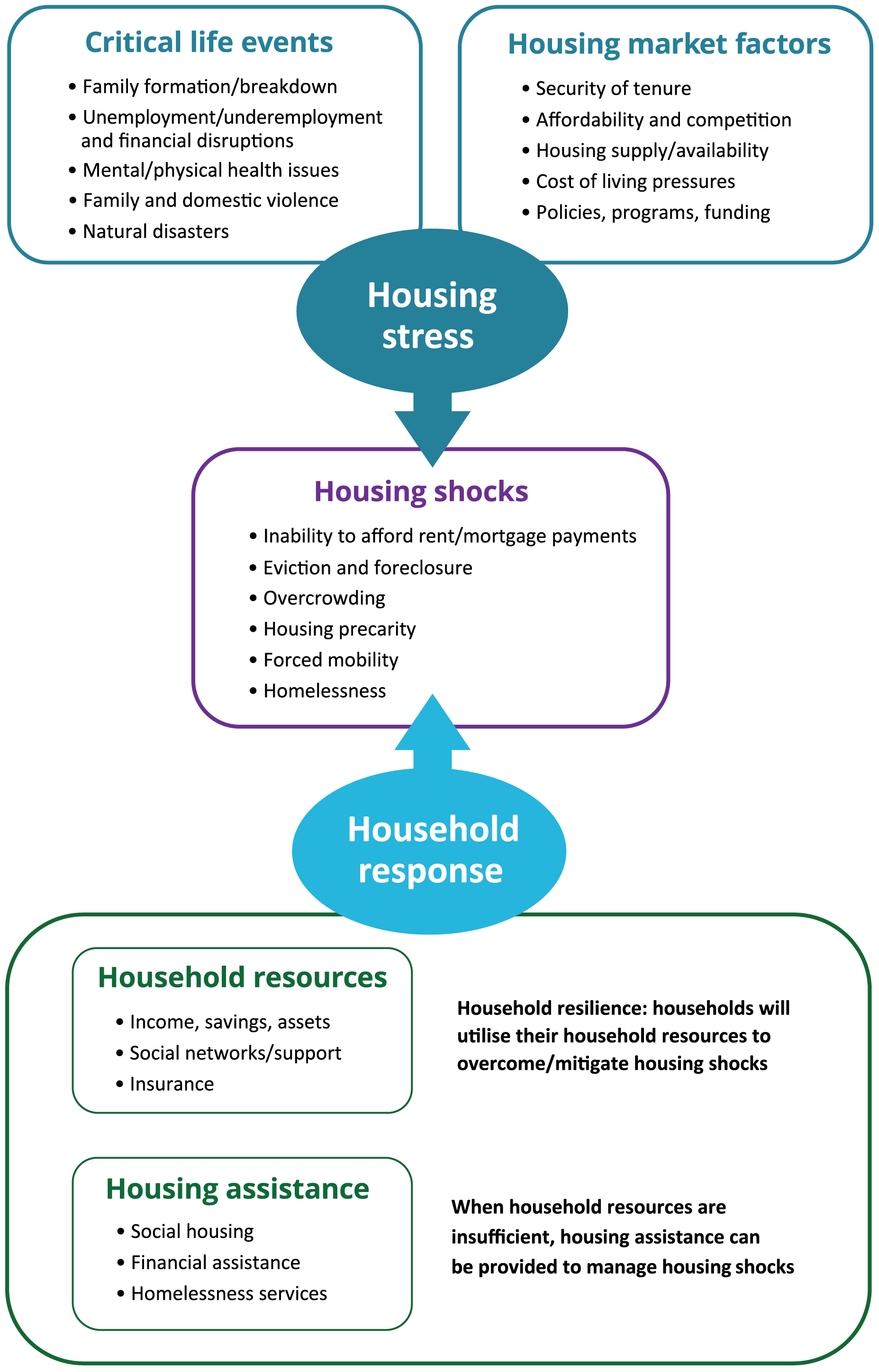
The diagram illustrates how critical life events and housing market factors interact to create or worsen housing stress. The housing shocks box outlines some of the potential flow on effects of this stress. The boxes at the bottom of the diagram present strategies for addressing housing shocks, including utilising household resources. If these resources are insufficient, people may seek housing assistance from governments.
Scope of available housing assistance
The housing programs and assistance explored throughout this report include:
- social housing, owned and managed by government and non-government organisations, including:
- public housing (PH)
- state owned and managed Indigenous housing (SOMIH)
- community housing (CH)
- Indigenous community housing (ICH)
- financial assistance given to tenants to meet private rental costs, including:
- Commonwealth Rent Assistance (CRA)
- Private Rent Assistance (PRA)
- financial assistance with home purchase, including:
- Home Purchase Assistance (HPA).
This report does not cover the provision of services such as obtaining accommodation or sustaining tenancies provided by specialist homelessness services. For information relating to homelessness services see Homelessness services.
Social housing
Social housing is low cost or subsidised rental housing provided to eligible Australians by government or non-government (including not-for-profit) organisations and includes:
- Public housing: Rental housing managed by state and territory housing authorities. This includes dwellings that are owned by the housing authority or leased from the private sector or other housing program areas and used to provide public rental housing or leased to public housing tenants. Public housing can be accessed by non-Indigenous Australians, Aboriginal and Torres Strait Islander (First Nations) people, and permanent residents.
- Community housing: Housing managed by community-based organisations, available to low to moderate income or special needs households. Community housing models vary across states and territories, and the housing stock may be owned by a variety of groups including government. Community housing can be accessed by non-Indigenous Australians, First Nations people, and permanent residents.
- State owned and managed Indigenous housing (SOMIH): Housing that state and territory governments provide and manage. It is available to households that have at least one member who identifies as being of Aboriginal and/or Torres Strait Islander origin.
- Indigenous community housing (ICH): Any community housing that is owned or managed by an Indigenous Community Housing Organisation (ICHO). These organisations may either directly manage the dwellings they own or sublease tenancy management services to the relevant state/territory housing authority or another organisation. Services include managing tenancy arrangements, collecting rent, providing subsidised rent and performing housing maintenance. This type of housing is available to households with at least one First Nations member (NIAA n.d.).
Financial assistance with rental costs
- Commonwealth Rent Assistance is a payment provided by the Australian government to eligible families and individuals who pay or are liable to pay private rent or community housing rent. Commonwealth Rent Assistance is paid at 75 cents for every dollar above a minimum rental threshold until a maximum rate (or ceiling) is reached. The minimum threshold and maximum rates vary according to the recipients’ household or family situation, including the number of children (DSS 2025).
- Private Rent Assistance is financial assistance administered by each state and territory government. It is provided to low-income households experiencing difficulty with securing or maintaining private rental accommodation. Private Rent Assistance is usually provided as a one-off form of support – such as bond loans and rental grants – but may also include ongoing rental subsidies and payment of relocation expenses.
Financial assistance with home purchase
The Australian and state and territory governments provide assistance and programs to support more Australians to achieve home ownership.
For a summary of Australian Government programs see First Home Buyers (Australian Government 2025). Housing Australia administers a number of these schemes, including the 5% Deposit Scheme and the Help to Buy Scheme (Housing Australia 2025).
Home Purchase Assistance is a form of government financial assistance administered by each state and territory. It is provided to eligible households to improve their access to, and maintain, home ownership. Home Purchase Assistance varies by state and territory, and some products are only offered within certain jurisdictions.
The Indigenous Home Ownership Program supports First Nations people into affordable, appropriate, and secure housing. The program aims to address barriers to home ownership by providing access to knowledge, skills and networks to support home buyers and owners (IBA 2024).
The National Disability Insurance Scheme (NDIS) funds Specialist Disability Accommodation (SDA) for NDIS participants with extreme functional impairment or very high support needs, when deemed necessary and reasonable. SDA funding is used to stimulate investment in the building of new dwellings for NDIS participants (NDIS 2025).
Some of these schemes can be used in conjunction with one another and/or state and territory first homeowner grants and stamp duty concessions. There may also be state‑specific programs in addition to those listed above.
ABS (Australian Bureau of Statistics) (2026) Consumer Price Index Australia, accessed 20 January 2026.
ABS (2022) Income, accessed 19 March 2025.
Australian Government (2025) First Home Buyers, accessed 26 May 2026.
AIHW (Australian Institute of Health and Welfare) (2025) Housing affordability, accessed 13 May 2026.
Bentley R, Mason K, Jacobs D, Blakely T, Howden-Chapman P, Li A, Adamkiewicz G and Reeves A (2025) Housing as a social determinant of health: a contemporary framework, The Lancet Public Health, 10(10).
Bridge C, Flatau P, Whekan S, Wood G and Yates J (2007) How does housing assistance affect employment, health, and social cohesion?, AHURI Research & Policy Bulletin issue 87, AHURI, Melbourne.
Carnemolla and Skinner (2021) Outcomes Associated With Providing Secure, Stable, And Permanent Housing For People Who Have Been Homeless: An International Scoping Review, Journal of Planning Literature, 36(4):508–525.
Cotality (2026) Quarterly Rental Review, accessed 4 February 2026.
DSS (Department of Social Services) (2025) Rent Assistance, DSS website, accessed 19 February 2026.
Ghasri M, Stone W, Easthope H and Veeroja, P (2022) Predicting Risk To Inform Housing Policy And Practice, AHURI Final Report No. 393, AHURI, Melbourne.
IBA (Indigenous Business Australia) (2024) Indigenous Business Australia Annual report 2023–24, Indigenous Business Australia, Australian Government, accessed 19 March 2025.
Housing Australia (2025) Support to buy a home, Housing Australia website, accessed 6 June 2025.
NDIS (National Disability Insurance Scheme) (2025) Specialist Disability Accommodation, NDIS website, accessed 19 March 2025.
NHSAC (Nationals Housing Supply and Affordability Council) (2026) State of the Housing System 2026, NHSAC website, accessed 14 May 2026.
NIAA (National Indigenous Australians Agency) (n.d.) Indigenous Community Housing Organisations, NIAA website, accessed 20 March 2025.
SGS Economics and Planning (2025) Rental Affordability Index 2025, SGS Economics and Planning, accessed 2 February 2026.
Stone W, Parkinson S, Sharam A and Ralston L (2016) Housing assistance need and provision in Australia: a household-based policy analysis, AHURI Final Report No. 262, AHURI, Melbourne.
The Treasury (2025) Supporting people into home ownership, The Treasury, Australian Government website, accessed 13 May 2026.