

Total health spending
Estimates for total health spending capture the national aggregate of all spending on health goods and services for recurrent and capital purposes.
In 2022–23, Australia spent an estimated $252.5 billion on health. In real terms, this represented a 0.3% or $0.7 billion decrease in spending from 2021–22 (Figure 1a). The real growth was lower than the average over the decade from 2012–13 (3.3%), however, the 2022–23 value was broadly consistent with the longer-term trend. This suggests an ‘adjustment’ in health spending since 2021–22 following a low growth during the early stages of the pandemic associated with activity restrictions in 2019–20, a ‘continued rebound’ in next two years (2020–21 and 2021–22) due to government spending on the public health response to the pandemic, then a return to the pre-pandemic trend in 2022–23 after all COVID-19 restrictions and spending were mostly removed (Figure 1b).
For further information, see Health system spending on the response to COVID-19.
Figure 1a: Nominal(a) and real(b) total health expenditure, 2012–13 to 2022–23
The line graph shows that total health spending in both current and constant prices increased each year from 2012–13 to 2022–23. Total health spending in current prices increased from $146.4 billion in 2012–13 to $252.5 billion in 2022–23. In the same period, total health spending in constant prices increased from $183 billion to $252.5 billion.
- Nominal spending refers to spending not adjusted for inflation from one year to another year.
- Real spending refers to spending accounted for inflation by removing the effect of changes in prices over year. Real health spending is in 2022–23 prices.
Source: AIHW Health Expenditure Database (Table 1).
Figure 1b: Total health spending, constant prices, during the COVID-19 pandemic (2019–20 to 2022–23) compared with the pre-pandemic period
The line graph shows the total health spending, in the four years during the COVID-19 pandemic (2019–20 to 2022–23) compared to the trend of the previous 10-year period (2008–09 to 2018–19). Assuming the average growth rate for the previous 10-year period remains the same for 2019–20 and 2022–23, the trend amounts of total health spending in constant prices for 2019–20, 2020–21, 2021–22 and 2022–23 were $226.6 billion, $234.6 billion, $243.0, and 251.7 billion, respectively. While the actual amounts for these years were $222.4 billion, $238.3 billion, $253.3 billion and $252.5 billion, respectively.
Notes:
- Actual amount is the health spending in 2022–23 prices.
- Trend amount refers to the health spending in 2022–23 prices, following the trend of the previous 10-year period (assuming the average annual growth rate for the previous 10-year period remains the same for the period from 2019–20 to 2022–23).
Source: AIHW Health Expenditure Database (Table 1).
The main areas in which spending decreased were:
- primary health care, by $7.5 billion (8.2% decrease)
- referred medical services, by $1.3 billion (5.9% decrease)
- research, by 0.1 billion (1.6% decrease) (tables A5 and A6).
Estimated spending on some other areas increased, including:
- hospitals, by $4.8 billion (4.7% increase)
- other services (including patient transport services, aids and appliances, and administration expenses) by $1.3 billion (7.4% increase)
- capital expenditure by $2.1 billion (16.5% increase).
Find out more in Table A6.
Figure Table A6: Total health expenditure, constant prices, by area of expenditure and source of funds, 2022–23 ($ million)
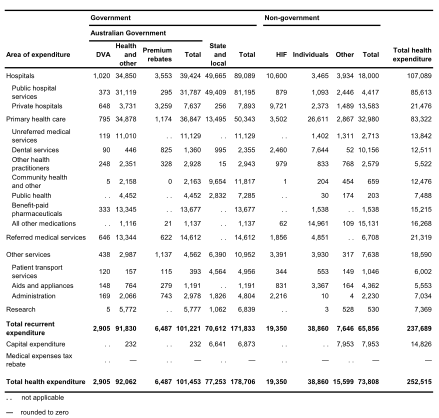
Notes
- ‘Health and other’ figures include Australian Government Department of Health and Aged Care’s own programs, grants to states and territories (including National Health Reform grants, National Partnership of COVID-19 Response grants, PBS section 100 programs in public hospitals and other National Partnership Payments), funding by other Australian Government agencies (including Department of Defence, capital consumption, and others).
- ‘HIF’ figures include health spending by Health insurance providers.
- ‘Other’ figures include health spending funded by other non-government sources (such as injury compensation insurance providers, non-government sector capital spending, non-patient revenue of private hospitals, and other private spending on health and medical research).
The table shows the total health spending in constant prices, by area of spending and source of funds in 2022–23. In this year, total governments funded $178.7 billion of which $101.5 billion by the Australian Government and $77.3 billion by state and territory governments. In 2022–23, non-government entities (including individuals, private health insurance providers, injury compensation insurers and other private sources) spent an estimate of $73.8 billion on health. Individuals spent at $38.9 billion on health, private health providers $19.3 billion and other non-government sources $15.6 billion.
The table is also available as an Excel file.