


Summary
Permanent hearing loss affects approximately 1 to 2 babies per 1,000 births (Vos et al 2019). Universal newborn hearing screening aims to identify those born with permanent congenital hearing impairment. All Australian states and territories have universal newborn hearing screening programs, however, there is no standardised national data collection to support the measurement of screening delivery.
In February 2023, the AIHW submitted a feasibility report to the Department of Health, Disability and Ageing which provided advice on current newborn hearing screening collections and practices across states and territories, and made recommendations for establishing a national data collection.
A national data collection is an agreed set of specifications to collect data for a particular purpose. An Australian national data collection for newborn hearing screening would improve the availability and quality of data, allowing for consistent measurement, reporting, and benchmarking for programs and outcomes nationally and internationally.
In June 2023, the Department of Health, Disability and Ageing further funded the AIHW to develop a national data collection for newborn hearing screening. The key outcomes of this project include:
- Establishment of an advisory committee, the National Neonatal Hearing Screening Data Development Committee (the data development committee), to advise the AIHW on the development of the data collection. Chaired by the AIHW, the committee includes representation from all state and territory departments responsible for newborn hearing screening to ensure national agreement and consistency.
- The data development committee agreement that the scope of the data collection would include unit-record data on all liveborn babies in each Australian state and territory.
- Development of data standards and specifications for 21 data items to capture key demographic information, as well as data on the screening, outcomes, referrals, and reasons a newborn was not screened. These data items have been agreed to by the data development committee.
- Outlining the feasibility of reporting against the newborn hearing screening national performance indicators under the National Framework for Newborn Hearing Screening, published by the Department of Health, Disability and Ageing. This replaced the former National Framework for Neonatal Hearing Screening, published in 2013.
Initially, this work has focused solely on the newborn screening component of hearing programs, as this is where data is readily available across all jurisdictions. Future work could ensure the development of data along the screening pathway, such as audiological assessment and early intervention services.
Further medium- to long-term development could include expansion and further improvement of the collection to include data on audiological assessment, amplification, implantation, early intervention and risk factors. These next steps would enable a more holistic national understanding of the hearing screening pathway, and the ability to report against all proposed National Framework indicators.
A summary of recommended next steps, from short- to long-term development, is provided in Figure 1 below.
Figure 1: Summary of recommended next steps
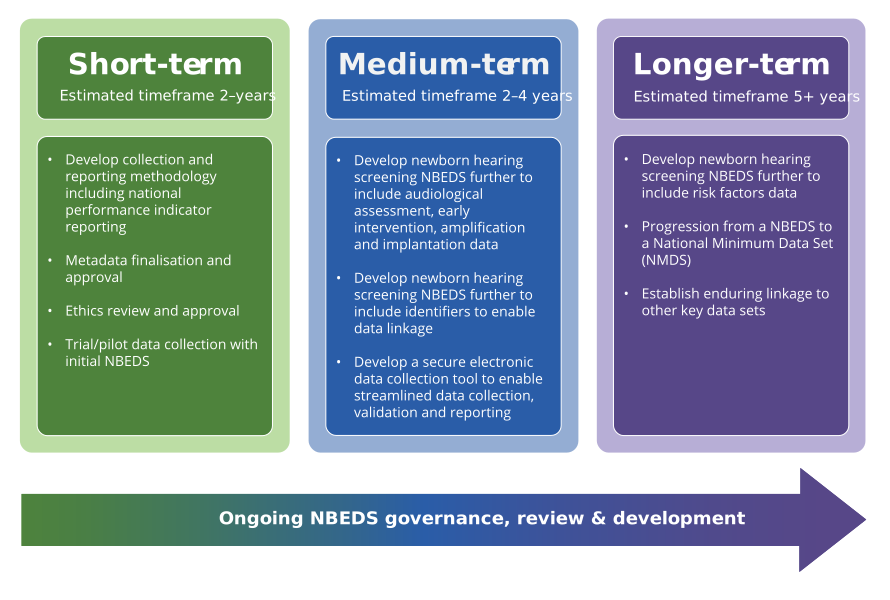
Note: A National Best Endeavours Data Set (NBEDS) is a metadata set for which there is a commitment to provide data nationally on a ‘best endeavours’ basis but is not formally mandated for national collection. When data quality, comparability, and universal coverage are achieved, a business case is made to the advisory committee and then the National Health Data and Information Standards Committee, for these data items to become mandatory for collection. See Glossary for full definitions.