


Recommendations and next steps
Recommendations
Based on the AIHW’s consultation with the National Newborn Hearing Screening Data Development Committee, the following recommendations are made regarding the continued development of a national newborn hearing screening NBEDS:
Recommendation 1
All state and territory newborn hearing screening programs should continue to be engaged through the data development committee to maintain and develop consistent data standards in the newborn hearing screening National Best Endeavours Data Set (NBEDS). This will ensure:
- regular and consistent reporting, both within jurisdictions and nationally
- the ability to measure key performance indicators
- the provision of benchmarks for service improvement
- the ability for comparison across services, nationally and internationally.
Recommendation 2
Further work be undertaken to progress the NBEDS to an implementation phase, including:
- development of specific collection and reporting methodology
- finalisation of data provision and reporting frequency
- authoritative review and endorsement of metadata
- AIHW ethics approval of the new collection
- implementation of a trial or pilot data collection
- ongoing monitoring and review
- exploration of the capacity for reporting data back to services.
Recommendation 3
Further data development work be undertaken to expand the national newborn hearing screening NBEDS, including:
- identification and development of new data items to capture data from other parts of the screening pathway.
- consultation to assess the capacity to collate information on audiological assessment, risk factors, early intervention, amplification and implantation services in the NBEDS. The most appropriate data sources for these hearing screening pathway components need to be explored.
- the inclusion of identifying data and/or a data linkage key to enable future linkage with socio-demographic, medical, educational and employment administrative datasets.
Recommendation 4
The continued development and governance of the newborn hearing screening NBEDS, through engagement with the following key stakeholders:
- state and territory newborn hearing screening programs via the data development committee, to ensure national agreement and consistency on data standards and reporting
- other hearing specialists and organisations (including audiologists, Hearing Australia and the National Disability Insurance Agency) to better understand data from these aspects of the hearing pathway
- the AIHW metadata team to ensure data specifications meet national standards
- the AIHW Ethics Committee to ensure the data collection are ethically acceptable and that data about people is handled with respect and in best practice.
Next steps
All jurisdictions support the development of a newborn hearing screening NBEDS and have provided agreement on the data items for inclusion. The key next step is to progress the national newborn hearing screening NBEDS to an implementation phase, to facilitate data collection and reporting.
The initial focus of the collection is on demographic and screening information and can be built upon further to include data on diagnostic audiological assessment. Further work should also be undertaken to assess the capacity to include information on identifiers (to aid data linkage), risk factors, early intervention, amplification and implantation services.
Given there are challenges that arise from differences in program practices and data collection between the states and territories, all jurisdictions need to continue to be engaged to develop and work towards consistent national data standards. The National Framework may also provide a strong impetus for jurisdictional collaboration, and national consistency towards common goals.
A range of short, medium and longer-term steps are recommended to build on this work.
Short-term development (2 years)
The AIHW recommends the next steps be undertaken to ensure the timely continued development of the NBEDS during 2025–26.
Step 1: Development of collection and reporting methodology
The following collection methodologies need to be further discussed and agreed by the data development committee:
- Frequency of data collection
- Means of data provision from jurisdictional systems to the AIHW
- Data validation processes
- Frequency of reporting
- Required reporting products (such as published reports and resources, data tables and other products, such as data return to source)
Processes for reporting on the national performance indicators under the National Framework will also need to be established.
Step 2: Metadata finalisation and authoritative endorsement
- Technical review of metadata items: The approved data specifications require review by the team of metadata experts at the AIHW. This will ensure the specifications meet national standards and are correctly formatted for input on AIHW’s metadata online registry (METEOR).
- National Health Data and Information Standards Committee approval: Following input into METEOR, the specifications will require formal approval from the National Health Data and Information Standards Committee. This committee provides advice to the AIHW for its work in developing and maintaining national health data and information standards and related national health information infrastructure, in the context of the National Health Information Agreement. Membership of the committee comprises all signatories to the National Health Information Agreement, including the Department of Health, Disability and Ageing. It is anticipated that the Newborn Hearing Screening NBEDS could be put to the National Health Data and Information Standards Committee for endorsement in the next project phase.
Step 3: Ethics approval
All new projects and data collections require an ethics application to be reviewed and approved by the AIHW Ethics Committee prior to the collection of data.
The AIHW Ethics Committee is established under section 16(1) of the Australian Institute of Health and Welfare Act 1987 and the Australian Institute of Health and Welfare (Ethics Committee) Regulations 2018. Its main responsibilities are to:
- advise on the ethical acceptability or otherwise of current or proposed health and welfare-related activities of the AIHW, or of bodies with which we collaborate or interact
- advise on the ethical acceptability of the AIHW activities involving information which can identify a person ('identifiable data')
- ensure data about people is handled with respect and in line with best practice
It is anticipated that an application to the AIHW Ethics Committee could be undertaken during the next project phase.
Step 4: Trial data/pilot collection
A pilot national data collection could potentially commence during 2025–26, pending relevant approvals and funding. Data would be provided to the AIHW by each state and territory department responsible for newborn hearing screening. A pilot test could be used to evaluate:
- the quality and consistency of the data received
- the ability of the NBEDS to meet national reporting requirements
- data provision challenges
- data validation issues
- modifications to data items that may be required
Ongoing review and development
The data development committee has provided in-principal approval for the 21 newborn hearing screening items. While these items have been agreed as a strong foundation for the data collection, further development of the data items may be required as the collection evolves and matures. Iterative improvements and annual reviews of data items are standard practice to ensure that items continue to be meaningful and fit-for purpose.
Development of a precise Data quality statement (outlining timeliness, accessibility, interpretability, relevance, accuracy and coherence) would also be required to accompany the NBEDS.
Medium to longer-term development (2–5 years+)
The agreed NBEDS data items are focused on the newborn hearing screening component of the pathway. Further development work is required develop the following data pertaining to other areas pathway including:
- audiological assessment: development of data on audiology assessment services could be undertaken by further exploring which jurisdictions hold audiology data within their newborn hearing screening programs and developing methods to overcome any data barriers. Engaging other relevant audiology stakeholders could also be progressed.
- early intervention (for example National Disability Insurance Scheme): Some relevant data on early intervention National Disability Insurance Scheme programs are likely captured by the National Disability Insurance Agency (such as status of the access request, date of access request decision, whether the participant is active and/or eligible, start date of paid support, whether the child has initial supports through the early childhood approach).
- amplification services (such as Hearing Aids): Amplification data could potentially be sourced from Hearing Australia. Initial scoping and steps towards appropriate national data provision and collection could also be explored.
- implantation services (such as Cochlear implants, bone conduction devices): Hearing Australia do not perform Cochlear implant evaluation or surgery but do provide support and have close relationships with cochlear implant clinics. The relevant data holdings for Cochlear implants would require further exploration. Hearing Australia do provide bone conduction devices to eligible people and may hold relevant data.
- risk factors: these could include a family history of hearing impairment, exposure to congenital infections or ototoxic medications, and syndromes associated with hearing loss, such as Down syndrome. Data items on the prevalence and monitoring of babies with these risk factors and their outcomes should also be considered for inclusion in a national data collection to enable research into risk factors and health outcomes associated with permanent congenital hearing impairment.
- identifiers to enable future data linkage: This could include linkage between screening, assessment and intervention datasets to better understand the context and pathway of participants. The AIHW are international leaders in data linkage with a strong record and accreditation as a data service provider (ADSP).
- secure electronic data collection tool to enable streamlined data collection, validation, and reporting could also be developed.
A summary of all potential development activities from short- to long-term are summarised in Figure 3 below.
Figure 3: Summary of recommended next steps
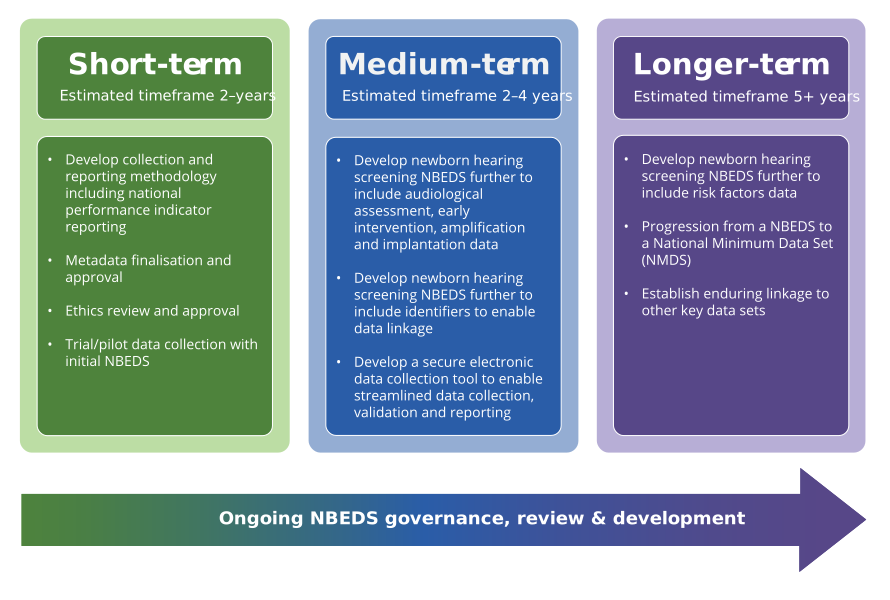
Note: A National Best Endeavours Data Set (NBEDS) is a metadata set for which there is a commitment to provide data nationally on a ‘best endeavours’ basis but is not formally mandated for national collection. When data quality, comparability, and universal coverage are achieved, a business case is made to the advisory committee and then the National Health Data and Information Standards Committee, for these data items to become mandatory for collection. See Glossary for full definitions.