


Rank
Suicide rates by rank
Rank describes organisational and workforce structures that determine a member’s position, conditions, opportunities, and entitlements (such as pay and conditions). This analysis is based on rank at time of separation. Rank is presented in 2 broad groups: officer ranks and other ranks1.
For ex-serving males and females, 14% were officers and 86% were in the other ranks group at time of separation. The suicide rates for these groups are given in Table 12.
Rank at time of separation | Ex-serving males: Suicide rate per 100,000 population per year | Ex-serving females: Suicide rate per 100,000 population per year |
|---|---|---|
Officer ranks(a) | 17.1 | 9.7* |
Other ranks(b) | 32.9 | 15.6 |
Notes:
- For the purposes of this analysis this is a Defence member who holds a rank of O00 (Midshipman or Officer Cadet) to O10 (Admiral, General, or Air Chief Marshal).
- A Defence member who holds an equivalent rank to E00 (Recruit Seaman, Private, or Aircraftman) to E10 (Warrant Officer of the Navy, Regimental Sergeant Major of the Army, or Warrant Officer of the Air Force).
* Suicide rates in this Table denoted with a '*' should be interpreted with caution as the number of suicides is fewer than 20. These rates are subject to large fluctuations.
Source: AIHW analysis of linked Defence historical personnel data–PMKeyS–NDI data 1985–2022.
Between 1997 and 2022, the suicide rate for ex-serving males who were officers at time of separation was approximately half that of those who separated at other ranks (17.1 compared with 32.9 per 100,000 population per year).
For ex-serving females, rates of suicide were similar for officers and other ranks (9.7 and 15.6 per 100,000 population per year). This is shown in Figure 20.
Figure 20: Suicide rate by rank, ex-serving males and females, 1997–2022
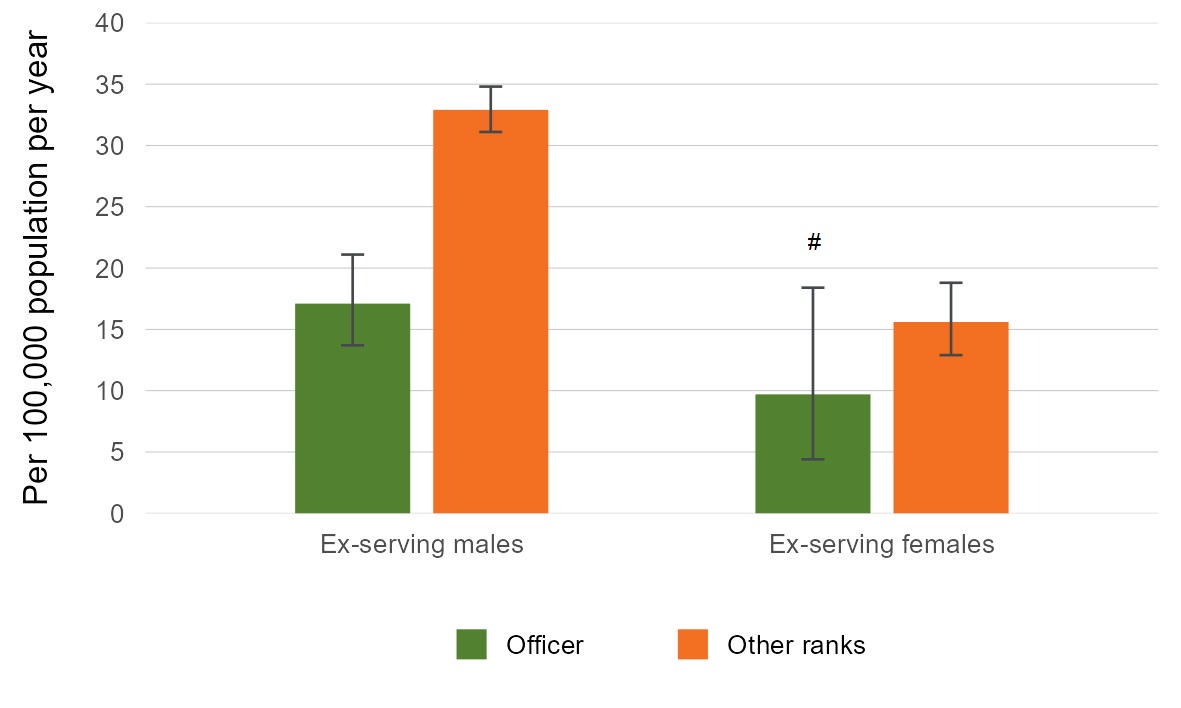
Note: # Suicide rates in this Figure denoted with a '#' should be interpreted with caution as the number of suicides is fewer than 20. These rates are subject to large fluctuations.
Source: AIHW analysis of linked Defence historical personnel data–PMKeyS–NDI data 1985–2022.
Suicide rates by rank over time
The interactive graph below (Figure 21) presents the suicide rates for ex-serving males in each of the rank groups, for all 3-year periods from 1997–1999 to 2020–2022.
Rates of suicide for ex-serving males who separated as ranks other than officer shows a drop between the late 1990s and the mid 2000s, which is consistent with patterns observed in the general Australian male population over this period (see Figure 5).
Analysis of suicide rates among officers is based on a small number of suicide deaths. Results have not been reported where there were less than 5 suicides in the 3-year periods, 2000 to 2002, 2004 to 2006 and 2005 to 2007.
Due to small numbers of suicide deaths among ex-serving females, suicide rates by rank over time are not reported.
Figure 21: Rate of suicide for ex-serving males by rank, 1997–1999 to 2020–2022
This time series line graph shows the weighted average suicide rate per 100,000 population per year of by rank in ex-serving males over time by 3-year periods from 1997 to 1999, to 2020 to 2022.
