


Reason for separation
What are the reasons for separation?
The reasons that members separate from the Australian Defence Force (ADF) can be categorised into 5 broad groups (see Technical notes for the categorisation of these groups):
- voluntary separation
- involuntary medical separation
- involuntary separation: Retention not in service interest. This is a classification which covers a broad range of specific reasons including separation due to a member’s performance, behaviour and suitability, or Defence workforce planning and requirements
- other involuntary separation (for reasons other than medical or Retention not in service interest). These include being physically unfit for service, training failure and disciplinary reasons
- contractual or administrative change.
This year’s report is the first in the series to report statistics by the involuntary separation reason of ‘Retention not in service interest.’ In previous reports, this separation reason was part of the involuntary separation group.
The separation date used in this report is when a member leaves the ADF entirely, that is when they are no longer a permanent or reserve member. Separation reason is therefore the reason recorded for leaving their last engagement with the ADF.
Due to a change in the way the reason for separating from the ADF was recorded in 2002, analysis is only reported for ADF members who separated from 1 January 2003 onwards and does not include those who separated prior to 2003. ADF members who separated from 1 January 2003 comprise 44% of ex-serving ADF members who had served at least one day since 1 January 1985. Among this cohort:
- the most common type of reason for separation was voluntary separation, with similar proportions for males and females (44% and 43% respectively)
- this was followed by involuntary medical separation (males 16% and females 20%)
- next was other involuntary separation (males 17% and females 13%)
- involuntary separation for Retention not in service interest accounted for 11% of male separations, and 8.7% of female separations
- contractual or administrative changes accounted for 11% of male separations and 14% of female separations.
Suicide rates by reason for separation
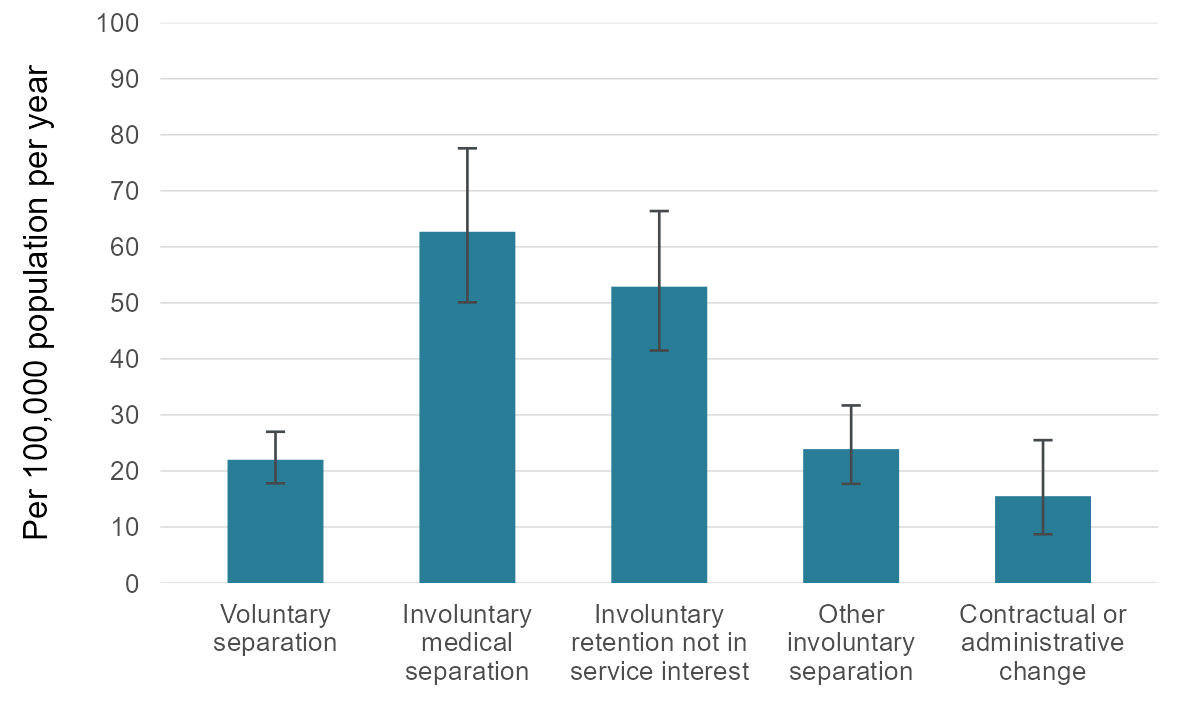
Between 2003 and 2022, the suicide rate for ex-serving males by reason for separation was lowest for those who separated either voluntarily, other involuntary or for contractual/administrative reasons (22.0, 23.9 and 15.5 per 100,000 population per year respectively) and highest for those whose reason for separation was involuntary medical or involuntary Retention not in service interest (62.7 and 52.9 per 100,000 population per year respectively).
This is demonstrated in Table 8 and Figure 12.
Reason for separation | Ex-serving males: Suicide rate per 100,000 population per year | Ex-serving females: Suicide rate per 100,000 population per year |
|---|---|---|
Voluntary | 22.0 | 15.9* |
Involuntary medical | 62.7 | 36.3* |
Involuntary retention not in service interest(b) | 52.9 | . . |
Other involuntary | 23.9 | 18.0* |
Contractual or administrative | 15.5 | 0 |
Notes:
- Due to a change in the way the reasons for separating the ADF was recorded during 2002, analysis is presented only for ADF members who left from 1 January 2003 onwards. These members comprise 43% of the total ex-serving members with at least one day of service since 1 January 1985.
- Due to small number of suicide deaths, females who separated for involuntary Retention not in service interest were aggregated with the other involuntary separation group for suicide rate analysis.
* Suicide rates in this Table denoted with a '*' should be interpreted with caution as the number of suicides is fewer than 20. These rates are subject to large fluctuations.
. . Not applicable
Source: AIHW analysis of linked Defence historical personnel data–PMKeyS–NDI data 1985–2022.
Figure 12: Suicide rates by reason for separation, ex-serving males, 2003–2022
Source: AIHW analysis of linked Defence historical personnel data–PMKeyS–NDI data 1985–2022.
The age-adjusted analysis for the male voluntary, other involuntary, and contractual/administrative separation cohorts indicates that there is no statistical difference in suicide rate between these cohorts and the Australian male population. Similar analyses indicate that the involuntary Retention not in service interest and involuntary medical cohorts have a higher rate of suicide than the Australian population.
Compared with the Australian male population, suicide rates between 2003 and 2022 for ex-serving males were:
- similar to those who separated for voluntary reasons
- 159% higher (or 2.59 times) for those who separated for involuntary medical reasons
- 122% higher (or 2.22 times) for those who separated for involuntary Retention not in service interest
- similar to those who separated for other involuntary reasons
- similar to those who separated for contractual or administrative reasons.
Of the sub-populations studied in this report, the male involuntary medical separation cohort has the highest suicide rate.
Due to small number of suicide deaths, females who separated for involuntary Retention not in service interest were aggregated with the other involuntary separation group for suicide rate analysis. Between 2003 and 2022, the suicide rates for ex-serving females by reason for separation were statistically similar for voluntary separation, involuntary medical separation, and other involuntary separation, noting that the wide confidence intervals here make significant differences difficult to identify. Where comparisons are found to be not statistically significant, there may still be a real difference of practical importance that the statistical test did not detect due to the small size of the female ex-serving cohort. See Supplementary table S4.2 on Data.
Since there were no suicide deaths among ex-serving females who separated for contractual or administrative reasons this column does not appear in Figure 13.
Figure 13: Suicide rates by reason for separation, ex-serving females, 2003–2022

Notes:
Due to small number of suicide deaths, females who separated for involuntary Retention not in service interest were aggregated with the other involuntary separation group for suicide rate analysis.
# Suicide rates in this Figure denoted with a '#' should be interpreted with caution as the number of suicides is fewer than 20. These rates are subject to large fluctuations.
Source: AIHW analysis of linked Defence historical personnel data–PMKeyS–NDI data 1985–2022.
Age and sex standardised analyses for ex-serving females broken down by reason for separation show that each reason for separation cohort (apart from contractual or administrative) has a higher suicide rate compared to the respective general Australian population, including the voluntary separation cohort. See Supplementary table S4.1.
Suicide rates by reason for separation over time
Due to the shortened period of usable data and lower population numbers (See Suicide rates by reason for separation), the time series graphs for reason for separation among ex-serving males are presented in 5-year periods from 2003–2007 to 2018–2022 (Figure 14). While the suicide rate of ex-serving males who separated for Involuntary retention not in service interest has been rising steadily over time from 2005–2009 to 2018–2022 (32.3 to 67.8 per 100,000 population per year), these differences were not statistically significant. Suicide rates among ex-serving males within all other separation reason groups remained relatively unchanged over time with no statistically significant differences observed.
Due to the small number of suicide deaths among ex-serving females, suicide rates for females by reason for separation over time are not reported.
Figure 14: Rate of suicide for ex-serving males by reason for separation, 2003–2007 to 2018–2022
This time series line graph shows the weighted average suicide rate per 100,000 population per year of ex-serving males by reason for separation over time by 5-year periods from 2000 to 2007, to 2018 to 2022.
