Appendix A2: technical information
Age
Numbers of young people under supervision include young people of all ages (as well as those aged 18 and over), unless otherwise specified. Rates refer to young people aged 10–17 only, in order to enable meaningful comparisons (see Population rates).
Age on an average day is calculated based on the age a young person is each day that they are under supervision. If a young person changes age during a period of supervision, then the average daily number under supervision will reflect this. Average daily data broken down by age will not be comparable to Youth justice in Australia releases prior to 2019–20, as age was previously calculated using a different methodology.
For example, the days that the young person was aged 17 will be counted in the daily average for 17-year-olds, and the days that they were aged 18 will be counted in the daily average for 18-year-olds. This allows for precise measurement of the age of young people under supervision on an average day.
For 'during the year' presentations of data (or unique counts of young people) age is calculated as at the start of the first relevant period of supervision unless that period of supervision began before the financial year, in which case age is calculated as at the start of the financial year. As a result, a young person's age can vary across tables, as age is calculated in respect to the type of supervision being analysed.
For example, a young person enters supervised bail aged 17 on 1 August and leaves on 30 August. They turn 18 on 15 September, enter sentenced detention on 1 December and are released on 1 January on parole, which ends on 30 January. They have no other periods of community-based supervision during the financial year.
- In the supervised bail analysis, they will appear as a 17-year-old.
- In the sentenced detention analysis, they will appear as an 18-year-old.
- In the parole analysis, they will appear as an 18-year-old.
This means that for a particular age group, the total number of young people under supervision may not be the sum of the number of young people under particular types of supervision for 'during the year' tables.
Age range for treatment as a young person
Across Australia, young people may be charged with a criminal offence if they are aged 10 or over. The upper age limit for treatment as a young person is 17 (at the time an offence was allegedly committed) in all states and territories. In Queensland, the age limit was previously 16 but changed to 17 years from 12 February 2018. Young people aged 18 and older at the time an offence was allegedly committed are dealt with under the criminal legislation relating to adults.
However, it is possible for young people aged 18 and over to be under youth justice supervision. This can be because of one of the following:
- the offence was committed when the young person was aged 17 or younger
- the continuation of supervision once they turn 18
- their vulnerability or immaturity.
In addition, in Victoria, some young people aged 18–20 may be sentenced to detention in a youth facility (known as the 'dual track' system).
Average and median
Two measures of central tendency are reported using data from the YJ NMDS:
- Average (mean) – the average, or mean, is calculated by summing all of the values and dividing by the number of observations. In YJ NMDS data, averages are used in the reporting of 'average day' numbers (see Average day) and the total amount of time spent under supervision during the year.
- Median – this is the middle value of a set of observations, when arranged in order of value. Medians are often reported where data are not normally distributed or include extreme values that would distort the average. In YJ NMDS data, median is used to report the duration of completed periods of supervision, due to the skewed distribution of the data. The duration of completed periods of supervision ranges from one day to more than 10 years.
Community-based supervision
The YJ NMDS contains information on the start and end of supervised orders that youth justice agencies administer, as well as on the start and end of detention periods.
As the start and end dates in the YJ NMDS do not include time stamps, a young person is counted as being under community-based supervision for any day that is covered by a community-based supervised order and is not covered by a detention period.
In some circumstances, the young person is considered to have moved between community-based supervision and detention on the same day and is counted as having both types of supervision:
- When a detention period starts on a particular day (and the previous detention period ended before that day) and a community-based supervision order starts on or before that day and ends on or after that day, the young person is counted as having both community-based supervision and detention on that day.
- When a detention period ends on a particular day (and the next detention period starts after that day) and a community-based supervision order starts on or before that day and ends on or after that day, the young person is counted as having both community-based supervision and detention on that day.
- When a detention period ends on a particular day and another detention period starts on the same day and a community-based supervision order starts on or before that day and ends on or after that day, the young person is counted as having only detention on that day.
- Where any detention periods either end before a particular day or start after that particular day and a community-based supervision order starts on or before that day and ends on or after that day, the young person is counted as having only community-based supervision on that day. See also Supervision periods.
Duration
Duration is calculated in whole days. For example:
- if a young person entered supervision on 1 January and left on 5 January, this is counted as 5 days under supervision,
- if a young person entered and left supervision on the same day, this is counted as one day under supervision.
First supervision and supervision history
The YJ NMDS contains the date on which the youth justice agency first supervised or case managed each young person under supervision. This date is used in analyses of age at first supervision.
In contrast to the age at first supervision, analyses of the first type of supervision and supervision history are restricted to those young people for whom information on this first supervision is available in the YJ NMDS.
For all states and territories except Tasmania, the Australian Capital Territory and the Northern Territory, information on the first type of supervision is available for all young people whose first supervision was on or after 1 July 2000. For Tasmania, this is 1 January 2006 (as complete data on detention are available only from this date). For the Australian Capital Territory, this is 1 July 2008 (as data for 2003–04 to 2007–08 are available only in YJ NMDS 2007 format). For the Northern Territory, this is 1 July 2012.
The first supervision type is determined for each young person with available data by selecting the records with the earliest start date. Because it is possible for young people to be under more than one type of supervision at the same time, young people may have multiple first supervision types.
A young person's supervision history is composed of all available information in the YJ NMDS, up to and including the current reporting year. Only young people with information from their first supervision are included in this analysis.
Number under supervision
Reports based on the YJ NMDS contain information on both:
- the number of young people under supervision on an average day
- the number of young people under supervision during the year.
The 'average day' measure reflects the number of young people under supervision on a typical day during the year, and gives an indication of the average number of young people supported by the supervision system at any one time. It is a summary measure that reflects both the number of young people supervised, and the amount of time they spent under supervision. This measure is the main focus of most YJ NMDS data.
In contrast, the 'during the year' measure is a count of the number of unique individuals who were supervised at any time during the year.
Comparing the 'average day' and 'during the year' measures provides information on the average amount of time spent under supervision during the year.
For example, there could be 100 young people under community-based supervision at some time during the year, but only 50 on an average day.
This tells us that the average length of time those young people were supervised during the year was 6 months (50/100*12 months). By contrast, if 100 people are in detention during the year and 25 on an average day, the average length of time those young people spent in detention is 3 months (25/100*12 months).
In 2023–24, only 20% of young people under supervision were in detention on an average day, but 50% experienced detention at some time during the year. This difference reflects the fact that young people spent substantially less time in detention, overall, than under community-based supervision.
Both the 'average day' and 'during the year' counts are provided in most supplementary tables, where appropriate.
Average day
The number of young people under supervision on an average day is calculated by summing the number of days each young person spends under supervision during the year and dividing this total by the number of days in the financial year.
For the number on an average day, components may not sum to the total because young people can experience different types of supervision on the same day.
During the year
The number of young people under supervision during the year is calculated by counting each distinct young person under supervision during the financial year. Each young person is counted only once, even if they entered and exited supervision multiple times during the year.
For the number during the year, components may not sum to the total because:
- young people can experience different types of supervision during the year
- age is calculated specific to the type of supervision being analysed.
For example, if there were 100 young people under supervision in a particular year and each of these 100 young people had been detained and under community-based supervision at different times during the year, the relevant totals would show that there were 100 young people in detention, 100 young people under community-based supervision and a total of 100 young people under supervision.
Population rates
Population rates allow for the comparison of different groups while taking into account differences in population sizes. Because there are differences between the states and territories in the extent to which youth justice agencies can supervise young people aged 18 and over, rates compared in this report are restricted to young people aged 10–17.
Box 1: The impact of changes to the minimum age of criminal responsibility on rates in 2023–24
In this report, rates are usually calculated for young people aged 10–17. In 2023, the Australian Capital Territory and Northern Territory raised the minimum age of criminal responsibility from 10 to 12. This means that 10- and 11-year-olds cannot be held criminally responsible for their conduct in these jurisdictions during 2023–24.
To account for the increased age of criminal responsibility in these jurisdictions, the rates for the Australian Capital Territory and Northern Territory in 2023–24 are for young people aged 12–17 (instead of 10–17) as 10- and 11-year-olds are absent from both the number (numerator) and population (denominator) used to calculate rates. The rates for Australia in 2023–24 will use the sum of the 12–17 population for the Australian Capital Territory and Northern Territory and the 10–17 population for all other jurisdictions. All rates prior to 2023-24 will use the 10–17 population for all jurisdictions and Australia.
Note that care should be taken when comparing 2023–24 rates with prior years for the Australian Capital Territory and Northern Territory. As the exclusion of 10- and 11-year-olds for these jurisdictions in 2023–24 has reduced the total in-scope population (denominator) by about 25%, rates will appear higher than in prior years.
The calculation of rates excludes young people for whom data on particular variables are not available and are not calculated where there are fewer than 5 young people, due to a lack of reliability.
Rates are expressed as the number per 10,000 of young people in the population.
The number of young people on an average day is rounded to one decimal place. The rate for an average day is calculated using the number on an average day before rounding.
Box 2: Updates and changes to populations used in 2023–24
2021 Census counts of Aboriginal and Torres Strait Islander people
Trends for First Nations people in this report are calculated using population estimates and projections based on the 2021 Census. Trends are limited to 2016 onwards, due to a large non-demographic increase in Census counts of Aboriginal and Torres Strait Islander people between 2016 and 2021. The rates for Aboriginal and Torres Strait Islander people in this report are generally lower than, and are not comparable to, those in previous reports.
For further information, see the following information from the Australian Bureau of Statistics (ABS):
- Understanding change in counts of Aboriginal and Torres Strait Islander people
- Guide to using historical estimates for comparative analysis and reporting.
2023–24 changes – population table S142
Due to the unavailability of the usual ABS data in the 2021 Aboriginal and Torres Strait Islander experimental projections of Indigenous populations to 2021 (Series B), the populations in table S142 were derived using the 2021 Aboriginal and Torres Strait Islander experimental projections of Indigenous populations by Remoteness Areas of Australia.
Remoteness areas are not available by state and territory, which meant that 10- and 11-year-olds in the Australian Capital Territory and Northern Territory could not be removed due to the increased age of criminal responsibility of 12 years old in 2023-24. This has led to slightly inconsistent populations between Table S142 and other population tables.
This also meant that an additional table excluding the Northern Territory population could not be produced for rates tables where the Northern Territory is absent from the numerator in 2023-24. This means that rates derived from the populations in Table S124 will be slightly lower due to the slightly higher populations.
2023–24 changes – population tables S143 and S146
For population tables S143 and S146, the AIHW estimated the Australian Capital Territory and Northern Territory populations for the required age groups, as these are not published by the ABS. This is a result of these jurisdictions increasing the minimum age of criminal responsibility to 12 years old in 2023-24. The statistical estimation process produces minor discrepancies with ABS published totals. These discrepancies have negligible effects on rate calculations.
Box 3: Population rates and COVID‑19
The COVID‑19 pandemic and the resulting Australian Government closure of the international border from 20 March 2020, caused significant disruptions to the usual Australian population trends. This report uses Australian Estimated Resident Population (ERP) estimates that reflect these disruptions.
In the year July 2020 to June 2021, the overall population growth was much smaller than the years prior and in particular, there was a relatively large decline in the population of Victoria. ABS reporting indicates these were primarily due to net-negative international migration (National, state and territory population, June 2021).
Be aware that this change in the usual population trends may complicate your interpretation of statistics calculated from these ERPs. For example, rates and proportions may be greater than in previous years due to decreases in the denominator (population size) of some sub-populations.
Rate ratios
Rate ratios are used to compare First Nations and non-Indigenous rates and to provide a measure of the level of First Nations over-representation. They should be interpreted with caution where there are small denominators, rare events, or rates that converge while declining (or diverge while increasing).
Rate ratios are calculated using the rates rounded to 3 decimal places. Rates are presented in the supplementary tables to one decimal place.
Rate ratios are not calculated where one or both of the rates have fewer than 5 young people in the numerator.
Receptions
A reception occurs when a detention period starts and the young person either:
- was not in detention immediately before the start of the current detention period
- did not escape from detention or abscond from leave in the immediately preceding detention period.
The start of a detention period is considered a reception only when the detention period starts at least 2 full days after the end of the previous detention period. This accounts for young people being transported to court and returning to detention on remand or sentenced detention following a court hearing, as well as for young people transferred between detention centres.
There may be a small number of young people who are counted as having a reception where their travel time is longer than 2 full days when travelling to and from remote locations.
Releases
A release from detention occurs where a detention period ends and the young person was not detained immediately following the end of the current detention period.
A release does not include instances where the young person escaped from detention or absconded from leave.
The end of a detention period is considered a release only when the detention periods ends at least 2 full days before the start of the next detention period. This accounts for young people being transported to court and returning to detention on remand or sentenced detention following a court hearing, as well as for young people transferred between detention centres.
There may be a small number of young people who are counted as having a release where their travel time is longer than 2 full days when travelling to and from remote locations.
Remand periods followed by a period of sentenced supervision
All periods of sentenced supervision that start within one day of the end of a remand period are included except where there is a further remand period that starts on the same day as the period of sentenced supervision. Remand periods are also only included in the analysis where they end with detention end reason '1 – Complete'. For example, remand periods that ended because a young person was released into bail to await their sentencing are not included.
Remoteness
YJ NMDS reporting uses the Australian Statistical Geography Standard (ASGS) Remoteness Areas Structure that the Australian Bureau of Statistics (ABS) has developed to analyse the remoteness of the usual residence of the town or suburb of young people under supervision.
This structure allows areas that share common characteristics of remoteness to be classified into broad geographical regions of Australia. These areas are Major cities, Inner regional, Outer regional, Remote and Very remote.
The remoteness of the young person's usual residence was determined using the most recent postcode of their last known address. Young people with invalid, missing or unknown postcodes of last known home address were excluded from the analysis.
The number of young people under supervision in each remoteness area was estimated based on each young person's most recent postcode.
Some postcode areas were split between 2 or more remoteness areas. Where this was the case, the data were weighted according to the proportion of the population of the postcode area in each remoteness area.
Some young people may appear in remoteness areas for which there is no population within that state or territory. This is due to young people whose last known home address is in a different state or territory to the one in which they are under supervision.
Socioeconomic position
YJ NMDS reporting uses the Socio-Economic Indexes for Areas (SEIFA) that the ABS has developed to analyse the socioeconomic position of the usual residence of young people under supervision. The Index of Relative Socio-Economic Advantage and Disadvantage is used.
The socioeconomic position of the area of the young person's usual residence was determined by allocating the relevant SEIFA population-based (2016) quintile score to the most recent postcode of the last known home address. Young people with invalid, missing or unknown postcodes of last known home address were excluded from the analysis.
The number of young people under supervision in each area was estimated based on each young person's most recent postcode. Some postcode areas were split between 2 or more areas with different SEIFA scores. Where this was the case, the data were weighted according to the proportion of the population of the postcode area in each SEIFA area.
The SEIFA represents the average of all people living in the area, and not the socioeconomic position of a particular individual living in the area. As a result, socioeconomic analyses in YJ NMDS reporting indicate the level of socioeconomic advantage and disadvantage in the area of usual residence of the young person, not the level of socioeconomic advantage and disadvantage of each individual young person or their family.
Some young people may appear in socioeconomic areas for which there is no population within that state or territory. This is due to young people whose last known home address is in a different state or territory to the one in which they are under supervision.
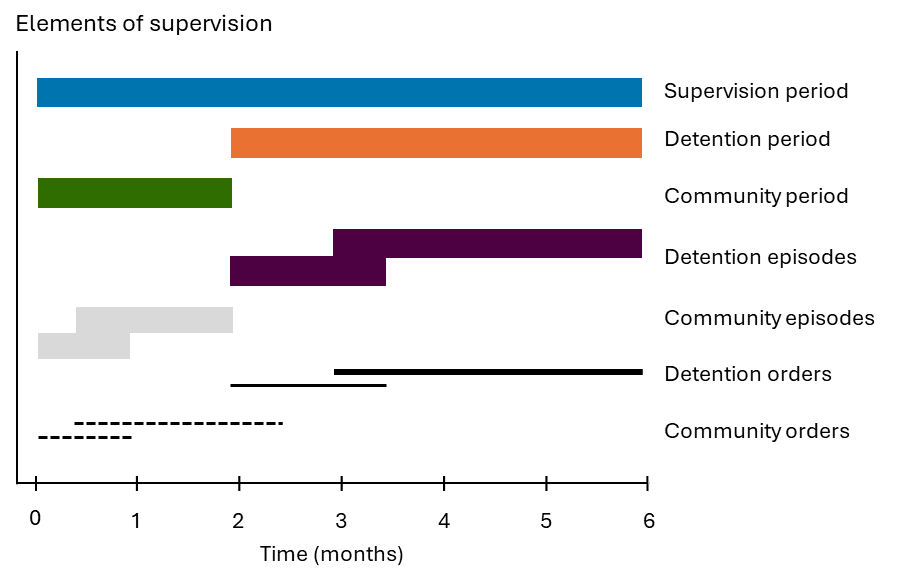
Supervision periods
A supervision period is the period of time a young person spent under continuous youth justice supervision. It should be noted that:
- periods of youth justice supervision may be comprised of both periods under community-based supervision and periods in detention
- periods spent either under community-based supervision or in detention may consist of multiple or concurrent orders and episode types.
Young people may not serve the full duration of orders for several reasons, including:
- community orders and periods spent under community-based supervision may be interrupted by time spent in detention
- the full duration of a sentenced detention order may not be served where the young person is released on parole or supervised release.
An example of the relationship between periods, episodes and orders is shown in Figure A1.1. In this example, a young person spent 6 continuous months under supervision, with the first 2 months under community-based supervision and the remaining 4 months in detention. The young person experienced 2 different types of community supervision in the first 2 months (for example, probation and bail). The young person then experienced 2 different types of detention (for example, remand and sentenced detention).
Figure A1.1: Example of the relationship between orders, episodes and periods in YJ NMDS data