

First Nations people under youth justice supervision

The vast majority of First Nations young people have never been under supervision. About 6.6% of young people aged 10–17 in Australia identified as being of Aboriginal or Torres Strait Islander origin. More than half (1,852 or 57%) of the young people aged 10–17 under supervision on an average day in 2023–24 were First Nations Australians (tables S143 and S3a). This means that 1.1% of First Nations young people were under supervision in 2023–24.

About half (55%) of those aged 10–17 under community-based supervision were First Nations Australians, while just under 2 in 3 (65%) of those aged 10–17 in detention were First Nations Australians (tables S36a and S74a).

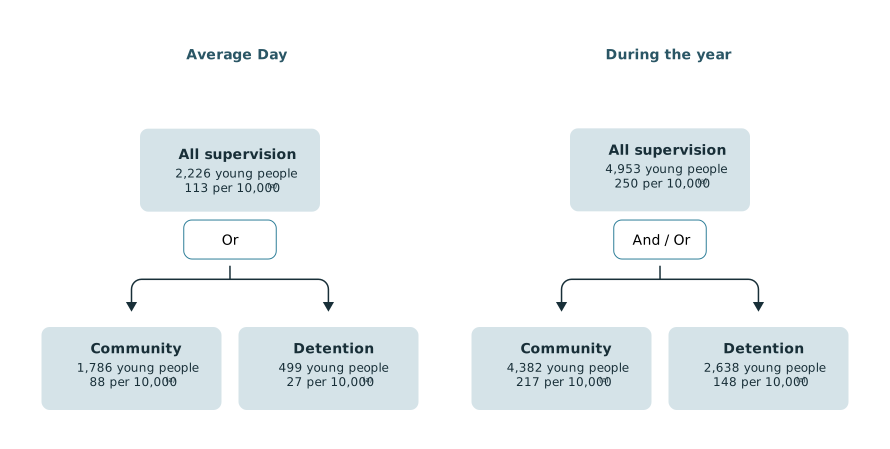
Of young First Nations people who were 10 and over, 2,226 were under youth justice supervision in Australia and 4,953 young people were supervised at some time during the year (Figure 3.1)

On an average day, most First Nations young people aged 10 and over who were under supervision were supervised in the community (80%) – the remainder (22%) were in detention (Figure 3.1). (Proportions may not sum to 100% as some young people are supervised under community-based supervision and detention on the same day.)

Although just 499 First Nations young people were in detention on an average day, about half (53%, or 2,638) of all First Nations young people who were supervised during 2023–24 had been in detention at some time during the year (Figure 3.1).

Figure 3.1: First Nations young people under supervision on an average day and during the year, by supervision type, 2023–24 (number and rate)
See following for extended description.

  1. Rates are presented for young people aged 10–17.

Notes:

  1. The average daily number of all supervision will not equal the sum of community-based supervision and detention because young people can be in both types of supervision on the same day.
  2. Young people can be in both community-based supervision and detention during the year so the sum of these types of supervision will not be equal to the total number of young people under youth justice supervision.
  3. The number and rate of young people on an average day is not available for the Northern Territory in 2023–24 for all supervision and community-based supervision.
  4. Rates for the Australian Capital Territory and Northern Territory in 2023–24 are for young people aged 12–17 due to the increase to the minimum age of criminal responsibility from 10 to 12 in those jurisdictions.

Source: tables S2a, S2b, S4a, S4b, S35a, S35b, S37a, S37b, S73a, S73b, S75a and S75b.

In 2023–24, the rate of First Nations young people aged 10–17 under supervision on an average day was 113 per 10,000, compared with 5.6 per 10,000 for non-Indigenous young people (Table 3.1c). This means First Nations young people aged 10–17 were about 20 times as likely as their non-Indigenous counterparts to be under supervision on an average day.

First Nations young people were over-represented under youth justice supervision in every state and territory where data was available (Figure 3.2).

The rate of First Nations young people aged 10–17 under supervision on an average day ranged from 34 per 10,000 in Victoria to 159 per 10,000 in Queensland. The over-representation of First Nations young people under youth justice supervision as measured by the rate ratio among jurisdictions with data available, ranged from about 4 times as high in Tasmania to about 22 times as high in Queensland (Table 3.1c).

Table 3.1a: Young people aged 10–17* under community-based supervision on an average day, by Indigenous status and state and territory, 2023–24 (rate per 10,000)
Community-based supervisionNSWVicQldWASATasACT*NT*Australia
First Nations62.427.2119.0124.9122.147.2120.0*n.a.*88.1
Non-Indigenous4.02.85.66.25.910.213.4*n.a.*4.7
All young people8.83.315.714.612.214.517.1*n.a.*10.0
Rate ratio15.59.821.320.020.64.69.0*n.a.*19.0

Footnotes and notes are provided following Table 3.1c.

Table 3.1b: Young people aged 10–17* in detention on an average day, by Indigenous status and state and territory, 2023–24 (rate per 10,000)
DetentionNSWVicQldWASATasACT*NT*Australia
First Nations18.67.341.128.117.08.338.9*48.4*26.6
Non-Indigenous0.80.71.61.00.82.22.7*1.4*1.0
All young people2.10.85.12.91.72.93.9*21.6*2.7
Rate ratio23.310.826.428.521.13.814.5*34.0*26.5

Footnotes and notes are provided following Table 3.1c.

Table 3.1c: Young people aged 10–17* under all youth justice supervision on an average day, by Indigenous status and state and territory, 2023–24 (rate per 10,000)
All youth justice supervisionNSWVicQldWASATasACT*NT*Australia
First Nations80.434.2158.8151.7137.655.1156.9*n.a.*112.7
Non-Indigenous4.83.47.17.26.712.315.9*n.a.*5.6
All young people10.94.120.617.413.817.320.8*n.a.*12.5
Rate ratio16.810.022.421.220.64.59.9*n.a.*20.1

(Footnotes and notes for tables 3.1a, 3.1b and 3.1c)

*Rates for the Australian Capital Territory and Northern Territory in 2023–24 are for young people aged 12–17 due to the increase to the minimum age of criminal responsibility from 10 to 12 in those jurisdictions.

Notes

  1. Rates are not published where there were fewer than 5 young people.
  2. First Nations rates for Victoria, South Australia, Tasmania and the Australian Capital Territory should be interpreted with caution due to First Nations population denominators that are less than 10,000.
  3. The rate ratio is calculated by dividing the First Nations rate by the non-Indigenous rate.
  4. The rate ratio has been calculated using rates to 3 decimal places.
  5. Age on an average day is calculated based on the age a young person is each day that they are under supervision. If a young person changes age during a period of supervision, the average daily number under supervision will reflect this. Average daily data broken down by age will not be comparable with data in Youth justice in Australia releases before 2019–20.
  6. The number and rate of young people on an average day not available for the Northern Territory in 2023–24 for all supervision and community-based supervision.

Source: tables S4a, S37a and S75a.

Figure 3.2: Young people aged 10–17 under supervision on an average day, by Indigenous status and state and territory, 2023–24

An interactive chart shows that the rate ratio varied across jurisdictions, with Queensland, Western Australia and South Australia having a higher rate ratio than the national average.

An interactive chart shows that the rate ratio varied across jurisdictions, with Queensland, Western Australia and South Australia having a higher rate ratio than the national average.

Notes

  1. Age on an average day is calculated based on the age a young person is each day that they are under supervision. If a young person changes age during a period of supervision, the average daily number under supervision will reflect this. Average daily data broken down by age will not be comparable with data in Youth justice in Australia releases before 2019–20.
  2. The number and rate of young people on an average day not available for the Northern Territory in 2023–24 for all supervision.
  3. Rates for the Australian Capital Territory and Northern Territory in 2023–24 are for young people aged 12–17 due to the increase to the minimum age of criminal responsibility from 10 to 12 in those jurisdictions.

Source: Table 3.1c.

On average, First Nations young people under supervision were younger than their non‑Indigenous counterparts (Figure 3.3). This was the case among both males and females (Table S5a).

On an average day in 2023–24, 5.4% of First Nations young people under supervision were aged 10–13 compared with 2.1% of non-Indigenous young people (Table S7a).

Similar proportions of First Nations and non-Indigenous young people under supervision were male (77% and 82%, respectively) (Table S5a).

Figure 3.3: Young people under supervision on an average day, by age and Indigenous status, 2023–24

Interactive chart shows that First Nations young people were most commonly aged 17 when under supervision, compared with 18 and over for non-Indigenous young people.

Interactive chart shows that First Nations young people were most commonly aged 17 when under supervision, compared with 18 and over for non-Indigenous young people.

Notes

  1. Numerators are the number of young people of a particular age – denominators are the total number of young people of all ages for First Nations and non-Indigenous people.
  2. Age on an average day is calculated based on the age a young person is each day that they are under supervision. If a young person changes age during a period of supervision, the average daily number under supervision will reflect this. Average daily data broken down by age will not be comparable with data in Youth justice in Australia releases before 2019–20.
  3. The number and rate of young people on an average day not available for the Northern Territory in 2023–24 for all supervision.

Source: Table S5a.