


SHS system overview
Homelessness and being at risk of homelessness is associated with social and economic disadvantage. Governments across Australia fund a range of services to provide support to people experiencing housing insecurity. These Specialist Homelessness Services (SHS) are delivered by non-government organisations including agencies specialised in providing support to specific target groups (such as young people or people experiencing family and domestic violence), as well as agencies with general service offerings to those experiencing or at risk of homelessness.
For information about the various policy responses of governments, see Policy Framework.
Specialist homelessness services
A specialist homelessness service is an agency that receives government funding to provide accommodation or accommodation related services and/or assistance and support services to people experiencing homelessness or at risk of homelessness. These agencies are required to participate in the Specialist Homelessness Services Collection (SHSC).
SHS agencies vary in size and in the types of assistance provided. Across Australia, agencies provide prevention and early intervention services, and crisis and post crisis assistance to people experiencing or at risk of homelessness. SHS agencies differ in the services they are funded to deliver. For example, some agencies focus on specifically assisting people experiencing homelessness, while others might deliver a broader range of homelessness and housing support and services. Also, some agencies deliver support to people within a specific situation, for example those experiencing family and domestic violence, or youth experiencing housing insecurity.
While accommodation is the main funded service provided by SHS agencies, the other types of services an agency provides can range from basic, short-term interventions such as advice and information, meals and shower or laundry facilities through to more specialised and time intensive services such as financial advice, counselling and professional legal services (see Glossary for a complete list of service types).
Organisations not directly funded by governments also provide a wide range of support services to people in need; they are not required to provide data to the SHSC. Some SHS agencies may also provide services beyond the agreed scope of SHS-funded services; these are also excluded from the SHSC.
The Specialist Homelessness Services Collection
Around 1.7 million clients have been supported by Specialist Homelessness Services since the collection began on 1 July 2011.
This publication draws on SHSC data to describe services and support provided to people experiencing homelessness or at risk of homelessness. Data from around 1,800 SHS agencies across Australia are provided directly to the AIHW every month. State and territory governments make choices about the services delivered through the SHS funded agencies. Therefore, the models of support delivered through the SHS system differ between states/territories.
All SHSC agencies report standardised data about the clients they support each month to the AIHW, as specified by the SHS National Minimum Dataset (NMDS). Data are collected about the characteristics and circumstances of clients when they first present to an agency. Additional data on the assistance received by clients and their circumstances are collected at the end of the month in which the client receives services, and again when contact with the client has ceased.
The SHSC is a comprehensive picture of the specialist homelessness services received by clients, and outcomes achieved (Figure OVERVIEW.1). The SHSC data provide a measure of the service response directed to those experiencing housing insecurity. The data do not provide a measure of the extent of homelessness in the community, although SHSC data on emergency and supported accommodation contributes to the profile on homelessness in Australia.
Figure OVERVIEW.1: Conceptual framework of the Specialist Homelessness Services Collection

The data collected by agencies are based on periods of support provided to clients. Data related to support periods vary in terms of their duration, the number of times a client and an SHS agency or worker have contact within that period, and the reasons that support ends. Some support periods are relatively short – and are likely to have begun and ended in 2023–24. Others are much longer and may have been ongoing from the previous year and/or were still ongoing at the end of 2023–24.
Further information about the collection and information about the quality of the data obtained through the SHSC for 2023–24 is available in Technical notes.
Figure OVERVIEW.2: Specialist homelessness agencies and clients by jurisdiction, 2023-24
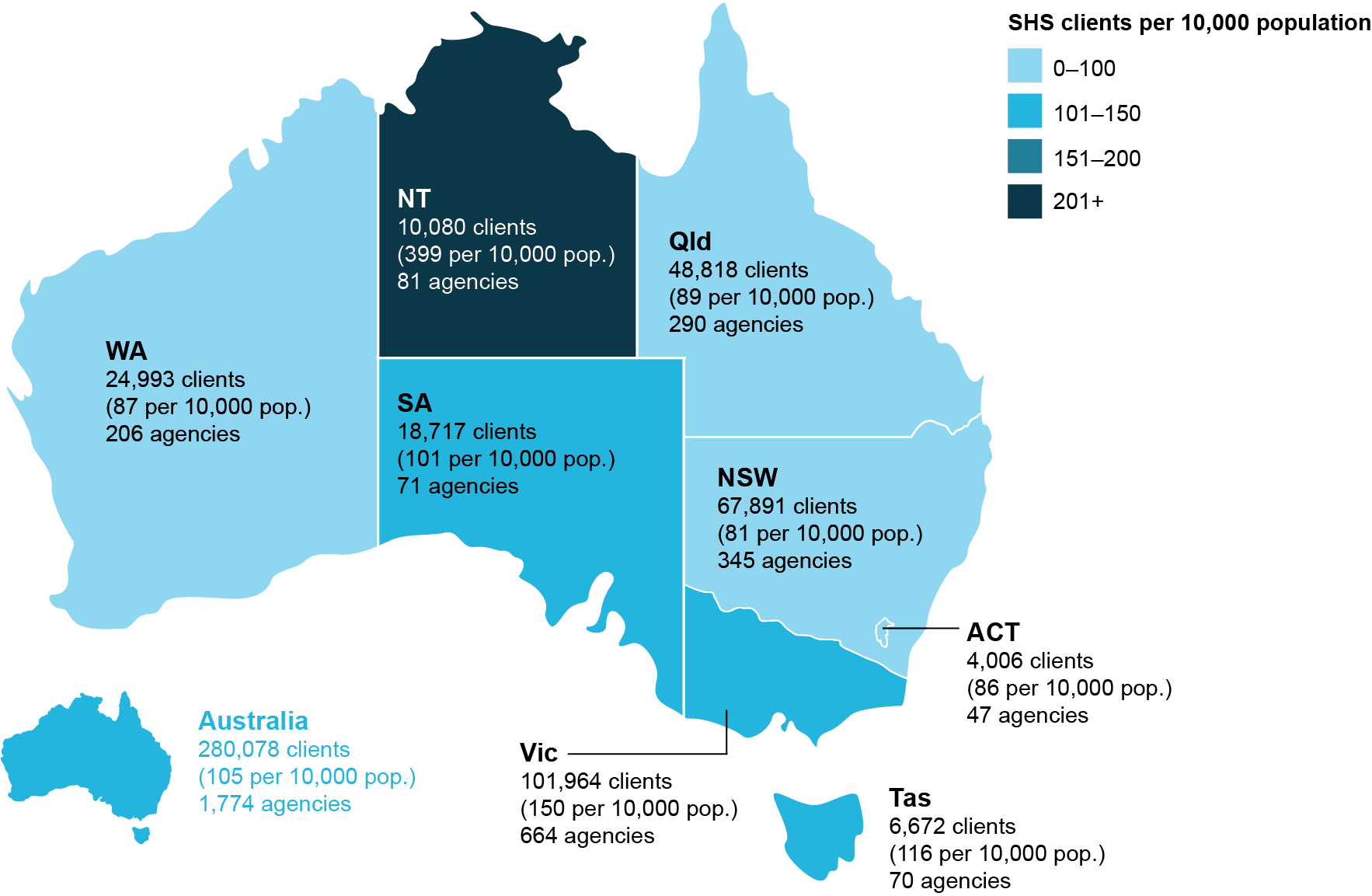
Notes:
1. Clients may access services in more than one state or territory, therefore the Australia total will be less than the sum of jurisdictions.
2. The agency count includes only those agencies that provided support periods with a valid Statistical Linkage Key (SLK).
Source: Specialist Homelessness Services Collection 2023–24.
SHS agencies vary in terms of the number of clients assisted, with some agencies assisting less than 100 clients per year and others assisting more than 1,500 people. Some agencies are represented by a larger ‘parent’ organisation while others are individual stand-alone agencies. The number of clients agencies assist (agency size) reflects the type and complexity of services provided, and differing state and territory service delivery models. Agency size is also influenced by specific jurisdictional factors such as the size and geographical distribution of their population.
In 2023–24, about half of all agencies assisted fewer than 100 clients (880 agencies or 50%) (Figure OVERVIEW.3). Agencies assisting a large number of clients (more than 1,500 clients) exist in all jurisdictions except New South Wales.
Figure OVERVIEW.3: Specialist homelessness agencies, by number of clients assisted and state and territory, 2023–24
Stacked bar chart shows the states with the largest numbers of agencies are Victoria (664) and NSW (345).

Specialist Homelessness Services and service delivery
Each state and territory manage their own system for the assessment, intake, referral and ongoing service management of SHS clients. Three distinct models of key delivery systems are presented below, however these systems represent a range of approaches that jurisdictions may take to coordinate entry to becoming an SHS client.
Changes in the delivery of services and their associated responses implemented by states and territories have the potential to impact SHSC annual data.
Box OVERVIEW.1
Community sector funding and support
- Assessment and intake: managed by individual SHS providers, consistent with state or territory policies.
- Referral: referral to other SHS providers if clients’ needs cannot be met by initial SHS provider.
- Can be supported by a coordinating service.
Central information management
- Assessment, intake and referral: managed at any SHS provider, via state or territory central information management tool.
- Central information management system assists in the identification of appropriate services and indicates the availability/vacancy of services at all SHS providers.
Central intake
- Assessment, intake and referral: managed by one or more ‘central intake’ agency.
- Central intake agencies prioritise access to services and only refer clients as services and/or vacancies are available.
- Central information management tool may exist to share information between SHS providers.
Once a person has contacted an agency, or a central intake service, specialist homelessness services can be provided, alternatively a client may be referred to another agency for a specific service (Figure OVERVIEW.4). In some instances, a client may not receive nor be referred for a service and their need remains unmet. These unmet needs are captured to assist in determining the ability of the sector to respond to client needs.
An Unassisted request for service is an instance where a person(s) approaches an agency and is unable to be provided with any assistance (see Data presentation and derivations). Limited data are collected about these occasions. The unassisted requests data does not reflect that some people may seek support from multiple different agencies on the same day, or that clients unassisted on one day may receive support on another day.
Figure OVERVIEW.4: Access to and delivery of Specialist Homelessness Services

Services provided by specialist homelessness agencies in all states and territories can be categorised as ‘accommodation services’ (either direct provision or referral of accommodation or assistance for the client to maintain housing) or ‘services other than accommodation’.
The proportion of SHS clients receiving accommodation services and services other than accommodation varied across states and territories in 2023–24 (Figure OVERVIEW.5):
- Almost 9 in 10 clients in Tasmania (87%) received accommodation services.
- Around two-thirds of clients in the Australian Capital Territory (66%), Western Australia (64%) and Queensland (64%) received accommodation services.
- The highest proportions of clients receiving services other than accommodation were in South Australia (55%), followed by New South Wales (49%) and Victoria (49%).
This variation likely reflects a combination of differences including the demand for accommodation services among SHS clients, differing service delivery models (that is, services delivered in a state/territory other than those provided through SHS agencies) and variable available housing options across jurisdictions (pathways out of homelessness) (Supplementary table OVERVIEW.3).
Figure OVERVIEW.5: Clients of Specialist Homelessness Services by service type, and state territory, 2023–24
Stacked bar chart shows the states with the largest proportion of accommodation services are Tasmania (86.7%) and ACT (65.8%).
