


Previously sentenced to supervision
Previous studies have shown a relationship between the likelihood of returning to sentenced supervision (and the criminal justice system more broadly) and offending history (Chen et al 2005; Lind 2011; Payne 2007; Payne & Weatherburn 2015; Stewart et al 2007). However, because offences are not captured in the YJ NMDS, it is not possible to fully explore the relationship in this report. Young people with no previous supervised sentences might still have had previous unsupervised sentences, and an offending history.
Previous supervised sentences and the type of sentenced supervision (that is, community-based supervision or detention) have a relationship to returning to sentenced supervision. Young people with prior supervised sentences were more likely to return to supervision within 6 or 12 months of release – whether from community-based supervision or detention – compared to those with no previous supervised sentences (Figure 2.10).
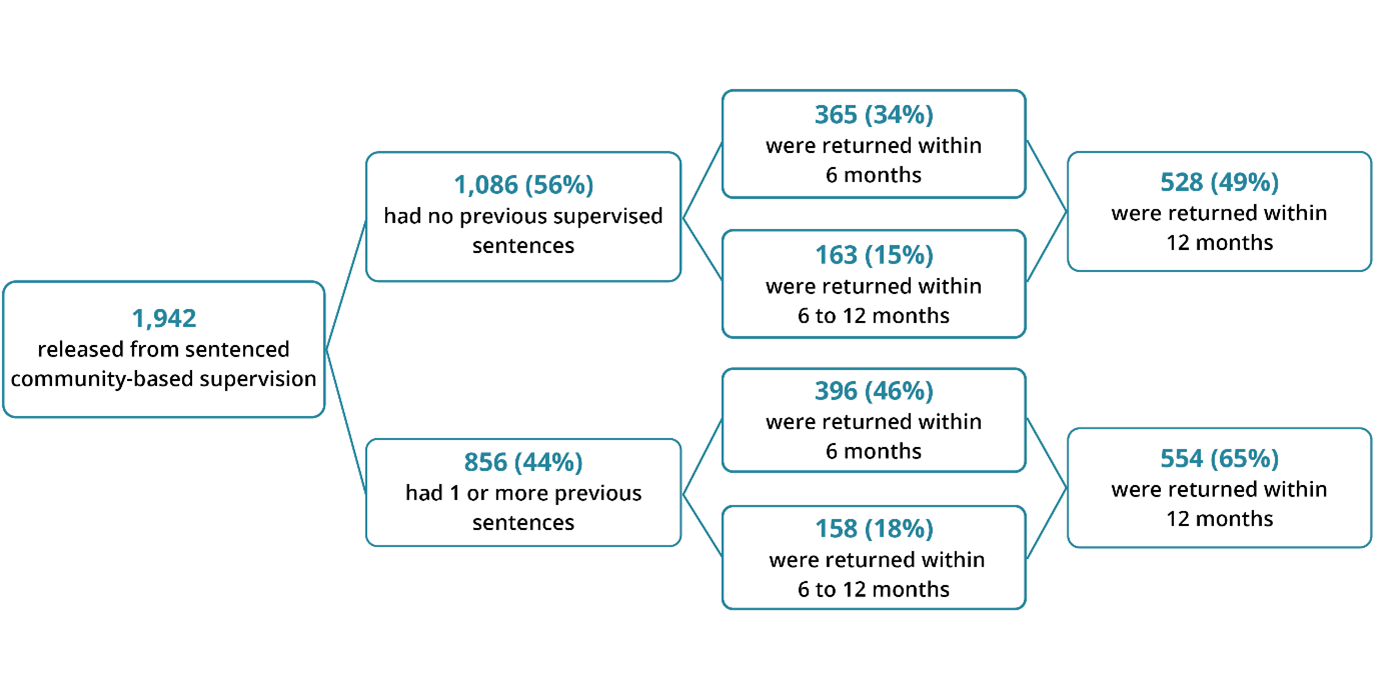
Of all young people aged 10–16 released from sentenced community-based supervision in 2022–23 (1,942), just over half (56%) had no previous supervised sentence (Table S11).
- Young people with one or more previous supervised sentences of any type were 1.3 times as likely as young people with no previous supervised sentences to receive another supervised sentence within 12 months (65% compared with 49%).
- The rate of returns within 6 months followed a similar pattern: young people with one or more previous supervised sentences were 1.4 times as likely as young people with no previous supervised sentence to receive another supervised sentence (46% compared with 34%) (Figure 2.8).
Figure 2.8: Young people released from sentenced community-based supervision in 2022–23 who were returned within 6 and 12 months, by number of previous supervised sentences
Notes:
- Data relate to young people aged 10–16 at the time of release, to allow a 12-month follow-up period.
- Data for young people who were returned within 12 months includes young people who were returned within 6 months.
- Northern Territory data was not available for young people released from sentenced supervision in 2022–23.
Source: Supplementary table S11.
Of the 309 young people released from sentenced detention, about 9 in 10 (91%) had at least one previous supervised sentence of any type and about 1 in 10 (9.4%) had no previous supervised sentence.
- Young people with at least one previous supervised sentence (including a previous supervised detention sentence) were 1.2 times as likely as people who had no previous supervised sentence to receive another supervised sentence within 12 months (85% compared with 72%).
- The rate of returns within 6 months was slightly lower: young people with at least one supervised detention sentence were 1.1 times as likely as young people with no previous supervised sentence to receive another supervised sentence within 6 months (70% compared with 66%) (Figure 2.9).
Figure 2.9: Young people released from sentenced detention in 2022–23 who returned within 6 and 12 months, by number of previous supervised sentences

Notes:
- Data relate to young people aged 10–16 at the time of release, to allow a 12-month follow-up period.
- Data for young people who were returned within 12 months includes young people who were returned within 6 months.
- Northern Territory data was not available for young people released from sentenced supervision in 2022–23.
Source: Supplementary table S11.
Figure 2.10: Young people released from sentenced supervision in 2022–23 who returned within 6 and 12 months, by number of previous supervised sentences and type of supervision
This chart shows that young people with prior supervised sentences were more likely to return to supervision within 6 or 12 months of release.

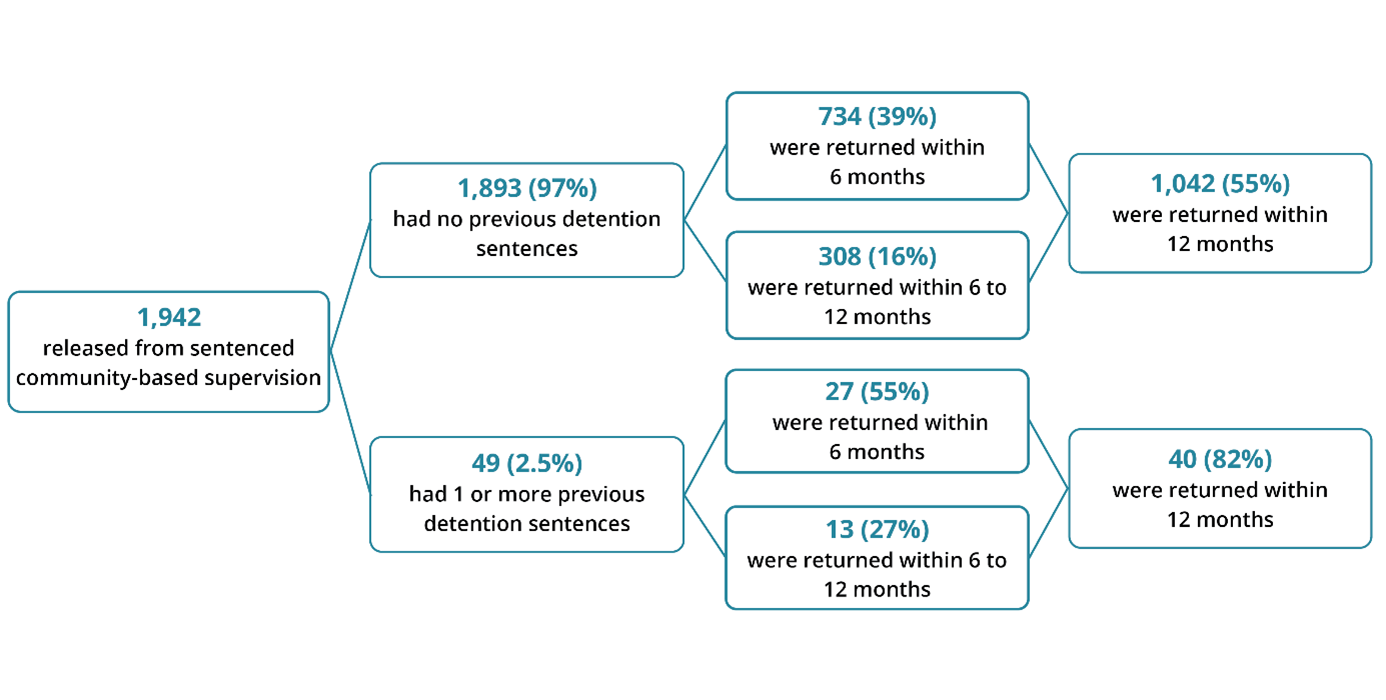
Of the 1,942 young people released from sentenced community-based supervision in 2022–23, 97% had no previous detention sentences and 2.5% had one or more. Young people released from sentenced community-based supervision with at least one previous detention sentence were 1.4 times as likely as young people who had no previous detention sentences to receive another supervised sentence within 6 months (55% compared with 39%) and 1.5 times as likely to receive one within 12 months (82% compared with 55%) (Figure 2.11, Figure 2.13).
Figure 2.11: Young people released from sentenced community-based supervision in 2022–23 who returned within 6 and 12 months, by number of previous detention sentences
Notes:
- Data relate to young people aged 10–16 at the time of release, to allow a 12-month follow-up period.
- Data for young people who were returned within 12 months includes young people who were returned within 6 months.
- Northern Territory data was not available for young people released from sentenced supervision in 2022–23.
Source: Supplementary table S12.
Of the 309 young people released from sentenced detention, more than half (60%) had no previous supervised sentences of detention. Young people with no previous detention sentences were more likely to receive another supervised sentence than those who previously received a detention sentence, both within 6 months (74% compared with 64%) and 12 months (86% compared with 82%) (Figure 2.12, Figure 2.13).
Figure 2.12: Young people released from sentenced detention in 2022–23 who returned within 6 and 12 months, by number of previous detention sentences

Notes:
- Data relate to young people aged 10–16 at the time of release, to allow a 12-month follow-up period.
- Data for young people who were returned within 12 months includes young people who were returned within 6 months.
- Northern Territory data was not available for young people released from sentenced supervision in 2022–23.
Source: Supplementary table S12.
Figure 2.13: Young people released from sentenced supervision in 2022–23 who returned within 6 and 12 months, by number of previous detention sentences and type of supervision release
This bar graph shows that young people released from sentenced detention, who did not have a previous sentence of detention were more likely to return within 6 months.
