


Technical notes
Overarching methods
General methods for estimation of burden of disease can be found in Australian Burden of Disease Study: methods and supplementary material 2018 (AIHW 2021b). This includes descriptions for years of life lost (YLL), years lived with disability (YLD), disability-adjusted life years (DALY) and health-adjusted life expectancy (HALE).
How the Australian Burden of Disease Study 2024 differs from previous studies
The 2003, 2011, 2015 and 2018 Australian Burden of Disease Studies (referred to as ‘major studies’) produced estimates for an agreed ‘reference year’. Due to the complex methods for deriving estimates and availability of key data sources there was a 3–4 year lag between the reference year and the year of publication of results. Following ABDS 2018, the AIHW has produced annual updates of national disease burden estimates projected to the year of publication (referred to as ‘nowcasting’) utilising the most recent updates for major data sources. This has enhanced the frequency and timeliness of the data and maximised the use of these estimates for policy development. ABDS 2022 and ABDS 2023 (referred to as ‘annual updates’) published estimates of disease burden for the nowcast years of 2022 and 2023 respectively.
The ABDS 2024 builds on work from the ABDS 2022 and ABDS 2023 to produce national disease burden estimates for the year of publication (2024) for 220 diseases and injuries. ABDS 2024 also includes estimates of attributable burden for 20 risk factors (last updated as part of ABDS 2018) in 2024 using a nowcast methodology for the first time for selected risk factors. This Study provides burden of disease and risk factor estimates best matched to the public health context for the Australian population for 2024.
Figure 5.1 shows some of the key methodological differences between previous studies and ABDS 2024. Each iteration of the ABDS (both major and annual updates) contains a full set of burden estimates regenerated for each cause for each major study year (2011, 2015 and 2018) using any updated input estimates and/or reference inputs. Estimates for 2003 have not been regenerated since the 2018 major update.
Figure 5.1: Australian Burden of Disease Studies: changes over time
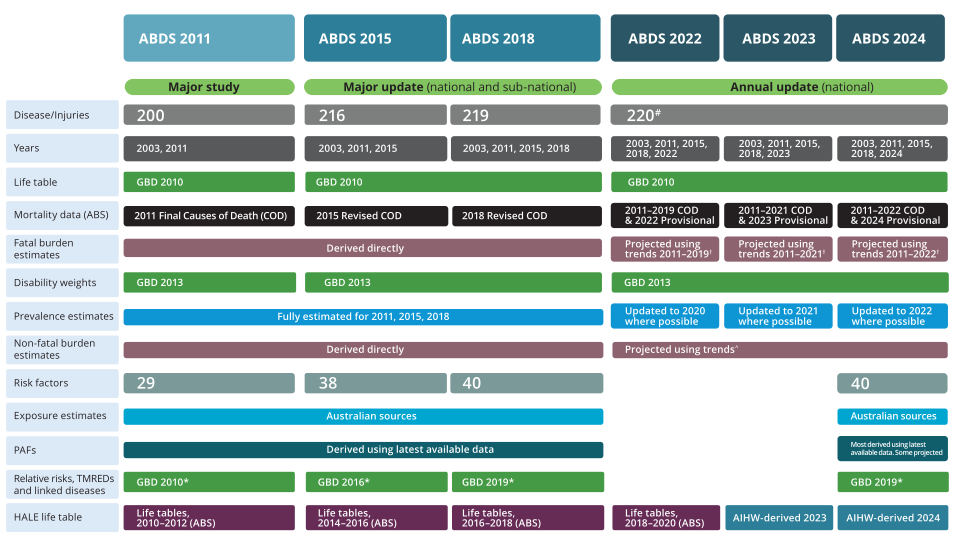 Notes:
1. #Includes COVID-19.
2. †Validated using Provisional Mortality Statistics (ABS) for available months of each year. For most causes, deaths in 2020 were excluded from the projection models.
3. ^Except COVID-19 and influenza estimates for which annual estimates are added and adjusted for co-morbidity separately. See Table S4 for projection model type and years included in ABDS 2024.
4. *Largely sourced from the Global Burden of Disease Study but supplemented by Australian-specific evidence where available.
5. Estimates are not to be compared across the studies due to different inputs and updates to methodology.
ABDS 2024 reports estimates for 2003, 2011, 2015, 2018 and 2024 for comparisons over time. Estimates for years prior to 2024 are either sourced from ABDS 2018 or have been revised to reflect updates in major data sources. The years included in trend analyses for projection models to estimate burden in 2024 may differ to these reporting years. Table S4 presents information about the years of data included in trend analyses for each disease or injury in ABDS 2024, as well as the type of projection model used.
Sex and gender data in ABDS
The ABDS presents results by male or female as this is what is currently recorded in the majority of the data collections used in the estimates. In some instances, male or female may refer to either sex or gender, depending on the data source. Due to small numbers, where sex or gender is included in datasets as a term other than male or female, this is not reported separately.
Population data
All Australian population-based rates for 2018 were calculated using populations rebased to the 2016 Census (ABS 2022).
Population-based rates for 2003, 2011 and 2015 were calculated using the latest available population estimates from the ABS.
Population data for 2024 were sourced from population projections by the Centre for Population (2022). The population under the ‘central scenario’ was used for this Study, which assumed overseas migration to Australia was significantly affected by the COVID–19 pandemic.
The 2001 Australian Standard Population was used for all age-standardisation, as per AIHW and ABS standards (ABS 2016).