


Summary

Living with illness or injury (non-fatal): 54% of total burden

Dying prematurely (fatal): 46% of total burden
Living with illness or injury caused more disease burden than dying prematurely. Between 2003 and 2024, there has been a moderate shift from fatal burden to non-fatal burden being the biggest contributor to total burden (Figure 1.1). This is mostly driven by fewer premature deaths in recent years.
Figure 1.1: Proportion (%) of total burden due to fatal and non-fatal burden in 2003 and 2024

Source: AIHW Australian Burden of Disease Database, Data tables.
To further explore the contribution of fatal and non-fatal burden over time, see the interactive data visualisations: Burden of disease in Australia and Fatal vs. non-fatal burden.
Long-term improvements in fatal burden but recent increases in non-fatal burden
Between 2003 and 2024 there was a 39% increase in the total number of DALY (from 4.2 million to 5.8 million) which was mainly due to increases in population size. After adjusting for population ageing, there was a 10% decline in the rate of total burden between 2003 and 2024 (Figure 1.2). This was driven by a 26% decrease in the rate of fatal burden, as the non-fatal burden rate increased by 7%. Note that when compared with 2018, rates for 2024 were higher for non-fatal, lower for fatal burden and similar for total burden after adjusting for age.
Figure 1.2: Change in the age-standardised total burden (DALY), fatal burden (YLL) and non-fatal burden (YLD) rate (per 1,000 population) between 2003 and 2024

Source: AIHW Australian Burden of Disease Database, Data tables.
Chronic diseases cause the majority of health burden
In 2024, the 5 disease groups causing the most burden were cancer, mental health conditions & substance use disorders, musculoskeletal conditions, cardiovascular diseases and neurological conditions (Table 1.1).
Together these disease groups accounted for around two-thirds (64%) of the total burden. These disease groups include mostly chronic, or long-lasting, conditions.
| Cancer | Mental health & substance use | Musculoskeletal | Cardiovascular | Neurological | |
|---|---|---|---|---|---|
| % of total DALY | 16.4 | 14.8 | 12.7 | 11.8 | 8.4 |
| % of DALY that was fatal | 91.3 | 1.8 | 2.9 | 75.0 | 49.8 |
| Change between 2003 and 2024(a) |  |  | | | |
(a) Based on the rate difference, that is, the absolute difference between the age-standardised rate of burden from 2003 to 2024.
Source: AIHW Australian Burden of Disease Database, Data tables.
To explore the contribution of fatal and non-fatal burden to total burden by disease group or by specific disease or injury, see the Fatal vs non-fatal burden interactive data visualisation.
Males and females experience disease burden differently
Overall and for most age groups, males experienced more total disease burden than females. This was driven by males having higher rates of fatal burden.
In 2024, the leading specific causes of total burden among males were coronary heart disease, back pain & problems and suicide & self-inflicted injuries (Figure 1.3). Among females, the leading cause was dementia, followed by anxiety disorders and back pain & problems.
Males experienced 3 times the amount of burden due to suicide & self-inflicted injuries and 2 times the amount of burden from coronary heart disease than females. Females experienced more burden than males from dementia and anxiety disorders.
Figure 1.3: Leading causes of total burden and proportion (%) of total burden by sex, 2024
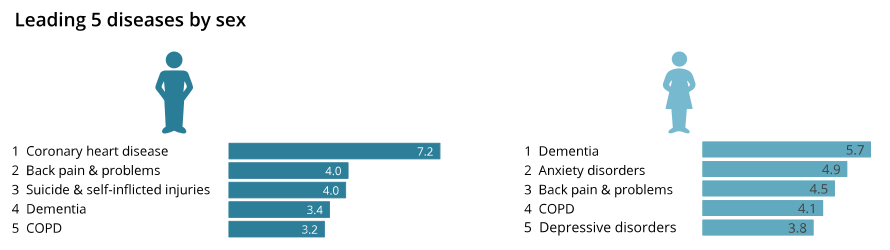
COPD = chronic obstructive pulmonary disease.
Source: AIHW Australian Burden of Disease Database, Data tables.
Changes in leading specific causes of burden over time
Between 2003 and 2024, the rate of total burden, after adjusting for age:
- decreased for coronary heart disease, stroke, rheumatoid arthritis, lung cancer and COPD.
- substantially increased for dementia, and its rank increased from the 12th leading cause of total burden in 2003 to the 5th leading cause in 2024. However, this increase is partly due to changes in practices of coding deaths due to dementia (see the Comparisons over time interactive data visualisation or refer to the Technical notes).
- increased for anxiety disorders, osteoarthritis, depressive disorders, suicide & self-inflicted injuries, back pain & problems and asthma.
Diseases that caused the most burden over the life course
Australians experience health loss from different diseases and injuries at various stages of life. Respiratory diseases caused burden throughout the life course, especially in children and older people. Mental health conditions & substance use disorders dominated the first half of the life course (ages 5–44), while musculoskeletal conditions, cardiovascular diseases and cancer feature more prominently in the latter part of the life course (ages 45 and over). Neurological conditions (namely dementia) are a leading cause of burden in older Australians (aged 65 and over).
For more information, see the interactive data visualisation: Leading causes of disease burden.
Australians living longer but no change in the proportion of life spent in full health
Australians are, on average, living longer and spending more years in full health (meaning no disease or injury). Years lived in full health is also referred to as health-adjusted life expectancy (HALE).
Males and females born in 2024 could expect to live an average of 88% and 86% of their lives in full health respectively (71.7 years of the 81.6 years of average life expectancy for males and 73.8 years of the 85.5 years of average life expectancy for females).
However, years lived in ill health are also increasing, resulting in no change in the proportion of life spent in full health between 2003 and 2024.
For further information about life expectancy, see: Life expectancy.
National Preventive Health Strategy 2021–2030: burden of disease targets
The National Preventive Health Strategy 2021–2030 (the Strategy) outlines the long-term approach to prevention in Australia. The Strategy aims to address the wider determinants of health, promote health equity and decrease the overall burden of disease through a whole-of-systems approach to prevention (Department of Health 2021).
There are 6 burden of disease specific targets in the Strategy. Data from the Australian Burden of Disease Study 2024 can be used to monitor 3 of these 6 targets which fall under the Strategy’s aims of 'all Australians have the best start in life', and 'all Australians live in good health and wellbeing for as long as possible'. An assessment of data reported for these 3 targets suggests there has been no change between 2018 (baseline year) and 2024 in the:
- proportion of the first 0–4 years lived in full health (around 92%)
- proportion of the first 25 years lived in full health (ranging between 91 and 92%)
- average number of years lived in full health (71 to 72 years for males and 74 years for females).
It should be noted that estimates for 2024 are projections so progress against the targets may change as 2024 data becomes available. COVID‑19’s impacts on burden and the health of the Australian population may also affect progress against these targets. More data points and further monitoring is required to determine if the targets set out in the Strategy can be achieved by 2030. For further information and data on the Strategy’s aims, targets and assessment of progress, including baseline data, see: National Preventive Health Strategy Monitoring Dashboard.
A large proportion of burden could be prevented
Over one-third (36%) of the total burden of disease in Australia in 2024 could have been prevented by reducing exposure to all the modifiable risk factors included in the Australian Burden of Disease Study 2024. This estimate has taken into account the complex pathways and interactions between diseases and risk factors.
Overweight (including obesity) has overtaken tobacco use as the leading risk factor
Overweight (including obesity) was the leading risk factor contributing to total disease burden in 2024 (8.3%). Prior to 2024, tobacco use had been the leading risk factor – there has been a substantial fall (41%) in the total burden attributable to tobacco use between 2003 and 2024, after adjusting for age.
The leading risk factors following overweight (including obesity) in 2024 were tobacco use (7.6%, excluding nicotine vaping), all dietary risks (4.8%), high blood pressure (4.4%) and high blood plasma glucose (4.2%) (Table 1.2). Tobacco use contributed the greatest amount of fatal burden and deaths in Australia while overweight (including obesity) contributed the most non-fatal burden in both males and females.
| Rank | Risk factor | % DALY | Risk factor | % YLL | Risk factor | % YLD |
|---|---|---|---|---|---|---|
| 1 | Overweight (including obesity) | 8.3 | Tobacco use(a) | 11.7 | Overweight (including obesity) | 7.1 |
| 2 | Tobacco use(a) | 7.6 | Overweight (including obesity) | 9.6 | Tobacco use(a) | 4.1 |
| 3 | Dietary risks | 4.8 | Dietary risks | 7.9 | High blood plasma glucose | 3.6 |
| 4 | High blood pressure | 4.4 | High blood pressure | 7.2 | Child abuse & neglect | 3.1 |
| 5 | High blood plasma glucose | 4.2 | Alcohol use | 5.4 | Alcohol use | 3.0 |
| All risk factors (joint effect)(b) | 35.8 | All risk factor (joint effect)(b) | 45.9 | All risk factors (joint effect) (b) | 27.2 |
- (a) Excludes nicotine vaping.
- (b) Includes all 20 risk factors.
Source: AIHW Australian Burden of Disease Database, Data tables.
The total burden attributable to the risk factors (the joint effect) included in this study was higher in males (38%) compared with females (33%). Risk factors with higher attributable burden in males compared with females included alcohol use, occupational exposures and hazards, illicit drug use and high cholesterol. Risk factors with higher attributable burden in females compared with males included iron deficiency, unsafe sex, bullying victimisation and intimate partner violence (only estimated in females).
To further explore leading risk factors, see the Burden attributable to risk factors interactive data visualisation.
After taking into account population growth and ageing, the rate of attributable burden due to overweight (including obesity) between 2003 and 2024 was similar. There was a large (41%) decline in the rate of attributable burden due to tobacco use over this period after adjusting for age.
There were also declines in the attributable DALY rate for some other risk factors including high blood pressure and high cholesterol (57% and 61% respectively between 2003 and 2024). The burden attributable to illicit drug use increased over this period (42% increase after adjusting for age).
To further explore changes in leading risk factors over time, see the Changes in risk factors over time interactive data visualisation.
Diseases and associated risk factors
Attributable burden reflects the direct link between a risk factor (for example, tobacco use) and a disease or injury outcome, referred to here as a linked disease (for example, lung cancer). Some risk factors had linked diseases across a large number of disease groups. Tobacco use, for example, contributed to the burden for 9 disease groups, including 36% of respiratory diseases, 15% of cancer, 5.1% of cardiovascular diseases, 2.6% of infectious diseases and 1.8% of endocrine disorders. All the risk factors combined (the joint effect) contributed substantially to the burden for endocrine disorders (96%), kidney & urinary diseases (73%), cardiovascular diseases (65%) and respiratory diseases (52%).
To further explore total burden for specific diseases attributable to risk factors, see the Diseases and associated risk factors interactive data visualisation.
Where do I go for more information?
For more information on the burden of disease in Australia, see:
- Australian Burden of Disease Study 2024 (this report) – Supplementary data tables
- Australian Burden of Disease Study 2018: Interactive data on disease burden:
- State and territory estimates
- Remoteness areas
- Socioeconomic groups including interactive data visualisations
- Australian Burden of Disease Study 2018: Interactive data on risk factor burden
- Australian Burden of Disease Study 2018: Interactive data on disease burden among Aboriginal and Torres Strait Islander people
- Australian Burden of Disease Study 2018: Interactive data on risk factor burden among Aboriginal and Torres Strait Islander people
- Australian Burden of Disease Study: impact and causes of illness and death in Aboriginal and Torres Strait Islander people 2018
- Australian Burden of Disease Study: Methods and supplementary material 2018.
For more on this topic, see Burden of disease.
References
Department of Health (2021) National Preventive Health Strategy 2021–2030, Department of Health, Australian Government, accessed 11 September 2024.