


Needs of tenants – amenities
Housing amenities influence a tenant’s exposure to cold, heat, damp, mould, pollutants, injuries and infectious diseases (Howden-Chapman et al. 2023), so are vitally important to improving social housing tenants’ standard of living.
Meeting tenants’ amenities needs such as thermal comfort, security, and modifications and fixtures for tenants with special needs as well as the overall quality of the property contribute to improvements to tenants’ health and wellbeing (Rolfe et al. 2020).
Measuring the extent to which tenants had their need for amenities met provides an insight into which amenities tenants had the greatest need for, and which amenities tenants were most satisfied with.
NSHS question about whether amenities meet tenants’ needs
Information about whether features of a tenant’s home meet their needs was obtained from responses to the following question:
For each of the following, are your needs met in your current home (including the needs of those who live with you).
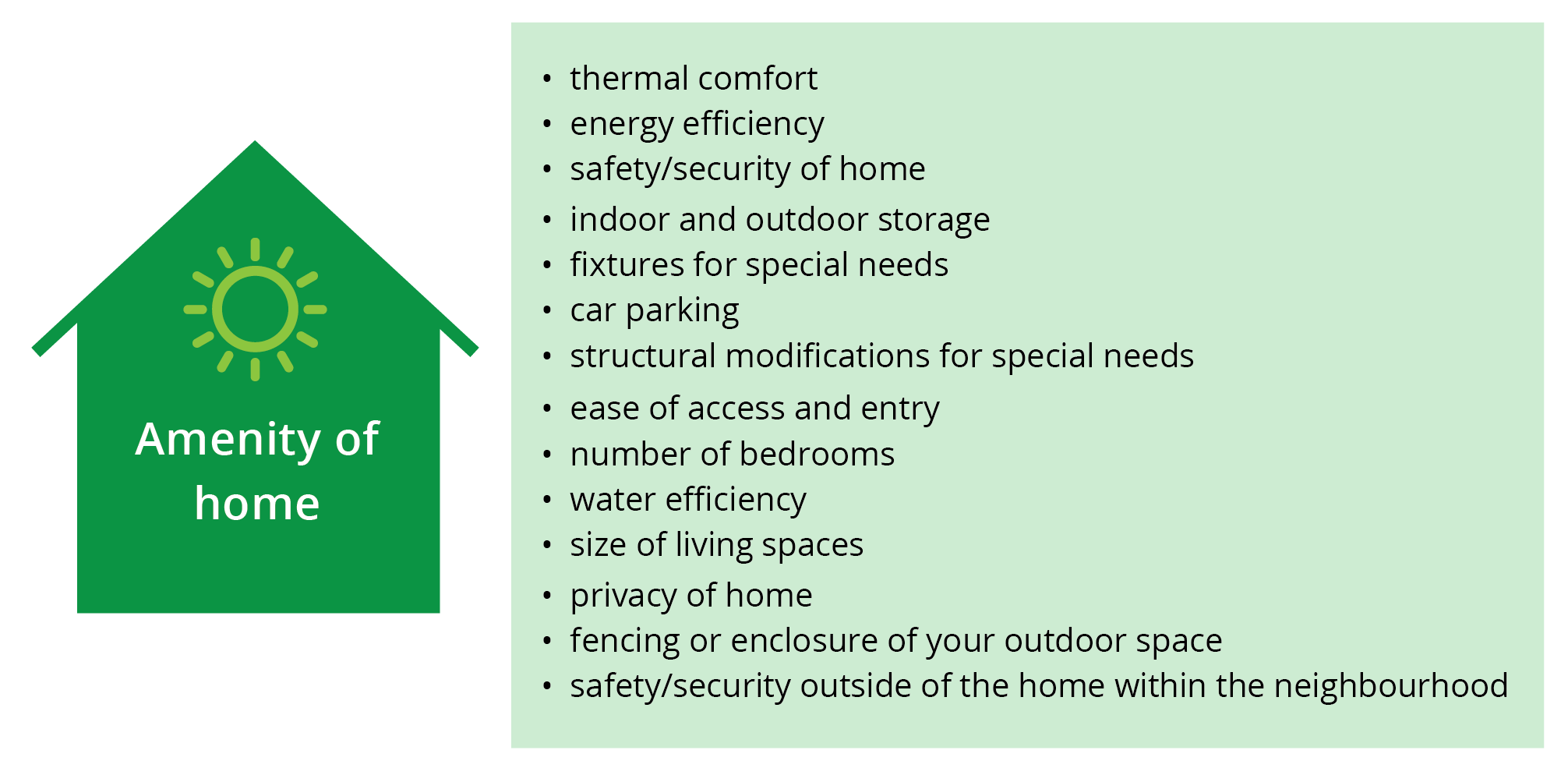
Respondents were asked to respond for a list of amenities (see illustration).
Figure Amenities of home.1: List of amenities that tenants were asked about in the survey
Amenities met the needs of most tenants in 2025
The majority of tenants reported that most of the features (that is, amenities) in their homes met the needs of their household (Figure Amenities.1, Table S3.1).
Although the rate of amenity needs met was high overall in 2025, there was variation between states and territories and housing programs and over time (Figure Amenities.1, Table S3.1). Nationally in 2025:
- the most commonly met amenity needs of public housing tenants were ease of access and entry (92%), access to outdoor space (91%), number of bedrooms (90%) and water efficiency (89%); the least commonly met amenity needs were outdoor storage (62%), indoor storage (70%) and thermal comfort (70%).
- among community housing tenants, the most commonly met amenity needs were ease of access and entry (93%), access to an outdoor space (92%), number of bedrooms and water efficiency (both 91%); outdoor storage (62%), indoor storage (74%), thermal comfort and safety/security within neighbourhood (both 75%) were the least met needs.
- the most commonly met amenity needs of SOMIH tenants were ease of access and entry (94%), access to an outdoor space (92%) and water efficiency (88%); outdoor storage and indoor storage (both 53%) and fencing or enclosure of outdoor space (59%) were the least met needs.
‘I was fortunate to move into a brand new unit with aircon, solar panels, a dishwasher, I was very lucky.’
‘Being able to raise and tend to a garden improves quality of and joy in life dramatically.’
Figure Amenities.1: Social housing tenants – needs met for an amenity (%), by social housing program, states and territories, 2025
This interactive horizontal bar graph shows the proportion of tenants whose needs were met by listed amenities, within each of the social housing programs over time. For Australia, ‘Ease of access and entry’ was the most commonly met tenant need in all social housing programs in all years.
