

Reported benefits of living in social housing
The key purpose of social housing is to provide affordable, safe and secure housing to some of the most vulnerable members of society who may otherwise struggle to access suitable housing (Freund et al. 2022). Living in social housing can lead to improved financial circumstances and for some, can improve physical safety by removing them from environments where they faced greater risk of physical harm (Taylor et al. 2023). Social housing often provides greater security of tenure, which has been found to have multiple benefits to both the individual, such as boosting economic mobility and improvements to physical and mental health, and to the broader community, such as fostering social cohesion and creating safer and better resourced communities (Bentley et al. 2025, Baumgartner et al. 2023).
To explore whether the social housing provided to tenants improved their health and wellbeing, tenants were asked about some of the benefits they perceived to gain from living in social housing.
NSHS question about benefits of social housing
Information about the benefits of living in social housing was obtained from responses to the following question:
For you, what are the benefits of living in social housing?
Survey respondents were asked to select Yes, it is a benefit, No, it is not a benefit or Not applicable from a list of nominated benefits.
The estimates presented in this chapter are the proportion of tenants who agree the nominated item is a benefit of living in social housing (after excluding those who answered ‘Not applicable’).
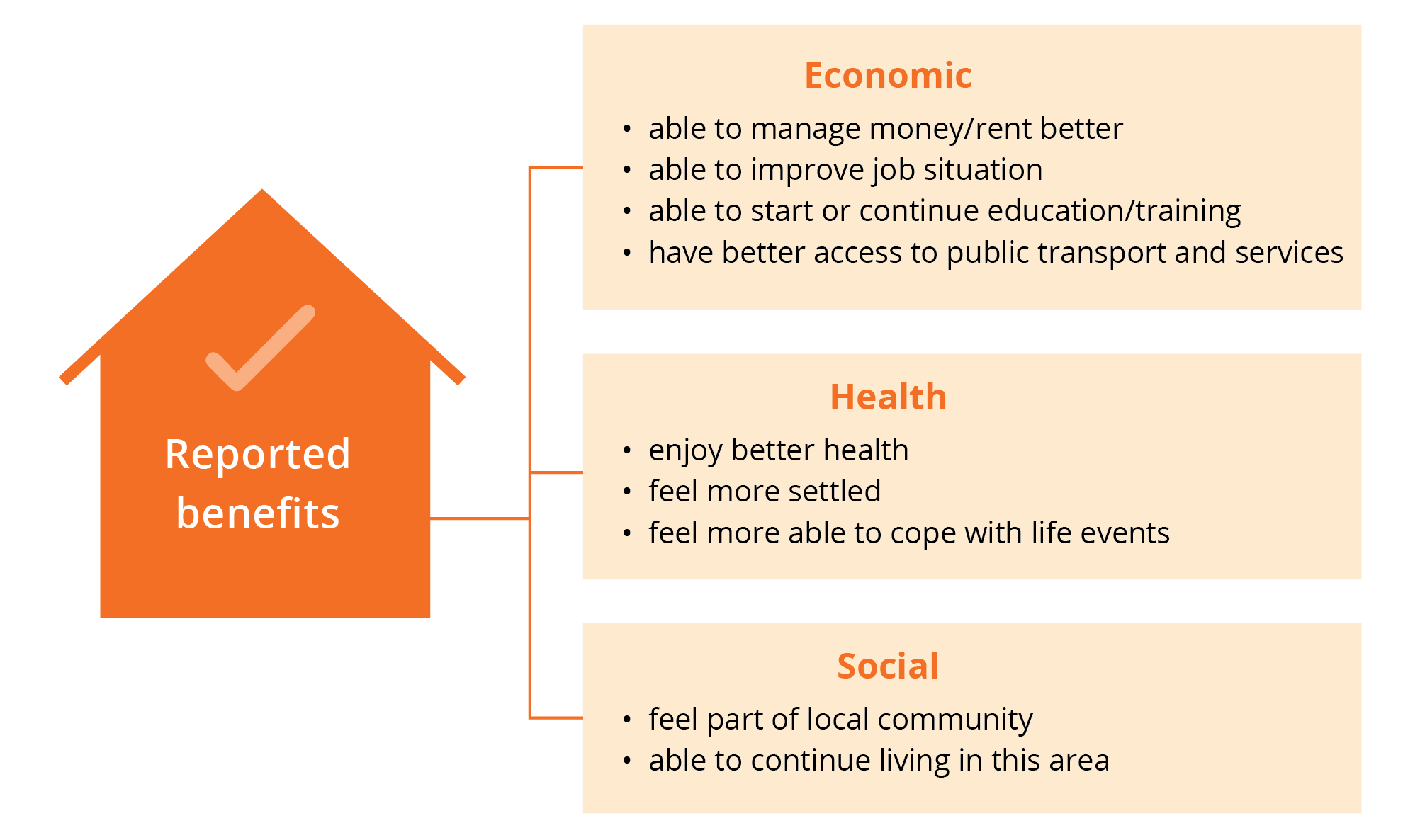
This section categorises the specific benefits surveyed into the following 3 broad life domains: economic, health and social (Figure Benefits.1), and reports some of the results relating to the specific benefits nominated in the questionnaire.
Figure Benefits.1: Life domains included in the National social housing survey
Tenants gained economic, health and social benefits
In 2025, around 80% of tenants reported benefits across all life domains – economic, social and health. However, tenants reported benefits across 2 domains more often than 3 (Figure Benefits.2, Table S2.1). Nonetheless, almost all tenants reported gaining at least one broad benefit from living in social housing – be it economic (97%), health (96%) or social (92%).
‘Able to balance day to day living expenses plus living among some lovely neighbours.’
‘Reduced anxiety because public housing is more stable for myself and my children.’
‘Staying close to support network is of a great benefit.’
‘Safe place, place to call home, affordable rent, a place to develop a garden, improve skills, make things, fix small jobs, for example., replacing tap washer, relaxing, a home to invite family and friends!’
Figure Benefits 2: Benefits of living in social housing by program and broad category, 2025
Interactive bar chart shows reported benefits of social housing in 2025 by program. Economic and health benefits are most common, while combined economic, health and social benefits are less common.
| Benefit type | Benefits |
|---|---|
| Economic | 97.1 |
| Health | 96.1 |
| Social | 91.9 |
| Economic and health | 87.2 |
| Economic and social | 84.6 |
| Health and social | 83.7 |
| Economic, health and social | 79.9 |
| Benefit type | Benefits |
|---|---|
| Economic | 97.4 |
| Health | 96.4 |
| Social | 92 |
| Economic and health | 87.1 |
| Economic and social | 84.5 |
| Health and social | 83.5 |
| Economic, health and social | 79.7 |
| Benefit type | Benefits |
|---|---|
| Economic | 96.3 |
| Health | 95.3 |
| Social | 91.3 |
| Economic and health | 86.9 |
| Economic and social | 84.1 |
| Health and social | 83.2 |
| Economic, health and social | 79.4 |
| Benefit type | Benefits |
|---|---|
| Economic | 97 |
| Health | 95.9 |
| Social | 94.1 |
| Economic and health | 93.8 |
| Economic and social | 91.7 |
| Health and social | 91.6 |
| Economic, health and social | 90.3 |
- The 'Economic benefits' category includes 'Able to manage rent/money better', 'Feel more able to improve job situation', 'Feel more able to start or continue education/training', 'Have better access to services', 'Have better access to public transport'.
- The 'Health benefits' category includes 'Feel more settled', 'Enjoy better health', 'Feel more able to cope with life events'.
- The 'Social benefits' category includes 'Feel part of the local community', 'Able to continue living in this area'.
- Respondents could report more than one benefit of living in social housing and may be assigned to more than one broad category of benefit type.
Source:
AIHW National Social Housing Survey 2025. Supplementary Table S2.1
Although the reported benefits of living in social housing were relatively similar across states and territories as well as all 3 housing programs, SOMIH tenants generally reported benefits across all domains and combinations of domains at a higher proportion than the other housing programs (Figure Benefits 3.1, Table S2.1).
Across all the housing programs, the most common benefits for tenants were ‘feeling more settled’ (95%), ‘being able to manage rent/money better’ (94%), and ‘able to continue living in the area’ (91%) (Figure Benefits.3, Table S2.2). The least common benefit tenants reported across all programs was ‘feeling more able to start or continue education/training’ (75%), and ‘feeling more able to improve their job situation’ (70%).
‘This have been my home over 30 years, I feel safe and independent with all essential services within walking distance. Multiple public transports options means give me access to markets and health services since I do not drive.’
‘It puts my mind at ease knowing I'm in a stable home environment. That I don't have to leave or worry about a roof over my head. I'm grateful for this. Also, I can do some gardening to relieve my stresses in life when I have the time.’
‘I can manage to pay for what I need most, from having cheap & stable accommodation & not needing to worry, reduces my stress levels. I was homeless for 5 years prior, it had a huge effect.’
‘Rent stays at a steady income for me. And I feel settled that this is my house and I won't be removed without reasons.’
Figure Benefits.3: Benefits by housing program, states and territories, 2025
This interactive bar chart shows specific benefits experienced by tenants within each of the social housing programs over time within each state and territory. The highest proportion of tenants across all programs in 2023 reported feeling more settled, followed by being able to manage rent and money better.
Tenants in outer regional and remote areas felt various psychosocial benefits
‘Have a stable fixed address. Have shelter from rain and sun. More comfortable and safer than sleeping rough or in a warehouse, et cetera. More privacy. Less noise, less dirt. Somewhere to safely lock up my belongings, stop intruders bothering me, et cetera.’
‘Quite area and I feel very safe I know my neighbours and they are there to help me when needed.’
Tenants living in outer regional and remote and very remote areas felt ‘more able to improve job situation’ (74% and 77%, respectively) and ‘enjoy better health’ (84% and 90%, respectively) at significantly higher proportions than those living in other areas and reported ‘better access to public transport’ (79% and 70%, respectively) at a significantly lower proportion compared with tenants in other areas.
Figure Benefits.4: Benefits by social housing program and remoteness area, 2025
This interactive bar chart shows specific benefits experienced by tenants within each of the social housing programs by remoteness area. For all remoteness areas across all housing programs in 2023, tenants reported feeling more settled, and being able to manage rent and money better as their top 2 benefits.
Tenants reported other benefits
Tenants were provided an option to report any additional benefits they felt as a result of being in social housing. Many of the comments reiterated benefits of the 3 broad life domains (see Figure Benefits 1), with tenants commenting about the positive impact housing stability had on their overall wellbeing. This included being able to avoid homelessness, improved mental health and improved family relationships.
‘This has allowed me to finally address my situation with domestic violence. I have the resources, time and opportunity to finally deal and heal with the physical, emotional, mental, financial and spiritual poor health it caused. I get to enjoy making connections in the community with a sense of safety and not of shame.’
‘I have permanent disability as well as my son who lives with me. Our medical services are just across the road which is wonderful. We have an ACROD card which our support workers can use and help us access the community. We have Physio and OT therapy which comes to us.’
‘I raised my grandchildren and having this house was great. I got them when they were three and I got this house. They are 23 now.’
Aubry, T, Bloch, G, Brcic, V, Saad, A, Magwood, O, Abdalla, T, Alkhateeb, Q, Xie, E, Mathew, C, Hannigan, T, Costello, C, Thavorn, K, Stergiopoulos, V, Tugwell, P, and Pottie, K, (2020). ‘Effectiveness of permanent supportive housing and income assistance interventions for homeless individuals in high-income countries: a systematic review’. The Lancet. Public health, 5 6, pp. e342-e360 . doi: 10.1016/s2468-2667(20)30055-4.
Baumgartner J, Rodriguez J, Berkhout F, Doyle Y, Ezzati M, Owuso G, Quayyum Z, Solomon B, Winters M, Adamkiewicz G and Robinson BE (2023) ‘Synthesizing the links between secure housing tenure and health for more equitable cities’, Wellcome Open Research, 7, 18, doi:10.12688/wellcomeopenres.17244.2.
Bentley, R, Mason, K, Jacobs, D, Blakely, T, Howden-Chapman, P, Li, Adamkiewicz, G. and Reeves, A, (2025). ‘Housing as a social determinant of health: a contemporary framework’. The Lancet Public Health, 10(10), pp.e855-e864.
Cheshire L, Pawson H, Easthope H and Stone W (2014) ‘Living with place disadvantage: community, practice and policy’, AHURI Final Report No. 228, AHURI, Melbourne.
Freund M, Sanson-Fisher R, Adamson D, Norton G., Hobden B and Clapham M (2022) ‘The wellbeing needs of social housing tenants in Australia: an exploratory study’, BMC Public Health 22, 582, doi:10.1186/s12889-022-12977-5.
Holding E, Blank L, Crowder M, Ferrari E and Goyder E (2020) ‘Exploring the relationship between housing concerns, mental health and wellbeing: a qualitative study of social housing tenants’, Journal of public health, 42(3):e231–e238, doi:10.1093/pubmed/fdz076.
Muir K, Powell A, Flanagan K, Stone W, Tually S, Faulkner D, Hartley C, and Pawson H (2020) ‘A pathway to where?’ Inquiry into understanding and reimagining social housing pathways’, AHURI Final Report No. 332, AHURI, Melbourne, doi:10.18408/ahuri-7118001.
Ong R, Singh R, Baker E, Bentley R and Hewton J (2022) ‘Precarious housing and wellbeing: a multidimensional investigation’, AHURI Final Report No. 373, AHURI, Melbourne, doi:10.18408/ahuri8123801.
Pawson H, Milligan V and Yates J (2020) Housing Policy in Australia: A Case for System Reform, Palgrave Macmillan, Singapore.
Taylor S, Johnson G, Watson J and Tyrrell E (2023) ‘Healthy, happy and housed? 12-month results from a longitudinal study of new social housing tenants’, Union Housing Research Lab, Melbourne.