


Defining disability
In Australia, many data collections identify disability based on concepts from the World Health Organization’s (WHO) International Classification of Functioning, Disability and Health (ICF).
The ICF defines a person’s functioning – body functions and structure, activities, and participation – as a dynamic interaction between health conditions and environmental or personal factors (Figure ABOUT.2; WHO 2002).
Disability is an umbrella term for any or all of the following:
- impairments – differences in body function or structure
- activity limitations – difficulties in executing activities
- participation restrictions – barriers or restrictions a person may experience when engaging in various life situations.
Disability is an outcome of interaction between a person’s health condition(s) and personal and environmental factors.
People with disability experience different degrees of impairment, activity limitations and participation restrictions. Disability can be related to genetic disorders, illnesses, accidents, ageing, injuries, or a combination of these factors. Importantly, how people experience disability is affected by both personal and environmental factors. Environmental factors include things like community attitudes, accessibility of buildings and facilities, and available opportunities, services and supports. Personal factors include things like age and gender, life events and experiences, education and socio-economic status.
Figure ABOUT.2: International Classification of Functioning, Disability and Health
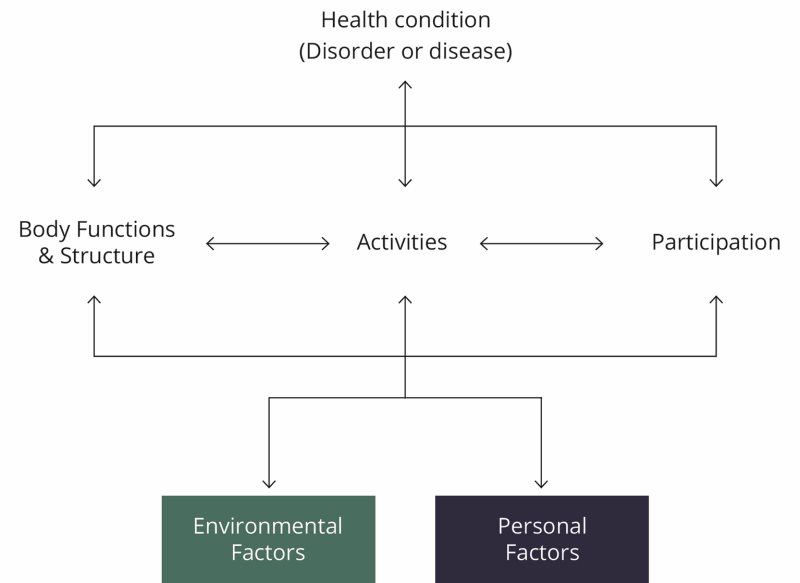
Source: Modified from WHO 2002.
The definition and identification of disability used in each data collection can vary, depending on the collection’s type and purpose. For example:
- The Australian Bureau of Statistics (ABS) Survey of Disability, Ageing and Carers (SDAC) uses a comprehensive set of questions to identify disability and is considered the gold standard of disability identification in Australia.
- Other ABS surveys, such as the National Health Survey, use a shorter set of questions to identify disability (the Short Disability Module).
- The NDIS bases eligibility on a narrower concept of disability which involves significant impairment to a person’s functional capacity.
- Some data collections, such as on hospital admissions, do not identify disability at all.
The data collections that capture disability information may also identify different characteristics of disability. These could include type of disability (such as sensory, physical, or psychosocial) or needs for support (how much of a restriction, difficulty, or need for aids or assistance a person may have). The degree of support is needed due to disability is also sometimes called severity of disability.
This report uses the definitions of disability and disability characteristics as specified in each data source. The Data sources section of this report provides these definitions for each data source used in the report, along with information on the in-scope population. This information is also summarised in Data table: Definitions of disability (available from Data tables).
Differences in definitions across data sources can make it difficult to compare data from different data collections (for more information, refer to Key data gaps).