


What can be done to improve the evidence?
Priority themes to improve the evidence base
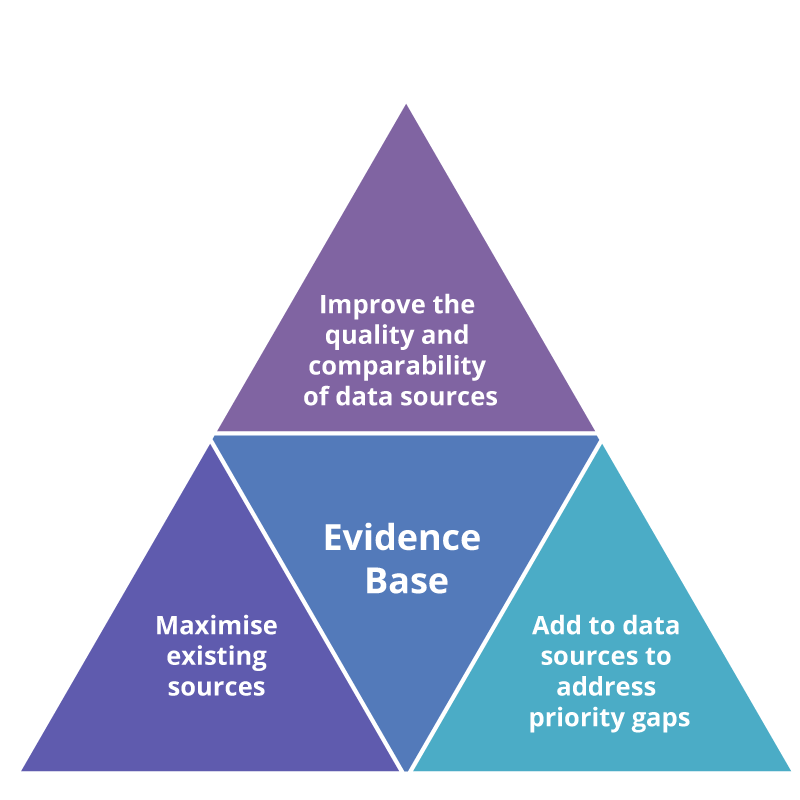
A useful framework for improving data is presented in Figure DATA.1. It involves making improvements in 3 key areas:
- maximising the use of existing data sources
- improving the quality and comparability of data across data sources
- adding to data sources, including by developing new data sources in priority areas and through data linkage.
Figure DATA.1: Priority themes to improve the evidence base for people with disability
Source: Adapted from Diagram 8 in ABS 2013.
Importantly, data gaps or issues should not prohibit reporting on what is available. Instead, data limitations should be acknowledged, and data agencies should work together to continually improve data availability and quality.
Maximise the use of existing data sources
Bringing together information from multiple data sources helps support a person-centred, whole-of-system view of the experiences of people with disability in Australia. This provides a more comprehensive picture than is possible by relying on any one data source.
Examples of national reporting and associated frameworks that draw on multiple sources to understand the experiences of people with disability are:
- this report
- reporting against the Australia’s Disability Strategy 2021–2031 Outcomes Framework
- the Report on Government Services (SCRGSP 2026)
- the disability and wellbeing monitoring framework and indicators developed by the Centre of Research Excellence in Disability and Health (Fortune et al. 2020).
Such national reports complement the large body of research on the experiences of people with disability in Australia and reporting at state and territory levels. However, much greater gains in understanding can come from sharing existing data sources, particularly through data linkage.
Improve the quality and comparability of data sources
Many different agencies and sectors collect information about people with disability, including:
- AIHW
- Australian Bureau of Statistics (ABS)
- Department of Health, Disability and Ageing (DHDA)
- Department of Social Services (DSS)
- National Disability Insurance Agency (NDIA)
- NDIS Quality and Safeguards Commission.
Each data collection may have its own approach to defining disability, reflecting the role of the collecting agency and the purpose of the collection. These differences can make it difficult to compare data from different collections.
Mainstream services – which cater to all people regardless of their disability status, such as schools, hospitals, and housing – also collect valuable information about their customers or clients. However, it is not always possible to identify records of people with disability in these data collections.
The quality and comparability of existing data sources could be improved by:
- harmonising how disability is captured in different data collections
- adding a disability flag in mainstream data collections – a standard set of questions to identify people with disability and the level of their disability.
These 2 options come with issues to consider. These include privacy implications, the role of (and the burden on) service providers, and the associated costs of data collection.
Given these issues, there is a growing view that data sharing and linkage, which could accommodate different definitions of disability and develop more consistent disability flags, is a practical way forward. Section ‘Safely share and link data to better understand pathways and outcomes’ below has more information on this, especially in relation to the National Disability Data Asset.
Harmonising definitions of disability across data sources
The definition of disability in a data source depends on the source’s purpose and how the data is collected. These considerations shape the questions used to determine if a respondent or a service user has disability. As a result, definitions of disability vary across population surveys and administrative data.
It is not always possible to perfectly align existing definitions of disability across data sources. With careful analysis and reporting, it may be possible to manage these differences. However, strategies to improve the consistency of definition and coverage between sources of data should also be considered. The World Health Organization’s International Classification of Functioning, Disability and Health (ICF) is an international standard framework and classification system, and provides a valuable basis for disability data development.
Adding a disability flag in mainstream data sources
The inclusion of a 'disability flag' in a data collection enables researchers to know which records within the collection belong to people with disability. This can reduce the need for new data sources.
An example of such flag is the standardised disability flag. This flag represents a set of questions about whether a person has difficulty or needs support with various everyday activities. These questions are based on the ICF and are broadly consistent with the ABS Short Disability Module (ABS 2025). Versions of the flag have been implemented in the AIHW’s Specialist Homelessness Services Collection (SHSC), the National Social Housing Survey, and National Prisoner Health Data Collection.
Another useful flag is the National Disability Insurance Scheme (NDIS) participation indicator, such as used within the SHSC. This flag can be used to look at the use of mainstream and other services by NDIS participants. Together with the standardised disability flag, it could be used to examine differences in the use of mainstream services between NDIS participants and other people with disability.
In its final report, the Royal Commission recommended that disability flags are included in data collections for key mainstream services (DRC 2023).
Add to data sources to address priority gap areas
Data gaps can also be addressed by:
- enhancing existing data sources by improving coverage and refining or adding data items
- enabling safe data sharing and linkage
- creating new data sources to fill priority gaps.
Enhance existing data sources
Existing data sources could be improved to better capture diversity and intersectionality in the disability population.
One way to improve a data source is to make it more accessible by introducing hybrid modes of data collection. Hybrid modes of data collection – such as combining face-to-face, telephone, and online methods – are more flexible and user-friendly and can help reduce respondent burden. One example of this is the Survey of Disability, Ageing and Carers which introduced the option of online questionnaire for the first time in 2022.
Existing data collections can also be improved by standardising how they capture diverse groups within the disability population. As highlighted above, key data gaps exist for people with disability who are Aboriginal and/or Torres Strait Islander, come from culturally and linguistically diverse backgrounds, or identify as LGBTIQ+. Having consistent agreed methods of identifying these groups in data collections can help ensure high data quality, improve comparability, and provide a more accurate picture of the needs of these groups.
Examples of standardised items that are being introduced in various survey and administrative data collections include the ABS data standards, such as:
- the Indigenous Status Standard (ABS 2014)
- the standards for statistics on cultural and linguistic diversity (ABS 2022)
- the Standard for Sex, Gender, Variations of Sex Characteristics and Sexual Orientation Variables (ABS 2020).
The new Occupation Standard Classification for Australia (OSCA) (ABS 2024) will allow more accurate reporting on disability workforce.
Safely share and link data to better understand pathways and outcomes
Safely sharing data for statistical purposes, including for data linkage, could lead to major improvements in understanding the experience of people with disability in Australia.
Many government agencies and organisations already have arrangements in place to share and release data in ways that support privacy and confidentiality of information. However, some data collected about people with disability are not widely available for use or sharing. These include, but are not limited to, data collected by non-government organisations but not collated for national analysis.
Improving the ability to access these data sources would assist in expanding the evidence base, particularly in understanding other services people with disability use.
Some benefits of data sharing cannot be realised without data linkage. For example, without data linkage it is difficult to see how different specialist disability support systems interact, such as how the NDIS interacts with other specialist disability services. It is also difficult to understand how these specialist disability services interact with mainstream supports.
What is data linkage?
Data linkage (also called data matching, data integration or record matching) combines information from multiple data sources while preserving privacy. This tells a much more powerful story than is possible from individual data sources in isolation.
Examples of improving the evidence base through data linkage
Data linkage can be used in many ways to improve the evidence base about people with disability, for example linking:
- disability support services and payments data to national hospital data, the Medicare Benefits Schedule and the Pharmaceutical Benefits Scheme – to provide insights into how people with disability use mainstream health services, and how these services complement specialist disability supports
- disability support services data to aged care and mental health data – to help improve understanding of how these sectors interact
- employment services data (including specialist disability employment services) with income support payments data – to provide information about the relationship between seeking employment and income support.
Linked data assets supporting disability research
Some examples of linked data assets that are being used for disability research include:
- Person Level Integrated Data Asset (PLIDA) – which combines information on health, education, government payments, income and taxation, employment, and population demographics (including the Census) over time.
- National Health Data Hub (NHDH) – which brings together a wealth of health-related information, including hospital and emergency department services, data on medications, use of health services, aged care, deaths, and immunisation.
The disability-related research using these data assets is carried out under disability and community co-governance provisions.
While data linkage is a powerful tool, it still has its challenges. These include lack of consistent linkage information across administrative systems in Australia, and complexities in data sharing and access arrangements. Data sources often need extensive ‘data cleaning’ before linkage, for example when different data ‘rules’ have been applied to seemingly similar data items in different sources. Finally, findings from the analysis of linked data need to be carefully reviewed to ensure privacy is protected. All these can make the data linkage complex, time-consuming, and costly.
The Australian and state and territory governments are working together with people with disability and the wider disability community on the National Disability Data Asset (NDDA). The NDDA brings together de-identified information from different government agencies about all Australians. These data will help us better understand experiences of people with disability and give us more information about programs and services used by people with disability.
The first step to achieving this purpose is through the development of disability indicators, or flags. These flags are constructed within the NDDA using disability-relevant information from various data sources. The flags have been developed in consultation with people with disability and their representatives, and will continue to be improved throughout the lifetime of the NDDA. More information about the disability flags can be found in Measuring disability factsheet (NDDA).
Insights from the National Disability Data Asset are shared in accessible formats on the data asset’s website (available at Insights (NDDA)).
Create new data sources where no data currently exist
When no data exist on a particular topic, or about a specific population, new data collections may need to be developed.
One area where new data collection is needed is disability services provided outside the NDIS. Before the NDIS, data about specialist disability services was collated in the AIHW’s Disability Services National Minimum Data Set (DS NMDS). The DS NMDS was last collated in 2018–19. After this, no national data have been available on services outside the NDIS, apart from disability employment services.
While the NDIS is a large scheme, it cannot provide all specialist disability supports to all people with disability. The Australian and state and territory governments are planning to introduce Foundational Supports to provide specific supports to people with disability outside the NDIS. The first phase of Foundational Supports, known as ‘Thriving Kids’, will start providing services from 1 October 2026. It is expected that the program will be supported by a data collection to evaluate and monitor its roll-out.
An example of a recent new survey data collection is the Australia’s Disability Strategy Survey (ADS Survey). The ADS Survey reports on community attitudes towards disability. The survey is part of Australia’s Disability Strategy 2021–2031 and is run by the Department of Health, Disability and Ageing. The aim of the survey is to collect data about disability awareness and attitudes in key service sectors (such as education and health care) and in the broad community. The survey also asks people with disability about their experiences when interacting with the services and being in the community. Reports on the survey can be found at Australia’s Disability Strategy Hub – Data and Research.