About this report
Disability affects many people, directly or indirectly. It may have large or small effects on people’s daily lives. Increasingly, disability is recognised as something that affects most people, to varying degrees and at different life stages.
Capturing the diverse experiences of people with disability in a reporting context is challenging. People with disability are not a homogeneous group. They have different types of disability and different support needs; come from all demographic and socioeconomic groups; and interact with every aspect of life in Australia. In addition, data collections, services and programs may have differing views of what disability is and how to best capture it in data.
This report is the latest in the series first released in September 2019. It presents key statistics about experiences and outcomes of people with disability in health, housing, education, employment, justice and safety, and social inclusion and support. In drawing this information together, the report also highlights Key data gaps.
This report is part of a wider system of data and reporting about people with disability in Australia. As such, rather than duplicate other efforts, it refers readers to other resources throughout. These include:
- Reporting on Australia’s Disability Strategy 2021–2031– reporting and tracking the progress of measures in Australia’s Disability Strategy Outcomes Framework
- Productivity Commission’s annual Report on Government Services – information on equity, effectiveness and efficiency of government services in Australia relating to people with disability
- National Disability Insurance Agency’s (NDIA) quarterly reporting on the National Disability Insurance Scheme (NDIS) – information on the NDIS in each jurisdiction.
The online report format makes it possible to readily update existing information and to add new content as data become available.
2026 update
From 2026, this report will be updated in stages, as more findings become available.
The first 2 main chapters to be updated are:
- Disability population and characteristics of disability. This chapter includes information on:
- How many people have disability
- Need for assistance with activities
- Use of aids by people with disability
- Disability-free life expectancy.
- Health of people with disability. This chapter includes information on:
- Health status of people with disability
- Health risk factors and behaviours
- Chronic conditions and disability
- Access to health services.
Other chapters will be added to the report pages over time.
What this report does not do
This report does not include information about several areas of significant interest to people with disability or the wider disability community. These areas include: carers; the disability workforce; pathways and transitions (for example, from school to work); and interactions between different life areas in determining outcomes for people with disability.
Some of these areas may be covered in subsequent releases of this report. However, little or no data are currently available for some topics. These will require data development or data linkage before findings can be reported (for more information, refer to Key data gaps).
The analyses presented in this report highlight differences in outcomes and experiences of different groups of people, or varying time trends. In many cases, there can be multiple possible reasons for these differences, including changes in government policies or variations in delivery of programs and services. However, this report does not make any such attributions, nor does it make any inferences about causation.
Person-centred reporting
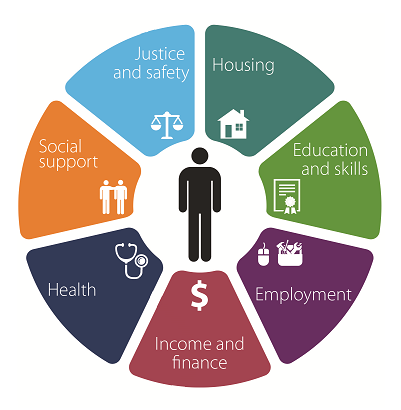
This report uses a person-centred reporting framework, which places the person at the core of understanding life pathways and experiences. This acknowledges that people’s experiences can vary, even for people who have similar conditions and support needs.
The report uses 7 broad life domains across which people pursue life outcomes (Figure ABOUT.1). The domains also represent common social policies and programs, both disability-specific and mainstream. The domains interact with each other, and with the environmental and personal factors, to shape the individual experience of disability (refer to Defining disability).
Figure ABOUT.1: Person-centred reporting and life domains