


Disability policy environment
The disability policy environment has significantly changed in recent years, especially in relation to service delivery. This includes:
- the launch of Australia’s Disability Strategy 2021–2031 (the Strategy) to replace the National Disability Strategy 2010–2020, and reporting against the Strategy’s outcomes framework via a dedicated website and a series of annual reports
- the implementation of the National Disability Insurance Scheme (NDIS)
- the establishment of the NDIS Quality and Safeguards Commission
- the continuing development of the National Disability Data Asset
- the implementation of a Royal Commission into Violence, Abuse, Neglect and Exploitation of People with Disability and subsequent commitments by governments based on the Commission’s recommendations.
- a focus on changing community attitudes and improving awareness of disability.
Common themes running through these changes include:
- making mainstream services (like health and education) accessible for people with disability
- quality and safety of specialist disability support and mainstream services
- the readiness of the market and workforce to deliver needed supports
- acknowledgment that specialist disability support services, such as those delivered through the NDIS, are only one part of a broader and interacting system of supports
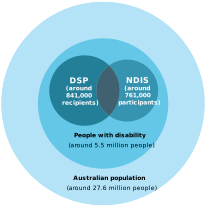
- recognition that, to improve the wellbeing of people with disability and their carers, sectors and organisations need to work together to meet the needs of all people with disability, including NDIS participants and those who do not use the NDIS (Figure ABOUT.3)
- the need to improve how we track and report on wellbeing of people with disability, and reducing key data gaps in this area.
Figure ABOUT.3: Key disability cohorts in the Australian population
Notes:
DSP = Disability Support Pension. NDIS = National Disability Insurance Scheme.
- People with disability estimates are as at 2022; population estimates are as at 30 June 2025; DSP recipient and NDIS participant numbers are as at December 2025.
- Figure is not to scale.
Sources: ABS 2024, ABS 2025, DSS 2026, NDIA 2026.
United Nations Convention on the Rights of Persons with Disabilities
Australia ratified the United Nations Convention on the Rights of Persons with Disabilities (UN CRPD) in 2008. The Convention’s purpose is to ‘promote, protect and ensure the full and equal enjoyment of all human rights and fundamental freedoms by all persons with disabilities, and to promote respect for their inherent dignity’ (UN 2008).
Australia’s Disability Strategy plays an important role in protecting, promoting and realising the human rights of people with disability in line with Australia’s commitments under the UN CRPD. The principles of the UN CRPD are also reflected in the Australian Human Rights Commission Act 1986 and in the mechanisms for the delivery of services to people with disability (such as the NDIS).
Australia’s Disability Strategy 2021–2031
The Strategy is Australia’s national disability policy framework. It sets out a plan for continuing to improve the lives of people with disability in Australia over the 10 years to 2031. The Strategy was launched on 3 December 2021 and builds on its predecessor, the National Disability Strategy 2010–2020.
The Strategy helps to protect, promote and realise the human rights of people with disability in line with Australia’s commitments under the UN CRPD.
The Strategy covers all people with disability, irrespective of whether they need or use specialist disability services. The Strategy aims to:
- provide national leadership towards greater inclusion of people with disability
- guide activity across all areas of public policy to be inclusive and responsive to people with disability
- drive mainstream services and systems to improve outcomes for people with disability
- engage, inform and involve the whole community in achieving a more inclusive society.
The Strategy and its supporting documents are available on the Disability Gateway website.
The AIHW regularly reports on the progress of the Strategy via a dedicated website Reporting on Australia’s Disability Strategy 2021–2031.
National Disability Insurance Scheme
The NDIS was progressively rolled out across Australia from July 2016, after a trial in 2013. From 1 July 2020, the NDIS has been made available to all eligible Australians, no matter where they live (Minister for the National Disability Insurance Scheme 2020).
The NDIS was a fundamental shift in the way Australians with significant and permanent disability access supports. It is based on insurance principles and aims to provide Australians who have permanent and significant disability with reasonable and necessary supports to live more independently and participate more fully in society (NDIA 2020). People with disability are directly funded under the NDIS. This is distinct from the previous system of funding to agencies and community organisations that provided disability support services under the National Disability Agreement (NDIA 2020).
The number of NDIS participants has continued to grow even after the Scheme’s full roll out. This has raised questions about the Scheme’s long-term sustainability. At present, the NDIS is undergoing reforms to stabilise its growth and expenses. The reforms include changes to laws and the operations of the National Disability Insurance Agency (NDIA). The reforms also aim to introduce additional support services within and outside of the NDIS (NDIA 2025).
NDIS Quality and Safeguards Commission
The NDIS Quality and Safeguards Commission (NDIS Commission) is an independent agency which aims to improve the quality and safety of NDIS supports and services. It started in July 2018 in New South Wales and South Australia, and gradually expanded across all states and territories, achieving national coverage on 1 December 2020.
The NDIS Commission uses a nationally-consistent approach to regulate the NDIS. It handles provider registration, complaints, reportable incidents, oversight of behaviour support, and compliance and enforcement. States and territories retain responsibility for NDIS worker screening, the authorisation of restrictive practices, and community visitor schemes.
National Disability Data Asset
The Australian and state and territory governments are working together with people with disability and the wider disability community on the National Disability Data Asset (NDDA). The NDDA brings together de-identified information from different government agencies about all Australians. These data will help us better understand experiences of people with disability and will give us more information about programs and services used by people with disability.
The National Disability Data Asset will be used to:
- provide a more complete picture of programs and services used by people with disability
- help governments improve these programs and services
- share information about how opportunities and outcomes could be improved
- improve reporting on outcomes for people with disability under Australia’s Disability Strategy 2021–2031.
Royal Commission into Violence, Abuse, Neglect and Exploitation of People with Disability
The Royal Commission into Violence, Abuse, Neglect and Exploitation of People with Disability (Royal Commission) was established in April 2019. It was one of the most extensive inquiries into the experiences of people with disability in Australia. It involved 32 public hearings, 1,785 private sessions, and heard from nearly 10,000 people.
The Royal Commission’s Final Report was delivered to the Australian Government on 29 September 2023 (DRC 2023). In the Report, the Royal Commission made 222 recommendations. Of these recommendations:
- 50 relate to areas of sole state and territory responsibility
- 85 relate to areas of joint Commonwealth and state/territory responsibility
- 87 relate to areas of sole Commonwealth responsibility.
Recommendations cover key themes of safety, protection, rights, inclusion, and accessibility for all people with disability. They set out a vision for Australia where people with disability are safe from violence, abuse, neglect, exploitation, and discrimination.
Governments responded to the Royal Commission’s recommendations on 31 July 2024 (Australian Government 2024). The response noted that the recommendations need to be implemented in stages given the broad range of required reforms.
All governments agreed to report every year on the progress of Royal Commission’s recommendations. The 2025 Progress Report provides the latest whole-of-government update (Australian Government 2025). The next progress report is expected to be published in late 2026.