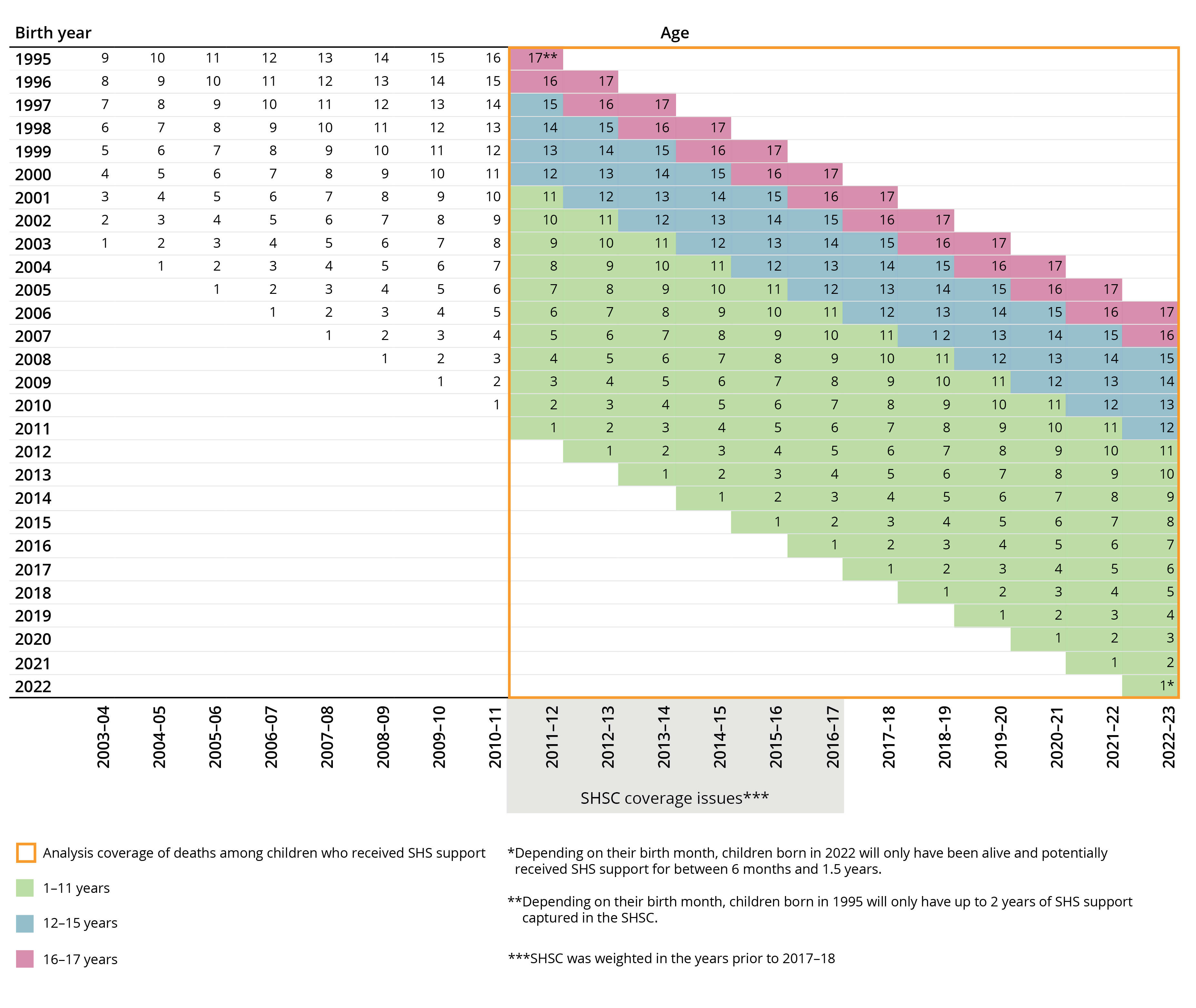
Access to stable housing is essential for the health and wellbeing of children (Murran and Brady 2023). Homelessness can impact a child’s physical and psychological health, and overall risk of injury, disease and premature death, making children at risk of homelessness or experiencing homelessness some of Australia’s most vulnerable (Flatau et al. 2016; Grattan et al. 2021). Understanding the scale and causes of deaths among children who have received specialist homelessness services (SHS) in their lifetime can provide information to improve prevention efforts and guide policy making.

For more background information and associated research see Children and young clients.

Analyses presented in this article are based on data from the NACS linked data set.

For help or support

The AIHW respectfully acknowledges the children who have died who are described in this article.

The material presented below may be distressing. Support is available via the following:

Children with a history of SHS support who have died

Throughout the period 2012–13 to 2022–23, around 520 children died who had received SHS support at any time in their life.

Children who had received SHS support accounted for 1 in 13 deaths among children in Australia over the 2012–13 to 2022–23 period (Supplementary table 1).

As a proportion of all child deaths annually, children who had received SHS support increased from 2.6% of all children who died in 2012–13 to 7.8% in 2017–18, peaking at 12% in 2021–22, before decreasing to 9.9% in 2022–23 (Figure 2). The increased proportion in later years is in part explained by data coverage issues in the early years of the data collection (up to 2016–17), and an increasing amount of possible time children may have received SHS support since July 2011. See analysis coverage for deaths among children who received SHS support.

Age at death

Throughout 2012–13 to 2022–23, around 2 in 5 (43%) deaths in children who received SHS support at any time in their life, were aged 1–11 years, 1 in 4 (24%) were aged 12–15 and 1 in 3 (33%) were aged 16–17.

In 2022–23, deaths among children who received SHS support at any time in their life accounted for (Figure 2):

  • 8.1% of all child deaths aged 1–11
  • 9.1% of all child deaths aged 12–15 
  • 15% of all child deaths aged 16–17.

Figure 2: Deaths among children who received SHS support (1–17), by age group, 2017–18 to 2022–23


Note: At the time of analyses, the cause of death information included in the National Death Index database was considered final for deaths registered prior to 2021, revised for deaths registered in 2021 and preliminary for deaths registered in 2022 and 2023. Preliminary data are subject to further revision.

Source: Supplementary table 1.

SHS support prior to death

Of the children who received SHS support and died throughout 2012–13 to 2022–23 (Supplementary table 2, Figure 3):

  • 2 in 5 (40% or 212) received SHS support in the last year of life (support was ongoing at the time of death or up to 12 months since support ended); 49 (9.3%) children were in ongoing support and 163 (31%) received support in the last 12 months of life
  • About 2 in 5 (41% or 217) children ceased receiving SHS support more than 2 years prior to death
  • Children aged 1–11 were more likely to have received SHS support in the last year of life (ongoing or up to 12 months) (45% or 102 children) compared with children aged 12–15 (28% or 35 children) and children aged 16–17 (44% or 75 children). In part this is because for younger children there is a greater possibility that SHS have been provided for most of their lifespan (since July 2011). See analysis coverage for deaths among children who received SHS support.

Among the 126 deaths in children aged 12–15 years who received SHS support, over half (51%) of deaths occurred more than 2 years since last they received SHS support. 

Figure 3: Deaths among children who received SHS support (1–17), by time since last SHS support, 2012–13 to 2022–23


Note: At the time of analyses, the cause of death information included in the National Death Index database was considered final for deaths registered prior to 2021, revised for deaths registered in 2021 and preliminary for deaths registered in 2022 and 2023. Preliminary data are subject to further revision.

Source: Supplementary table 2.

Underlying cause of death

Throughout the period 2012–13 to 2022–23, suicide and transport accidents were the most common causes of death in children with a history of SHS support.

External causes of death, such a suicide, transport accidents and assault, were common causes of death among children with a history of SHS support.

Children aged 1–11

Among children aged 1–11 who received SHS support (Figure 4):

  • Land transport accidents (37 children); certain conditions originating in the perinatal period, congenital malformations, deformations and chromosomal abnormalities (23 children); and assault (18 children) were the most common causes of death, accounting for one third (34% or 78 children) of deaths
  • Land transport accidents was the underlying cause of death 1 in 6 (16%) deaths and these accounted for 8.6% of all land transport accident deaths in children aged 1–11 nationally
  • Assault was the underlying cause of death 1 in 13 (7.9%) deaths and these accounted for 15% of all assault deaths in children aged 1–11 nationally.

Children aged 12–15

Among children aged 12–15 who received SHS support (Figure 4):

  • Suicide (38 children), land transport accidents (36 children) and accidental poisoning (9 children) were the three most common causes of death, accounting for two thirds (66%) of deaths.

Children aged 16–17

Among children aged 16–17 who received SHS support (Figure 4):

  • Suicide (75 children), land transport accidents (32 children) and assault (9 children) were the three most common causes of death, accounting for over two thirds (68%) of deaths
  • Suicide accounted for over 2 in 5 deaths (44% or 75 children) and 13% of all suicides among children aged 16–17 nationally
  • Land transport accidents accounted for almost one fifth (19% or 32 children) of deaths, and 8.6% of all land transport accident deaths in children aged 16–17 nationally
  • Assault accounted for 1 in 19 deaths (5.3% or 9 children), and nearly one quarter (23%) of all assault deaths in children aged 16–17 nationally.

Figure 4: Deaths among children who received SHS support (1–17), by age group and top 3 underlying causes of death, 2012–13 to 2022–23


Note: At the time of analyses, the cause of death information included in the National Death Index database was considered final for deaths registered prior to 2021, revised for deaths registered in 2021 and preliminary for deaths registered in 2022 and 2023. Preliminary data are subject to further revision.

Source: Supplementary table 3.

Data