


Comparisons across survey cycles
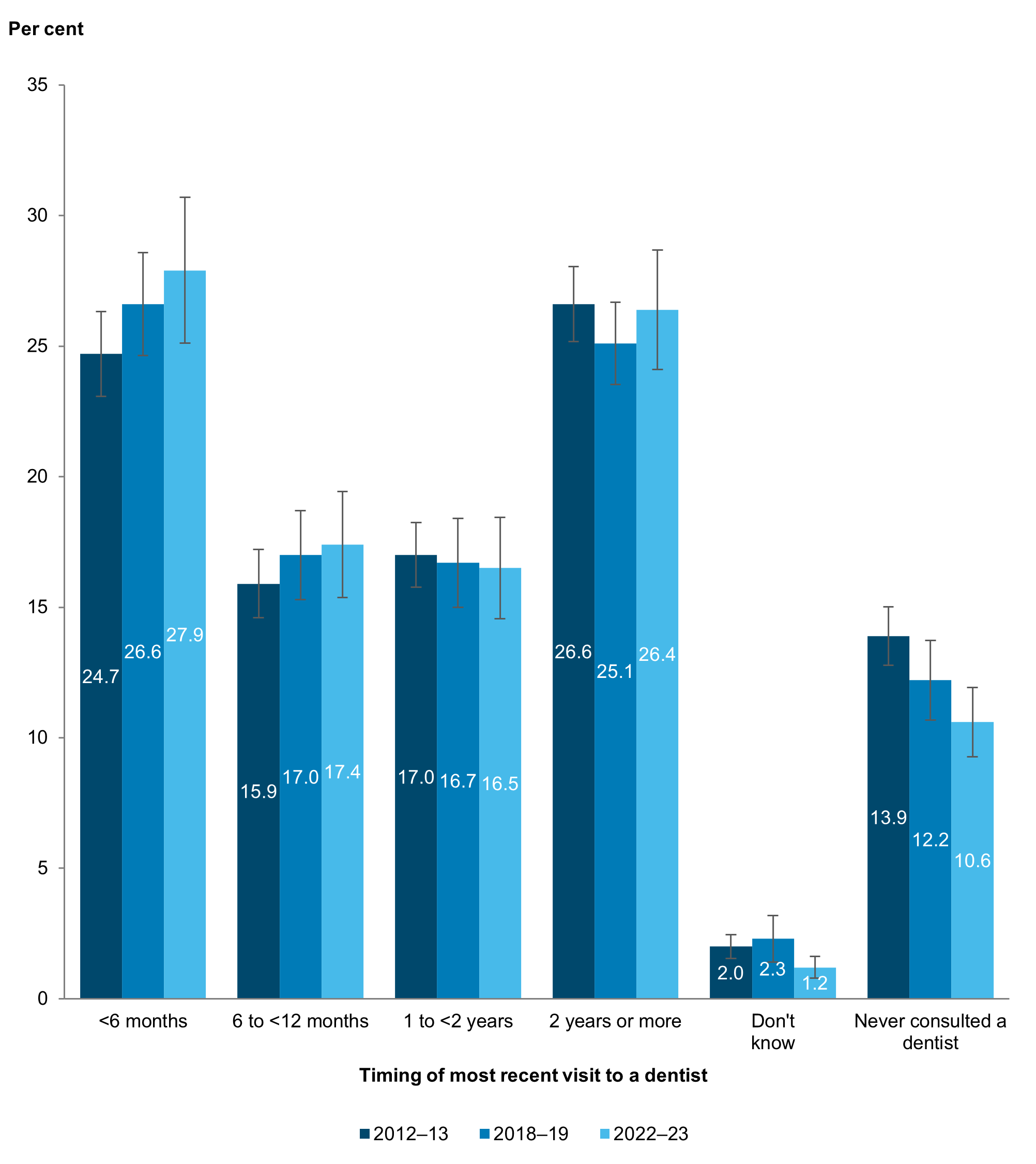
The distribution by the timing of Aboriginal and Torres Strait Islander people’s most recent trip to a dentist has remained relatively stable across survey cycles (Figures 24 and 25). There has, however, been a significant:
- increase in those aged 2 and over who had visited a dentist in the last 6 months – from 25% (or an estimated 150,000 of 607,000) in 2012–13 to 28% (or 264,000 of 946,000) in 2022–23
- decrease in those aged 2 and over who had never visited a dentist – 14% (or 84,200) in 2012–13 to 11% (101,000) in 2022–23).
Figure 24: Aboriginal and Torres Strait Islander people aged 2 and over, timing of most recent visit to a dentist, by survey cycle
Notes:
- Data are population weighted estimates.
- While non-overlapping confidence intervals (CIs) generally indicate statistical significance, overlapping CIs do not necessarily imply that a difference is not significant. See Technical notes for more information.
Source: AIHW analysis of 2012–13, 2018–19 and 2022–23 NATSIHS using DataLab (ABS 2013a, 2019a, 2025a).
The following data visualisation shows the time since people last had a dental visit by jurisdiction, remoteness, sex, age group, household income quintile and self-assessed health status.
Figure 25: Aboriginal and Torres Strait Islander people, timing of most recent visit to a dentist, by selected categories and survey cycle
Bar chart shows that in 2022–23, 20% of Aboriginal and Torres Strait Islander people aged 2 and over in Very remote areas had never seen a dentist, compared with 8% in Major cities.