


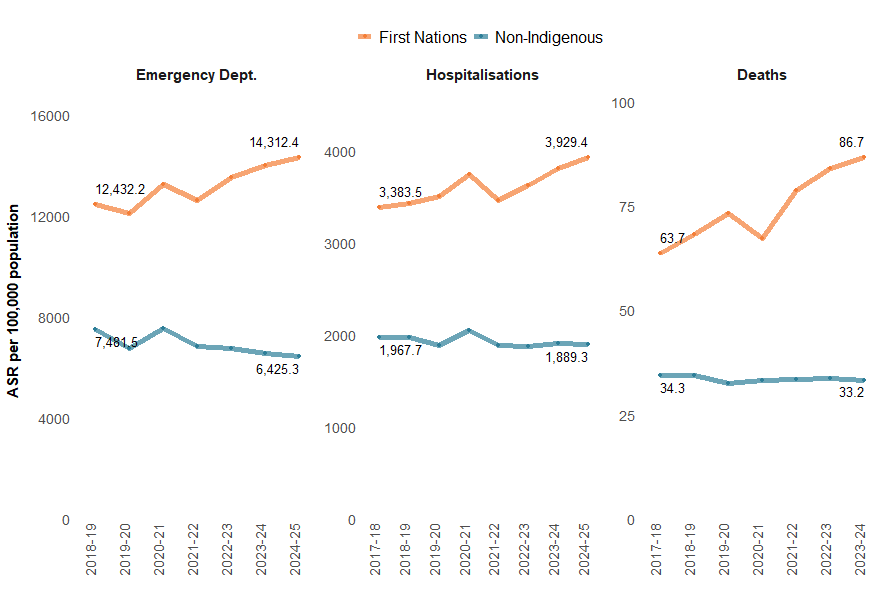
The gap in ED presentations between First Nations and non-Indigenous Australians has expanded over the last 6 years (Figure 24).
Age-standardised rates (ASRs) among First Nations people increased from 12,432.2 to 14,312.4 ED presentations per 100,000 population, while rates for non-Indigenous Australians declined from 7,481.5 to 6,425.3 per 100,000 population during the same time period. The Non-Admitted Patient Emergency Department Care (NAPEDC) Database provides information on ED presentations, but does not contain information about the causes behind this gap.
Similarly, the gap in injury hospitalisations has widened over the last decade (Figure 24), increasing from 1.7 to 2.1 times higher between 2017-18 and 2024-25.
Figure 24: Injury ED presentations (2018–19 to 2024–25), hospitalisations (2017–18 to 2024–25) and deaths (2017–18 to 2023–24) by Indigenous status
Notes:
- Age-standardised rates (ASR) per 100,000 population
- Deaths data only includes data for New South Wales, Queensland, Western Australia, South Australia, and the Northern Territory, as these jurisdictions are considered to have adequate levels of Indigenous identification in mortality data.
Sources: AIHW National Hospital Morbidity Database, AIHW National Mortality Database, AIHW National Non-admitted Patient Emergency Department Care Database and ABS Estimates and Projections, Aboriginal and Torres Strait Islander Australians.
For individual causes of injuries, First Nations people had a higher rate of hospitalisation than the non-Indigenous population due to:
- assault (around 784.4 cases, or 55.5 per 100,000) or 14.1 times as likely as non-Indigenous people
- intentional self-harm (around 257.8 cases, or 76.7 per 100,000) or 3.4 times as likely
- thermal causes (around 59.5 cases, or 19 per 100,000) or 3.1 times as likely.
First Nations people had higher injury death rates than non-Indigenous Australians for most causes, being about 7 times as likely to die from homicide (Table 7).
External cause of injury | First Nations ASR | Non-Indigenous ASR | Rate Ratio |
|---|---|---|---|
Homicide | 4.2 | 0.6 | 7.0 |
Accidental poisoning | 18.9 | 3.4 | 5.6 |
Transport | 12.9 | 3.5 | 3.7 |
Suicide | 26.0 | 8.0 | 3.3 |
All external causes | 86.7 | 33.2 | 2.6 |
Choking and suffocation | 6.5 | 2.9 | 2.2 |
Falls | 13.4 | 12.4 | 1.1 |
Notes:
- Age-standardised rates (ASRs) per 100,000 population.
- External causes with ASR numerators under 20 are not shown.
Sources: AIHW National Mortality Database and ABS Estimates and Projections, Aboriginal and Torres Strait Islander Australians.