Hospitalisations

Average length of hospital stay

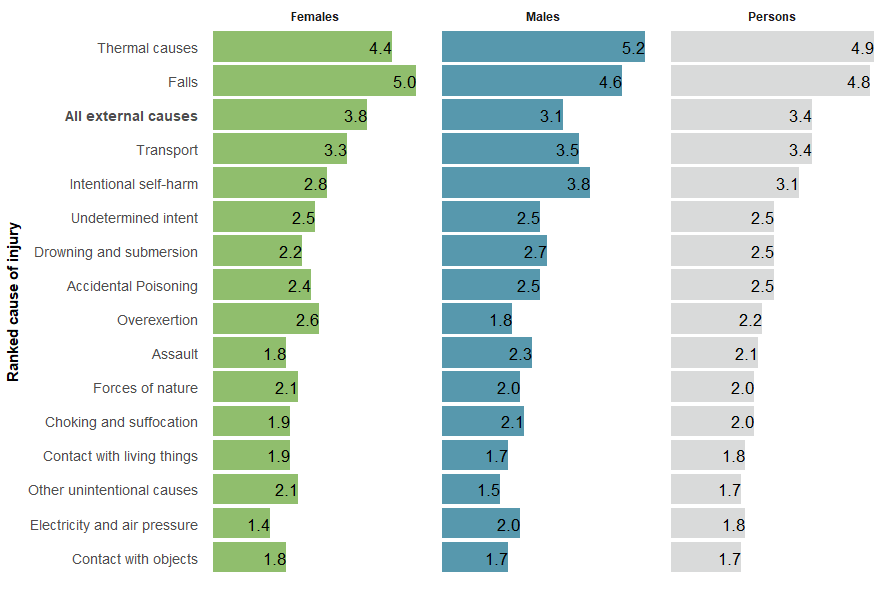
The three most severe injuries in 2023–24 as measured by average length of stay in hospital (by days) were due to thermal causes (4.9 days), falls (4.8 days) and transport (3.4 days) (Figure 12).

Figure 12: Average length of hospital days by injury cause and sex, Australia, 2023–24

Figure 13 shows the average length of hospital stays by cause and sex. Falls had the longest average length of hospital stay

Source: AIHW National Hospital Morbidity Database

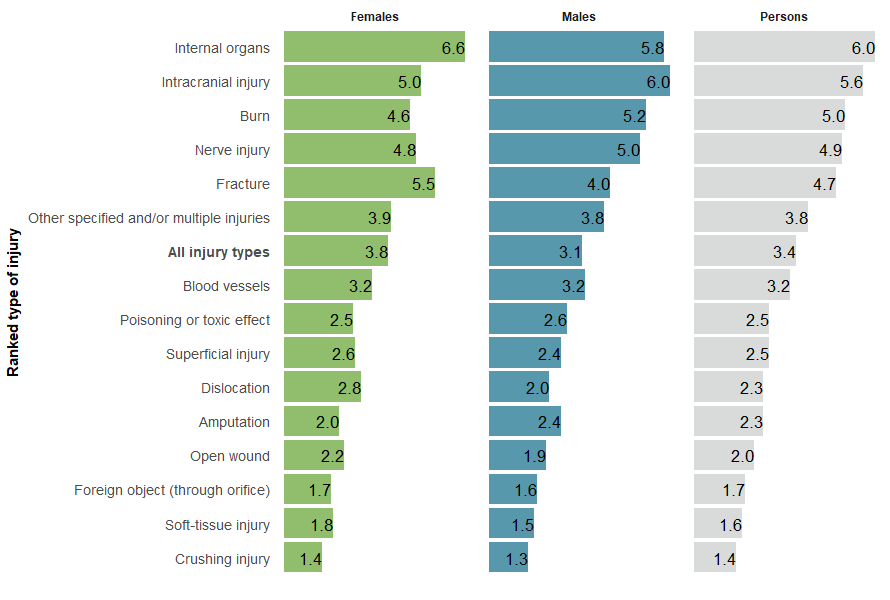
In terms of the most severe injury types, internal organ injuries were hospitalised for an average of 6.2 days, intracranial injuries 5.5 days, and burns 5.1 days (Figure 13).

Figure 13: Average length of stay in hospital (in days) by injury type and sex, Australia, 2023–24

Figure 13 shows the ranked length of hospital stay by cause and sex. Internal organ injuries had the longest average stay in hospital

Source: AIHW National Hospital Morbidity Database.

ICU, CVS and in-hospital deaths

An intensive care unit (ICU) is a designated ward of a hospital which is specially staffed and equipped to provide observation, care and treatment to patients with actual or potential life-threatening illnesses, injuries or complications, from which recovery is possible (METEOR 2018). 

In the ICU, patients may need continuous ventilatory support (CVS), or ‘life support’, when a patient breathes via an artificial airway with the aid of a machine.

In 2023–24:

  • ICU

    12,216 injury cases were admitted to intensive care units (about 2.1%, an ASR of 42.3 per 100,000 people)

  • CVS

    7,012 injury cases received continuous ventilatory support (about 1.2%, an ASR of 25.6 per 100,000 people)

  • In-hospital deaths

    3,411 hospitalised injury cases died in hospital (about 0.6%, an ASR of 9.4 per 100,000 people)

More males were admitted to an ICU than females, with age-standardised rates (ASR) of about 53.8 and 31.2 per 100,000 population respectively (Table 3).

While more females are hospitalised with falls overall (Figure 1) the rate of males admitted to ICU for falls is higher than that of females (13.9 and 8.4 per 100,000 population, respectively), indicating that severity of falls injury hospitalisations may be higher among males. For transport-related injuries, males were 3.2 times more likely to be admitted to ICU compared to women (13.9 and 4.3 per 100,000 population, respectively). More females were admitted to the ICU for intentional self-harm compared to males (11.4 and 9.4 per 100,000 population, respectively).

Table 3: Number of injury hospitalisations with ICU admission, by external cause of injury, Australia, 2023–24

External cause of injury

Males

Females

Persons

All external causes

7,544

4,664

12,216

Falls

2,162

1,542

3,706

Intentional self-harm

1,249

1,513

2,765

Transport

1,908

617

2,526

Accidental poisoning

635

367

1,002

Undetermined intent

367

181

549

Assault

406

92

499

Contact with objects

262

66

328

Other unintentional causes

149

96

245

Contact with living things

114

81

195

Thermal causes

145

43

188

Choking and suffocation

52

25

77

Drowning and submersion

46

22

68

Overexertion

30

16

46

Note: Rows with under 20 persons are not displayed

Source: AIHW National Hospital Morbidity Database

Males were around twice as likely to require CVS compared to women (ASRs of 33.4 and 18 per 100,000 population respectively) (Table 4). Injuries due to intentional self-harm (ASR 8.3 per 100,000 population), transport (ASR 5.4 per 100,000 population) and falls (ASR 3.5 per 100,000 population) were most likely to result in continuous ventilatory support.

Table 4: Number of injury hospitalisations with receipt of CVS, by external cause of injury, Australia, 2023–24

External cause of injury

Males

Females

Persons

All external causes

4,525

2,484

7,012

Intentional self-harm

1,081

1,115

2,199

Transport

1,141

348

1,489

Falls

767

343

1,110

Accidental poisoning

523

303

826

Undetermined intent

306

167

473

Assault

297

63

360

Contact with objects

134

34

168

Thermal causes

108

27

135

Other unintentional causes

40

19

59

Choking and suffocation

35

23

58

Contact with living things

37

21

58

Drowning and submersion

35

15

50

Note: Rows with under 20 persons are not displayed

Source: AIHW National Hospital Morbidity Database

Injuries caused by falls were the leading cause of deaths in hospital (ASR 6.8 per 100,000), followed by transport and intentional self-harm. Males were more likely to die in hospital than females (ASRs of 12.3 and 7.0 per 100,000 population, respectively) (Table 5).

Table 5: Number of injury deaths during hospitalisations, by external cause of injury, Australia, 2023–24

External cause of injury

Males

Females

Persons

All external causes

1,951

1,460

3,411

Falls

1,414

1,198

2,612

Transport

199

72

271

Intentional self-harm

130

53

183

Other unintentional causes

41

39

80

Contact with objects

31

23

54

Choking and suffocation

26

19

45

Assault

30

12

42

Accidental poisoning

20

10

30

Thermal causes

20

8

28

Undetermined intent

13

8

21

Drowning and submersion

14

6

20

Note: Rows with under 20 persons are not displayed

Source: AIHW National Hospital Morbidity Database

References

METEOR (2018), Intensive Care Unit – Metadata 327234, AIHW, accessed 22 May 2025.