



Sexual assault reported to police
Last updated: | See what’s been updated
Key findings
- Female sexual assault victimisation rates increased by 64% between 2010 and 2024.
- 7.7% of women who experienced sexual assault by a male in the 10 years before 2021–22 contacted police about the most recent incident.
- The majority of sexual assaults recorded by police in 2024 were perpetrated by someone known to the victim.
Victim-survivors of sexual violence may come in contact with police. This may be as a result of the victim-survivor, a witness or another person reporting the incident to the police. Incidents of sexual assault (a criminal offence) recorded by police are included in ABS Recorded Crime data (see Box 1). However, not all sexual assaults are reported to police, and as a result Recorded Crime data are an underestimate of sexual assaults in Australia.
What do we know about reporting sexual assault to police?
In recent years, there has been a growing awareness and willingness to address sexual violence, as seen through the #MeToo movement. Educational programs about consent have been introduced in schools and workplaces, alongside awareness campaigns, to further promote understanding and reduce barriers to addressing sexual violence (DSS 2022). Further, increased protections for some population groups in recent years, such as the expansion of laws on mandatory reporting of child sexual abuse, may have increased the propensity to report sexual assault by third parties. The National Plan to End Violence against Women and Children 2022–2032 (the National plan) highlights that more work is needed to remove barriers to reporting of sexual assault to police by victim-survivors (DSS 2022).
Rates of reporting sexual violence, such as sexual assault, to police have historically been impacted by a range of factors including: misconceptions about what constitutes sexual assault; mistrust of police; concerns relating to being believed and having to relive the experience; past negative experiences with police; institutional violence at the hands of police for some population groups; and barriers to accessing police, such as knowledge and understanding, geographical location and specific population group characteristics (ABS 2023; Douglas 2019; DSS 2022; Voce and Boxall 2018). Intersecting personal, situational, social, cultural, economic and political factors associated with inequality and discrimination may also impact victim-survivor ability to access police following an incident of sexual violence and/or likelihood of reporting sexual assault to police (Commission of Inquiry into Queensland Police Service responses to domestic and family violence 2022; DSS 2022). These factors may also influence the time a victim-survivor takes to report incidents of sexual assault to police. Data from the ABS suggest that close to 1 in 3 (33%) sexual assaults reported to police in 2024 had occurred more than a year earlier, and 9.9% had occurred 20 or more years ago (ABS 2025b).
Reports into women and girls’ experiences with the police and broader criminal justice system, such as the Queensland Hear her voice reports and the National Plan Victim-Survivor Advocates Consultation Final Report, acknowledge that work has been undertaken to improve police understanding of family, domestic and sexual violence (FDSV) and police responses to reports of gendered violence in recent years. However they also highlight responses are still inadequate and lacking in consistency (Fitz-Gibbon et al 2022; Queensland Government 2022). Reports such as these also highlight the need to improve police response for those victim-survivors who experience intersecting forms of inequality and discrimination, for example Aboriginal and Torres Strait Islander (First Nations) people, culturally and linguistically diverse people, people with disability, and LGBTIQA+ people, see Population groups (Fitz-Gibbon et al 2022; Queensland Government 2022). The National plan indicates that enhanced education and training of police in terms of responses to reporting of gendered crime and improved access to safe and/or alternative reporting options should be implemented to improve reporting experiences for all people in Australia (DSS 2022).
To understand the current extent of police involvement in sexual assaults in Australia, data on level of reporting to police, available from the ABS Personal Safety Survey (PSS), should be examined alongside recorded crime data (ABS Recorded Crime – Victims and ABS Recorded Crime – Offenders). For more information about these data sources, please see Data sources and technical notes.
Police-recorded sexual assault data are an underestimate of sexual assaults
7.7% of women who experienced sexual assault by a male in the 10 years before 2021–22 contacted police about the most recent incident.
Examining whether police are contacted following sexual assault can provide an indication of reporting levels and utilisation of police services. Data on whether police were contacted (by the victim-survivor and/or another person) after sexual assault, as well as reasons for not contacting, are available from the ABS PSS. In the PSS, victim-survivors are referred to as people who have experienced violence, see What is FDSV? for more details.
The 2021–22 PSS includes data on female victim-survivors’ most recent incident of sexual assault by a male in the last 10 years. According to these data:
- the police were contacted in relation to 8.3% of sexual assaults
- 7.7% of victim-survivors contacted police themselves (Figure 1; ABS 2023).
Data for males who experienced sexual assault are not available here due to data quality issues, see Data sources and technical notes.
Figure 1: Police contacted after most recent incident of sexual assault, females, 2021–22
Figure 1 shows the proportion and number of females that contacted police after their most recent incident of sexual assault in 2021-22.

Related data for women aged 18 years and over are available in the National Plan Outcomes measure Women who experienced sexual assault where the incident was reported to police.
Family, domestic and sexual violence data in Australia includes data on the proportion of sexual assaults in the 12 months prior to the PSS that were reported to police between 2005 and 2016. Comparable data are not available for the 2021–22 PSS.
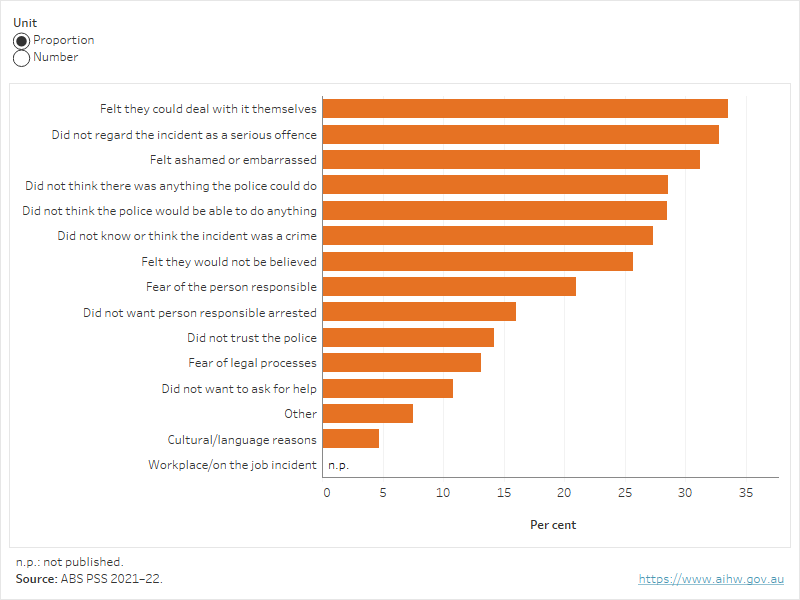
Examining reasons why people did not contact police after a sexual assault can provide insight into how victim-survivors can be better supported and encouraged to seek help. Figure 2 shows that there were a range of reasons why female victim-survivors did not contact police following their most recent incident of sexual assault by a male perpetrator in the last 10 years. According to the 2021–22 PSS, the 2 most common reasons were female victim-survivors did not contact police were they:
- felt like they could deal with it themselves
- did not regard the incident as a serious offence (ABS 2023).
Data for males who experienced sexual assault are not available here due to data quality issues, see Data sources and technical notes.
Figure 2: Reasons police not contacted after most recent incident of sexual assault by a male perpetrator, females, 2021–22
Figure 2 shows the proportion and number of females that did not contact police after their most recent incident of sexual assault in 2021-22, sorted by the reasons police was not contacted.
What do Recorded Crime data tell us?
The ABS collects data on sexual assaults recorded by police in the Recorded Crime – Victims and Recorded Crime – Offenders collections (see Box 1). These collections provide insights into police involvement in responses to sexual assaults in the Australian community over time and across different population groups (see Figure 4 and 5), as well as the different characteristics (see Figure 6) of those sexual assaults recorded by police.
ABS Recorded Crime collections are based on crimes recorded by police in each state and territory and published according to the Australian and New Zealand Standard Offence Classification (ANZSOC) (ABS 2011). While there may be some jurisdictional differences in police reporting due to legislative differences, as a general rule, for recorded crime data, sexual assault refers to any physical contact, or intent of contact, of a sexual nature directed toward another person where that person does not give consent, gives consent as a result of intimidation or deception, or consent is unable to be given because of youth, temporary/permanent (mental) incapacity or familial relationship. Differences in consent laws between states and territories may also impact sexual assaults captured in recorded crime data, see Consent for more information. Sexual assault includes aggravated sexual assault and non-aggravated sexual assault (see Data sources and technical notes for details).
Information on sexual assaults recorded by police are available on victims (Recorded Crime – Victims) and offenders (Recorded Crime – Offenders). Victims data include each incident of sexual assault that police record (not all sexual assaults are recorded) rather than reflecting a count of unique people. Victims data are not restricted by age and includes incidents of child sexual abuse (see Children and young people). Conversely, Offenders data include a count of unique alleged offenders aged 10 and over, irrespective of how many offences they may have committed within the same incident, or how many times police dealt with them during the reference period. Alleged offences recorded in offenders’ statistics may be later withdrawn or not be substantiated. Offenders data also include a count of police proceedings which are categorised as court or non-court actions (for example, warnings, conferencing, diversion). An individual offender may have more than one police proceeding recorded in the same reference period.
It is important to note that the number of police-recorded victims does not align with the number of recorded offenders nor the proceeding counts due to different counting rules, different reference periods, and variation in the time between when a crime is recorded and when police identify an offender. In some cases, police may never identify offenders.
The terms ‘victim’ and ‘offender’ are used here to align with the ABS recorded crime collections.
For more details, see Data sources and technical notes.
According to ABS Recorded Crime – Victims data, in Australia in 2024:
- almost 40,100 sexual assaults were recorded, with 4 in 5 (81% or 32,400) perpetrated against females
- the rate of sexual assault was higher for females (237 per 100,000) than males (52 per 100,000)
- there was significant variation in sexual assault rates between states and territories. ACT had the lowest rate of sexual assaults (89 per 100,000 persons) while NT had the highest rate (198 per 100,000) (ABS 2025b).
Has it changed over time?
-
There was a 64% increase in the rates of police-recorded sexual assault for women between 2010 and 2024
Source: ABS Recorded Crime - Victims
Recorded Crime – Victims data show that in Australia, between 2010 and 2024, sexual assault victimisation rates were consistently higher for females compared with males. During this time:
- the victimisation rate for females increased by 64% (from 144 to 237 per 100,000 females), with a 4% increase evident between 2023 and 2024
- the victimisation rate for males doubled (increasing from 26 to 52 per 100,000 males), with a 20% increase evident between 2023 and 2024
- the increase was generally consistent across jurisdictions, although the rate and pattern of increase varied (Figure 3; ABS 2025b).
Victimisation rates are based on all recorded sexual assaults irrespective of age and include incidents of child sexual abuse. See Data sources and technical notes for more information on rates and definitions related to sexual assault.
Changes in crime rates may be due to changes in reporting behaviour, increased awareness about forms of violence, changes to police practices, and/or an increase in sexual assault incidents. Between 2014 and 2024 there was an increase in the proportion of sexual assaults that were reported to police 12 or more months after the incident, from 23% of all sexual assaults in 2014 to 33% in 2024 (ABS 2025b).
Figure 3: Victims of sexual assault, by sex and location, 2010 to 2024
Figure 3 shows the rate and number of sexual assault victims by sex, or state/territory over time.

Is it the same for everyone?
Police-recorded sexual assaults can be explored in terms of a range of victim and crime characteristics, including: sex of victim, age at report, time to report, setting where the crime occurred, whether a weapon was used and relationship of offender to victim. Examining data by victim characteristics provides insight into which groups are most affected by sexual assault.
Sexual assault perpetrated against children is considered a form of child sexual abuse (see Children and young people). Incidents of child sexual abuse recorded by police are captured in ABS sexual assault victims data and can be examined when data are reported by age at report. According to Recorded Crime – Victims data, in 2024:
- The sexual assault victimisation rate was highest amongst people aged 10–17 years (519 per 100,000) and lowest for those aged 65 and over (15 per 100,000) at the time of reporting to police. This is true for both females and males.
- Between 2010 and 2024, the sexual assault victimisation rate increased across all age groups, except 0–9 years (Figure 4; ABS 2025b).
Figure 4: Victims of sexual assault, by age at report, 2010 to 2024
Figure 4 shows the rate and number of sexual assault victims for either males, females or persons by age at report over time.

Consistently over time, most sexual assaults were classified as aggravated, and most did not involve the use of weapon. Sexual assaults in a residential setting were consistently more common than in the community. In 2024, 80% of all sexual assaults were classified as aggravated and 69% occurred in a residential setting (ABS 2025b, ABS 2025c). See Data sources and technical notes for information on terminology used here.
Of all sexual assaults recorded in 2024, over 2 in 3 (67% or 27,000) were reported to police within the first year following the incident (Figure 5). A lower proportion was reported when only looking at sexual assaults categorised as family and domestic violence (FDV) (58%) (ABS 2025b).
Figure 5: Characteristics of sexual assault, 2010 to 2024
Figure 5 shows the number of victims of sexual assaults for a range of selected years including the latest year of data grouped by: whether aggravated sexual assault, time to report, setting of offence, weapon used, or whether finalised investigation as well as the proportion of all victims of sexual assault.

Perpetrators of sexual assault are often known to the victim
Data for the relationship of offender to victim from the Recorded Crime – Victims collection in 2024 exclude Western Australia and the Northern Territory. Across all other jurisdictions, of sexual assaults recorded in 2024:
- the majority were perpetrated by someone who knew the victim (ranging from 67% in Queensland to 91% in Tasmania)
- between 6% (in Tasmania) and 19% (in Victoria and Queensland) were perpetrated by strangers
- a perpetrator wasn’t able to be identified or a relationship was not specified for 3%–14% of cases (Figure 6; ABS 2025b).
Figure 6: Sexual assaults by relationship of offender to victim and jurisdiction, 2024
| Relationship | New South Wales | Victoria | Queensland | South Australia | Tasmania | Australian Capital Territory |
|---|---|---|---|---|---|---|
| Total known to victim | 84.9% | 68.8% | 67.4% | 81.3% | 91.0% | 73.6% |
| —Family member | 36.0% | 25.5% | 34.4% | 23.5% | 31.0% | 16.4% |
| —Non-family member | 49.0% | 43.3% | 33.0% | 57.7% | 60.0% | 56.8% |
| Stranger | 9.5% | 19.1% | 18.8% | 15.4% | 6.0% | 18.0% |
Notes:
- Data have been randomly adjusted to avoid the release of confidential data and discrepancies may occur between sums and totals.
- Relationship of offender to victim data are not available for Western Australia.
- A new crime recording system was introduced in the Northern Territory in November 2023 impacting relationship data quality for the 2023 and 2024 reference periods. As such, Northern Territory 2023 and 2024 relationship data has not been published while these issues are being reviewed.
- Family member includes partner, parent, child, sibling, boy/girlfriend, and other related family members.
- Non family member includes Ex-partner, Ex-boy/girlfriend, and other people known to the victim who were not included in the family member total.
For more information, see Data sources and technical notes.
Note: Total known to victim includes Family member and Non-family member.
How many people are recorded as sexual assault offenders?
According to ABS Recorded Crime - Offenders data, around 6,200 people had a principal offence of sexual assault recorded during 2023–24. This represents a rate of 26 offenders per 100,000 people (ABS 2025). These data do not reflect the total number of sexual assaults that recorded offenders were involved in or proceeded against by police during the period and do not include offenders of sexual assault whom police were unable to identify. There are currently no data available to establish the number offenders police were unable to identify. Future development work may provide some insight (Box 2).
Related data are included in the National Plan Outcomes measures:
- Offenders of sexual assaults and related offences
- Youth offenders of sexual assault and related offences.
Following police charges, individuals may become a defendant in 1 or more criminal court case. For more information on defendants in sexual assault cases, see Legal systems. Sexual assault offenders may also take part in specialist perpetrator interventions, which work to hold perpetrators to account and change their violent, coercive and abusive behaviours. More information can be found in Specialist perpetrator interventions.
There are several national data projects underway which will help improve understanding of sexual offender interactions with police and the broader criminal justice system in the future. The Australian Institute of Criminology piloted the Australian Sexual Offences Statistical (ASOS) collection in 2021‒22. The ASOS is a comprehensive statistical collection of sexual offences proceeded against by the police in Australia each year. It includes information on the offence, the offender’s characteristics and the victim’s characteristics. Findings from the 2022–23 data collection for all jurisdictions except South Australia and Tasmania are reported in Box 8 in Who uses violence?.
More broadly, the National Crime and Justice Data Linkage Project aims to link administrative datasets from across the criminal justice sector, including police, criminal courts and corrective services, forming the ABS Criminal Justice Data Asset. Once fully established, this data asset could provide insight on how perpetrators of FDSV, including sexual assault, move through the criminal justice sector.
Related material
More information
ABS (Australian Bureau of Statistics) (2011) Australian and New Zealand Standard Offence Classification (ANZSOC), ABS website, accessed 4 April 2023.
ABS (2023) Sexual Violence, 2021-22, ABS website, accessed 3 September 2025.
ABS (2025a) Recorded crime - Offenders, ABS website, accessed 9 April 2025.
ABS (2025b) Recorded crime - Victims, ABS website, accessed 3 September 2025.
ABS (2025c) Recorded crime - Victims, Customised report.
Douglas H (2019) Policing domestic and family violence, International Journal for Crime, Justice and Social Democracy, 8(2):31–49, doi:10.5204/ijcjsd.v8i2.1122.
DSS (Department of Social Services) (2022) National plan to end violence against women and children 2022–2032, DSS, Australian Government, accessed 15 November 2022.
Fitz-Gibbon K, Reeves E, Gelb K, McGowan J, Segrave M, Meyer S, and Maher JM (2022) National plan victim-survivor advocates consultation final report, Monash University, Victoria, accessed 29 November 2022.
Independent Commission of Inquiry into Queensland Police Service responses to domestic and family violence (2022) A call for change, The Commission of Inquiry website, accessed 30 November 2022.
Queensland Government (2022) Queensland Government response to Hear her voice – Report one – Addressing coercive control and DFV in Queensland, Queensland Government, accessed 15 November 2022.
Voce I and Boxall H (2018) ‘Who reports domestic violence to police? A review of the evidence’, Trends & issues in crime and criminal justice, 59, accessed 29 November 2022.
- Previous page FDV reported to police
- Next page Child protection