


Specialist crisis FDV services pilot project
What is the specialist crisis FDV services pilot project?
The Australian Government Department of Social Services has funded the Australian Institute of Health and Welfare (AIHW) to develop a pilot (prototype) data collection on specialist crisis family and domestic violence (FDV) services, due for completion in 2026.
The project:
- focuses on government-funded specialist FDV services that provide a crisis response to victim-survivors
- develops the necessary foundations for national data to support research and policy
- could be expanded in the future to consider other specialist services.
Further background information will be progressively released on the Context for developing a national data collection on specialist crisis FDV services page.
This project comprises three complementary phases of work.
Pilot data collection
The pilot data collection period ran from 2 March 2026 to 31 May 2026. The pilot collection aimed to: test a set of proposed national data items and definitions, and collect initial data to develop and test proposed measures of demand and unmet demand. Participating service outlets tested the collection of unit record client data using a ‘best endeavours’ approach and supplied pilot data to the AIHW.
Further information will be progressively released on the Pilot data collection page.
Dedicated First Nations phase of consultation
To ensure recommendations from this project are appropriately informed by the experience and expertise of Aboriginal and Torres Strait Islander (First Nations) people a dedicated First Nations phase of work is underway.
This involves consultation with organisations providing specialist crisis FDV services that predominantly support people who identify as Aboriginal and/or Torres Strait Islander, including organisations that are not Aboriginal Community Controlled Organisations. Details and timing of First Nations-led engagement with Aboriginal Community Controlled Organisations will be determined through ongoing planning and consultation with First Nations co-governance bodies. This work will be overseen by Our Ways – Strong Ways – Our Voices governance arrangements.
Technical consultation
The AIHW has engaged a third-party consultant to lead consultations with client management system developers and vendors, to improve understanding of existing client data systems and advise on the technical implications of a future national data collection. The focus of this technical phase of work is identifying potential longer-term solutions for a future ongoing collection (if one were to be established), that leverage existing systems as much as possible. It is a separate but complementary phase of work to the one-off pilot data collection being undertaken.
Why is it important?
There is currently no nationally collated information about specialist FDV services in Australia, except for some data available through the AIHW’s Specialist Homelessness Services collection.
The project is an opportunity for states and territories and service outlets to contribute to the design of a future national collection.
The project addresses several core national policy priority areas, including:
- creating nationally consistent FDV service data items, with harmonised definitions
- improving understanding of demand and unmet demand for FDV services
- increasing data on people experiencing FDV that may be linked to other data sources to provide insights into long-term outcomes.
Who has been consulted?
The AIHW has completed waves of consultation with state and territory departments that fund the in-scope services, and consulted with service provider organisations, national advisory groups, peak bodies, advocacy groups, and people with lived experience from across Australia. The project is engaging with services supporting First Nations people (see ‘Dedicated First Nations phase of consultation’ above).
Consultation with key stakeholders will continue throughout the project.
The AIHW acknowledges and sincerely thanks the individuals and organisations that have generously contributed their time and expertise to this project.
What has been achieved so far?
As of the end of June 2026, the AIHW has:
- For the pilot data collection
- completed the data collection period for the pilot; over 100 service outlets participated and supplied data to AIHW
- completed a post-pilot consultation process with participating outlets, to seek feedback on the pilot data items and methods.
- Completed a consultation process with 10 organisations that operate services that predominately support First Nations people (but are not Aboriginal Community Controlled Organisations). Seven of these organisations provide services in the Northern Territory.
- Reviewed a report on the findings of the technical consultations, led by a third-party consultant.
- Progressively published outputs to share emerging insights (for details, see ‘Where can I get more information?’ below).
- Provided regular updates on project progress to government departments and in-scope organisations through email newsletters.
A summary of the project’s early discovery work, including an overview of the in-depth consultation completed by the AIHW to June 2025, can be found in the report, Towards a pilot data collection on specialist crisis FDV services.
What are the next steps?
Over the remainder of 2026, the AIHW will progress analysis and synthesis of findings across the three phases of work, to inform recommendations for a potential ongoing national data collection.
Key next steps include:
- analysing pilot data and post‑pilot consultation feedback, and considering findings from the technical consultation phase
- progressively publishing outputs to share emerging insights and support ongoing engagement with stakeholders
- developing recommendations and a proposed implementation plan for a future national data collection, to be delivered to the Australian Government Department of Social Services by the end of November 2026.
Interim findings from consultation with organisations providing services that predominantly support First Nations people will be incorporated into the recommendations. Further First Nations‑led consultation will continue beyond 2026 and will inform decisions about future work.
What complementary work is underway elsewhere?
Separate to this project, several related initiatives are underway to strengthen data, capability and understanding of family, domestic and sexual violence service systems, including:
- The First Nations Family, Domestic and Sexual Violence Sector Strengthening Plan (FDSV SSP) is being developed as part of implementation of Priority Reform Two in the National Agreement on Closing the Gap. The FDSV SSP will develop actions to strengthen Aboriginal and Torres Strait Islander workforce capacity and capability across the family, domestic and sexual violence sector.
- The Safety Measures project is a sector‑led initiative focused on developing and testing conceptual and analytical approaches to better understand domestic and family violence service demand, capacity and impact. It is a project operating in selected jurisdictions (NT, SA and Victoria).
- Family Domestic and Sexual Violence Integrated Data System (FDSV IDS) is an AIHW project which has linked administrative data from a range of sources where there is evidence of family, domestic or sexual violence (FDSV), to create a series of FDSV cohorts or ‘flags’ for use in analysis of linked data. This work shows the potential of linked administrative data to provide more sophisticated, personalised and whole-of-system insights for people experiencing and using FDSV. If established, national data for specialist crisis FDV services could be included in the national data linkage system, subject to appropriate governance, approvals and data protections.
- In addition to their contributions to relevant national initiatives, some states/territories are also progressing complementary work within their own jurisdictions.
Where can I get more information?
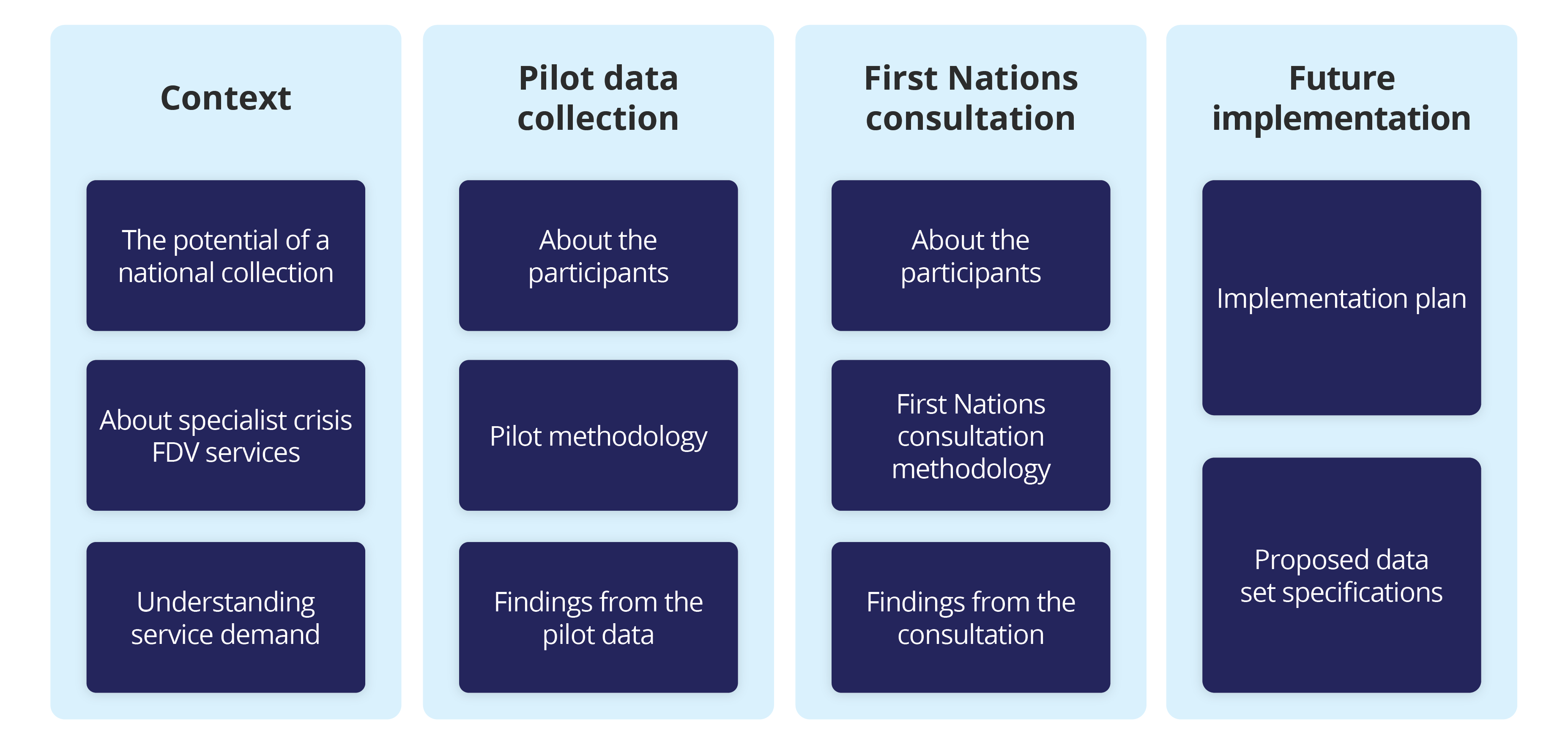
AIHW will publish a series of outputs across the life of the project (Figure 1). Findings will be released progressively on the project web pages to provide visibility of the work underway and support engagement with jurisdictions, service provider organisations and other stakeholders.
This reflects the iterative nature of national data development. Publishing as the project progresses allows AIHW to share emerging findings and feedback from consultation; each output reflects the project stage at the time of release.
Figure 1: Planned series of published outputs for the project
At present, selected outputs are available on the following pages:
- Context for developing a national data collection on specialist crisis FDV services
- Pilot data collection
- Data and downloads.
If you have any questions or would like to receive project updates, please contact [email protected].
- Previous page Women and children affected by family violence who return to homelessness
- Next page Context for developing a national data collection on specialist crisis FDV services