


Pilot data collection
AIHW will publish a series of outputs across the life of the project. Findings will be released progressively on the project web pages to provide visibility of the work underway and support engagement with jurisdictions, service provider organisations and other stakeholders.
This reflects the iterative nature of national data development. Publishing as the project progresses allows AIHW to share emerging findings and feedback from consultation; each output reflects the project stage at the time of release.
Methodology for the pilot data collection
The primary purpose of the pilot data collection was to:
- test a set of proposed national data items and definitions
- collect initial data to develop and test proposed measures of demand and unmet demand.
The pilot data collection period ran from 2 March 2026 to 31 May 2026. Participating service outlets tested the collection of unit record client data using a ‘best endeavours’ approach, and supplied pilot data to the AIHW. A detailed description of the scope and methods are provided in the Pilot data collection methodology report. Technical documents – including a data collection template, user guide, and metadata specifications – were made available to participating outlets.
Box 1: Key terms used in the pilot
Service: The activities taken by a service provider organisation to support a service user. For example, providing accommodation.
Service provider organisation (‘organisation’): A company or organisation that provides FDV crisis services. A service provider organisation may offer services at multiple service outlets. The term ‘organisation’ is used to refer generally to service provider organisations.
Service outlet (‘outlet’): A recognised branch of a service provider organisation that delivers support to service users. Outlets may represent distinct geographic areas or program types within a broader service provider. An organisation may have several outlets, or only one. The term ‘outlet’ is used to refer generally to service outlets. Organisations were asked to nominate specific outlets to participate. There was some variation in how each organisation interpreted the term ‘service outlet’ for the purposes of the pilot. In some instances, service outlets were considered separate by the organisations if they related to different programs of work even if they were located at the same service site.
A subset of outlets were in-scope for the pilot data collection (Figure 1). Further information on the recruitment of outlets participating in the pilot is provided in the Pilot data collection methodology report.
Figure 1: Overview of outlets in-scope for, and participating in, the pilot collection
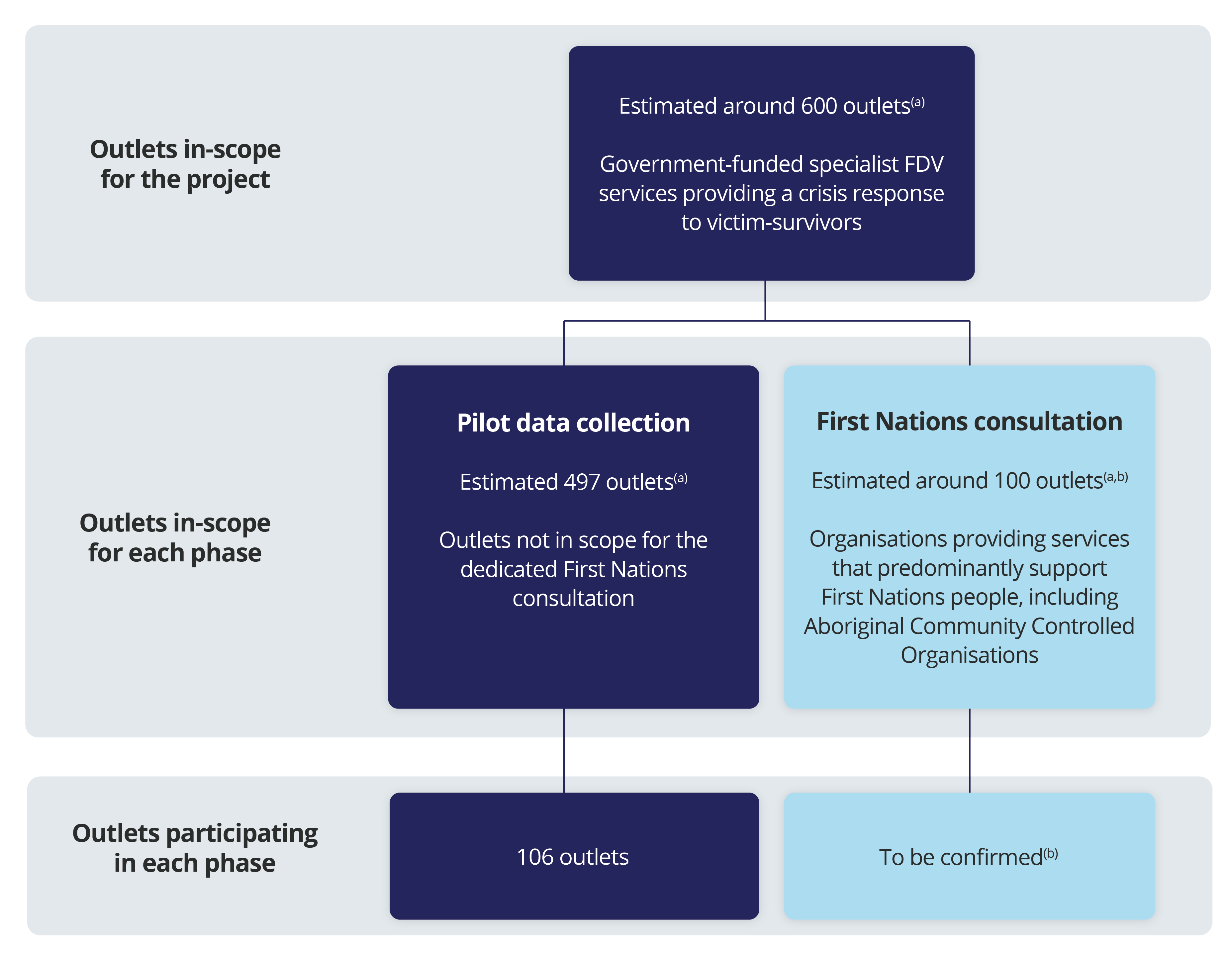
- This is an estimate at 13 March 2026, based on information available to the AIHW at that time. The information was sourced from state/territory government funding bodies, and service provider organisations.
- Recruitment of outlets to participate in the First Nations consultation was underway at the time of writing. The reported number of outlets may change once recruitment is completed.
Profile of service outlets participating in the pilot data collection
As noted in Figure 1 above, there are estimated to be 497 outlets in-scope for the pilot data collection (referred to below as ‘all in-scope outlets’). Of these, 106 outlets participated in the pilot data collection (referred to as ‘participating outlets’).
Data about participating outlets was primarily drawn from an information stocktake conducted before the pilot data collection commenced. These data provide a point-in-time summary of participating outlets, with information collected on a ‘best endeavours’ basis. These data should be interpreted with caution (see Box 2 for additional context).
Box 2: Interpreting data about the pilot sample
When interpreting data from the pilot – including data collected during the pilot period – the following should be kept in consideration.
Participating outlets may not be a statistically representative sample
The participating outlets may not be a statistically representative sample of all in-scope outlets.
Agreement to participate in the pilot was voluntary. AIHW provided funding to organisations to support participation in the pilot. An organisation’s decision to participate will likely be guided by their readiness and capacity constraints. This may lead to an under-representation of organisations that are smaller or have limited data capability.
Comparing participating outlets to all outlets in-scope for the pilot collection
Information about all in-scope outlets was available for selected characteristics – state/territory, remoteness, and outlets per organisation. As noted in Figure 1, the data available for all in-scope outlets is an estimate, based on information available to the AIHW at 13 March 2026.
It’s important to note that all in-scope outlets does not include organisations providing services that predominantly support First Nations people. These organisations, including Aboriginal Community Controlled Organisations and all outlets from the Northern Territory, are the focus of a dedicated First Nations consultation process. Further information on the First Nations consultation process will be progressively released on the project web pages.
Generalisability of data from the pilot collection
The data presented below suggest that the participating outlets have suitable coverage across state/territory and remoteness, and include a variety of service types. However, the participating outlets do not include organisations primarily supporting First Nations people, and smaller organisations (with fewer outlets) appear under-represented while larger organisations are relatively over-represented. These factors should be considered when interpreting data from this pilot.
It is important to recognise that the data were collected to inform the specific objectives of the pilot (that is, testing proposed data items and measures), rather than to produce nationally-representative statistics. While the data are appropriate and fit for the purposes of the pilot (subject to the limitations outlined above), they should not be used for broader generalisations or other purposes beyond the pilot’s scope. These considerations should guide how the pilot data are interpreted and used.
Modest data were available on selected characteristics of participating outlets, at the time of writing. Further data on clients and services will become available following completion of the pilot data collection. Data tables are available in the Data and downloads page.
Key findings
There are 106 participating outlets, comprising 21% of all in-scope outlets (estimated 497 outlets). Findings from the stocktake and pre-pilot consultations show:
- The participating outlets broadly reflect all in-scope outlets in regard to geographic location:
- The two groups have similar proportions of outlets across states/territories.
- Both groups have around 4 in 7 outlets in Major cities, around 1 in 4 outlets in Inner regional areas, and the remainder in Outer regional, Remote and very remote areas.
- 34 organisations are participating in the pilot. Of these, just under half (44%) have one participating outlet, around two in five organisations (38%) have 2-4 participating outlets, and the remaining 18% had 5 or more participating outlets. By comparison, among organisations of all in-scope outlets, two-thirds (65%) had 1 outlet in-scope for the pilot, and 8% had 5 or more outlets. This suggests that smaller organisations (with fewer outlets) may be under-represented in the pilot sample and larger organisations may be over-represented.
- Among participating outlets, organisations providing services that predominantly support First Nations people are not represented. These organisations were not in-scope for the pilot data collection and are instead the focus of a dedicated First Nations consultation process.
- Among participating outlets, the vast majority provide crisis case management (94%). The outlets that do not provide case management (6%) are providers of either helpline/central intake services, early intervention/outreach services, or services tailored for specific population groups.
- Around 3 in 4 (76%) participating outlets provide accommodation services; most are specialist family and domestic violence emergency accommodation (refuge) providers (62% of participating outlets).
- Previous page Context for developing a national data collection on specialist crisis FDV services
- Next page FDV pilot – Key resources for participants