

Context for developing a national data collection on specialist crisis FDV services
On this page In this section
Introduction The potential of a national data collection About specialist family and domestic violence servicesAIHW will publish a series of outputs across the life of the project. Findings will be released progressively on the project web pages to provide visibility of the work underway and support engagement with jurisdictions, service provider organisations and other stakeholders.
This reflects the iterative nature of national data development. Publishing as the project progresses allows AIHW to share emerging findings and feedback from consultation; each output reflects the project stage at the time of release.
The potential of a national data collection
In this section:
This section outlines how a national data collection on specialist family and domestic violence (FDV) services could address current data gaps and enhance the national evidence base over the longer term.
While it describes the potential long-term value of a national data collection, these benefits would be realised progressively. Establishing a national collection is a multi-stage undertaking, which would require an appropriate national policy mandate, agreement from state and territory governments, and investment in data standards, systems and governance.
The scope of this section is broader than crisis services. Although the pilot data collection is limited to crisis services, it is a foundational piece of work towards developing a national data collection, which could be expanded and applied to additional specialist services over time (for example, longer-term FDV support programs and FDV perpetrator programs).
Why establish a national data collection?
A key data gap in Australia is the absence of nationally consistent information on specialist FDV service delivery and the people who use these services.
Without national data, understanding of service demand, unmet need, and outcomes for victim-survivors is limited. This constrains policy development, service planning, investment decisions, and national reporting.
While the national Specialist Homelessness Services Collection captures some information on specialist service provision to people experiencing FDV, the focus of that collection is on homelessness rather than FDV. As such, there is value in developing nationally consistent data that has a focus on specialist FDV services.
What could it tell us about people experiencing family and domestic violence and the services that support them?
A national data collection would provide insights into the number of people seeking assistance from specialist FDV services, the nature of services required, and whether people get the help they need. It would also provide greater understanding of sector accessibility, capacity and responsiveness. Figure 1 provides an overview.
Figure 1: Examples of information a national data collection on specialist FDV services could provide
-
Service users
- Nationally-consistent count of service users
- Service user characteristics (e.g. demographics, case complexity, nature of violence)
- Met and unmet service demand
-
Sector
- Nationally-consistent count of service establishments
- Characteristics (e.g. geography)
- Capacity and responsiveness (e.g. wait times, service availability, staffing)
-
Connections across sectors
Data linkage with collections from other sectors (e.g. housing, justice, health) would enable analysis of people's pathways and outcomes
Note: The pilot data collection is a foundational piece of work. Some of the items listed above will be tested as part of the pilot; data linkage will not be tested as there is already evidence of the value of linkage of service data between sectors, for example specialist homelessness services and child protection.
The data in a national collection is used for research and policy purposes, rather than operational purposes – as such, a national collection will not include real-time data that can be used for day-to-day service provision.
With appropriate governance, including input from services, there are several potential longer-term use cases for a national collection.
A national collection could provide service-level evidence of whether people experiencing FDV can access timely and appropriate support. For example, if the data shows high unmet demand or long wait times to be allocated a case manager, this could indicate gaps in service provision.
It would also provide insights into the accessibility of services for priority populations (for example, First Nations people, people with disability, LGBTQIA+ people, people from CALD backgrounds, children and young people) and the capacity of services to respond to diverse needs. For example, if a certain demographic experiences longer wait times for crisis accommodation, this could highlight where more investment in specific services is required.
People experiencing FDV may come into contact with services across a range of sectors. As such, linkage of multiple data sources across various sectors, undertaken using privacy-protecting methods, provides the best opportunity for understanding service users’ pathways and outcomes.
To support these types of analyses, the AIHW has developed and tested the time-limited Family, Domestic and Sexual Violence Integrated Data System (FDSV IDS). If the FDSV IDS is established as an enduring FDSV research flag, a national data collection on specialist FDV services would be a valuable future addition as it could enhance and expand the FDSV cohorts available for analysis.
Similarly, if a national data collection on specialist FDV services was integrated into the AIHW linkage system, the following specific analysis related to crisis services could be explored:
- Are victim-survivors repeatedly receiving crisis FDV services, specialist homelessness services, and FDV-related income support (which may indicate gaps in effective service provision to support their recovery).
- What are the patterns of service use, for example emergency department visits, general practice visits, leading up to use of crisis FDV services (which may indicate early intervention points).
- Whether people with disability are using crisis services at a greater rate than those without (which may indicate the need for specialised care).
- How do outcomes for victim-survivors with a similar demographic and risk profile compare when they use different crisis services and/or use services for different timeframes (which may inform service evaluation).
The National Plan to End Violence Against Women and Children 2022–2032 (National Plan) requires data to show progress towards ending gender-based violence. The National Plan’s Performance Measurement Plan (PMP) outlines desired outcomes and indicators of success, accompanied by a range of measures to assess these. Currently there is a lack of data available to assess measures on specialist FDV service responses.
Pending the final scope and specifications of a national data collection on specialist FDV crisis services, it could supply data on a range of topics that may be of interest for National Plan reporting, such as:
- Service activity data – for example, met and unmet demand for specific service types (such as specialist FDV emergency accommodation, financial assistance, crisis counselling) may be of relevance under sub-outcomes 2.1 and 6.4 (the list of PMP measures [PDF 274kB] provides further information on sub-outcomes).
- Referral sources – for example, referrals to crisis services by police or central intake services may be of relevance under sub-outcomes 1.4 and 2.5.
- Priority population groups – for example, disaggregation of service data for children and young people, First Nations people, those from culturally and linguistically diverse (CALD) backgrounds, people with disability, and/or LGBTQIA+ people may be of relevance under sub-outcomes 2.1 and 5.1.
- Service establishment data – for example, a count of specialist FDV crisis service establishments may be of relevance under sub-outcome 2.6.
What are the potential benefits of a national collection?
Throughout this project, AIHW has completed waves of consultation with state and territory government departments, service provider organisations, national advisory groups, peak bodies, advocacy groups, and people with lived experience from across Australia. Informed by this consultation, key benefits of a national data collection on specialist FDV services include:
- Developing a shared understanding and taxonomy of specialist FDV services across the sector – developing nationally-consistent language and data standards across services and states/territories, particularly around program components (for example, case management) and level of service provision; this has the potential to contribute to an improved and shared understanding of good practice.
- Demonstrating the extent of the sector – nationally-consistent counts of service users and service establishments at national and state/territory level; understand which service elements are being most used.
- Understanding demand and accessibility – identify areas of peak service demand, or who might be missing out on services.
- Supporting evidence-based decision making – support policy making, program development and investment decisions.
- Improving coordination and integration of service delivery – support a more nationally-consistent understanding of, and approach to, service delivery for specialist FDV providers.
- Understanding a person’s journey through the service system – nationally-consistent data could support a view of people’s service pathways and outcomes, and therefore, contribute to understanding where the service gaps may be.
- Leading to streamlined data requirements for service provider organisations – a national data collection would establish a nationally-consistent set of data standards, which could potentially be used across multiple funding arrangements, sectors and data systems. This has the potential to lead to more streamlined data and reporting requirements between services, funding bodies and governments.
In the short term, outputs from the current pilot data collection and related project activities are intended to inform future decision making, test feasibility, and build the foundations for a possible national collection, rather than deliver a fully formed national dataset or comprehensive national reporting.
About specialist family and domestic violence services
In this section:
This section provides an overview of specialist crisis family and domestic violence (FDV) services, and the complex environment they operate in.
In general, specialist FDV services are focussed on FDV. The services provided can vary, but in general, they assist and support victim-survivors, perpetrators, and others affected by FDV, by providing short- and longer-term responses. These specialist services are distinct from mainstream, or general, services that are designed to support the broader population.
What is the scope of specialist FDV services for this project?
The scope of this project is government-funded specialist FDV services providing a crisis response to victim-survivors of FDV (Figure 2). The programs that are in scope are:
- crisis case coordination by specialist FDV service provider organisations upon referral by police or high-risk teams
- central intake lines that provide access to crisis accommodation and specialist FDV services, and/or helplines that provide crisis support like counselling, safety planning, referrals and information, and advice on legal matters
- crisis accommodation specific to FDV victims, including refuge, crisis, emergency, and temporary accommodation often accessible 24 hours a day, 7 days a week
- crisis support including, but not limited to, safety planning and risk assessment, referrals, advocacy, material aide, financial support, crisis counselling, crisis case management, legal and court support, child-specific programs, and information
- Keeping women safe in their homes programs, including safety upgrades for the home.
Figure 2: Services in-scope for this project, in the context of the broader service system
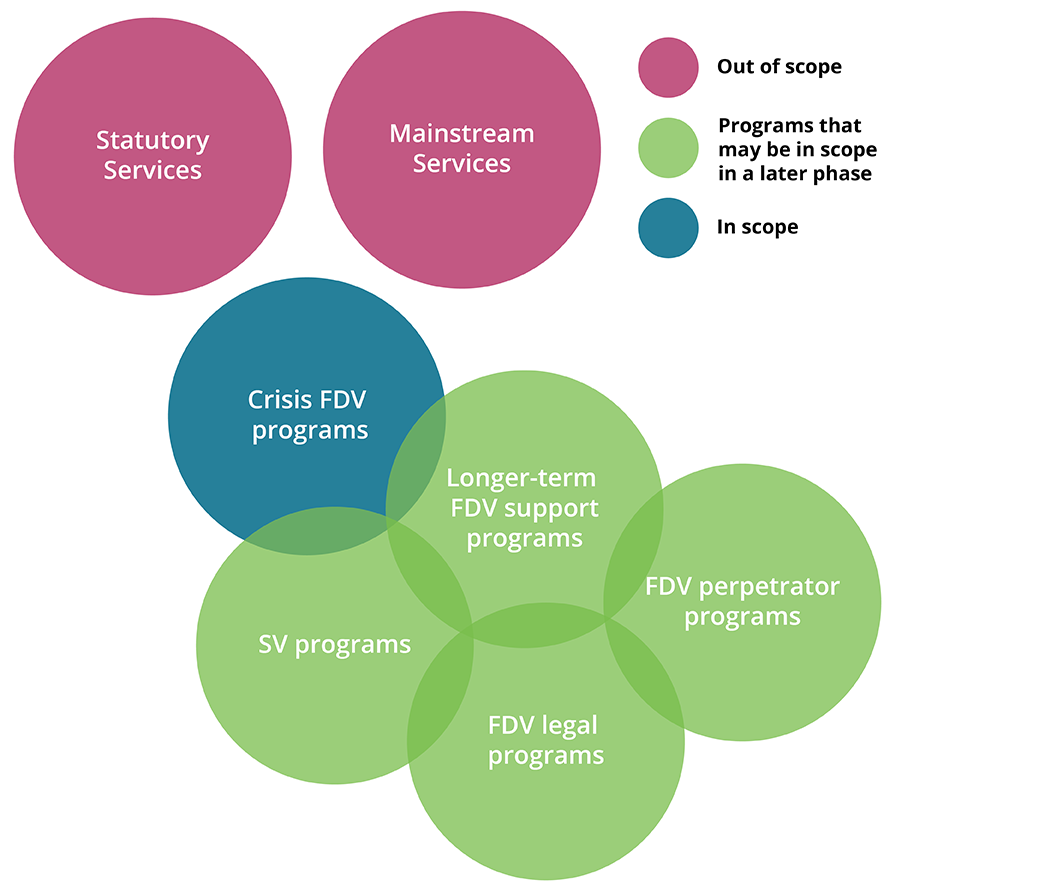
Note: The overlaps in the diagram indicate that the same service provider organisation may be funded to provide multiple programs. ‘SV’ refers to sexual violence.
The diagram features coloured overlapping circles with labels indicating different categories and relationships.
The diagram shows that Crisis FDV programs are in scope for this project, while Statutory services and Mainstream services are out of scope. The following are not currently in scope, but may be in scope in a later phase: Longer-term FDV support programs, Sexual violence (SV) programs, FDV legal programs, and FDV perpetrator programs.
The diagram shows there is some overlap across the programs that are currently in-scope and those that may be in scope at a later phase.
A key focus of this project is to more precisely define this scope so it can be implemented consistently across jurisdictions taking into consideration government funding arrangements. The programs that services deliver are funded, defined and structured in varying ways and the term ‘crisis’ is used differently across jurisdictions and service contexts (refer to ‘How complex is the operating environment of crisis FDV services’ below). This project provides an opportunity to test a practical typology of specialist crisis FDV service types, which can support a nationally consistent data collection while recognising jurisdictional variation and the broader service system in which these services operate.
As Figure 2 shows, the in-scope services for this project represent one part of a broader, interconnected specialist service system that supports people experiencing and using violence. Future data improvement work can be undertaken in stages to explore the inclusion of additional specialist services, informed by learnings from this project and drawing on related national data initiatives underway.
How complex is the operating environment of crisis FDV services?
Over time, a complex service system and operating environment has evolved. This complexity is driven by variation in funding models, service delivery models and state and territory legislation related to FDV across jurisdictions. This in turn influences the complexity of what, and how, data are collected and reported within and across jurisdictions. These factors can impact on the design of a national data collection.
The funding models for specialist FDV services can be complex and time-limited and vary between jurisdictions – Every state and territory government provides funding for specialist crisis FDV services in their jurisdiction. The Australian Government also provides some funding to states and territories for such services. The majority of specialist crisis FDV services are provided by non-government organisations. Services may be funded by multiple sources from different levels of government (state or territory and Australian Government) and multiple government portfolio areas (for example, community services and justice).
Services often have complex and burdensome data and reporting requirements linked to funding – Many services have overlapping but varying data and reporting requirements across multiple funding contracts. As a result, they have to collect lots of ‘similar but slightly different’ data, and may also have to duplicate data across multiple data systems and reporting outputs. Many services are struggling to manage the competing demands of multiple funders. When data burden is high and time-consuming, there is less capacity to provide services to people. As part of this project, the AIHW engaged a third-party consultant to consult and advise on the technical implications of a future national data collection. This work aims to prioritise potential solutions that leverage existing data systems, where possible.
Examples of data burden associated with complex funding arrangements
A medium-sized service provider organisation uses 3 different data systems plus Excel spreadsheets to meet their contractual data and reporting requirements. Data are not connected across systems, so duplicate manual data entry is required. The organisation currently has 24 contracts, all requiring quarterly reporting.
‘Crisis’ is used differently across jurisdictions and service contexts – ‘Crisis’ can be defined by both urgency and level of risk, depending on the context. ‘Crisis’ can also be identified subjectively by an individual, and an intervention that is considered a crisis response to one person may not be considered a crisis response by another person. As part of the pilot data collection, the AIHW is testing a definition of crisis based on urgency, that is used as a point-in-time criteria for identifying a person in scope.
Service type definitions vary between service provider organisations and jurisdictions – There are many terms that are commonly used to describe programs and activities delivered to victim-survivors of FDV. However, there are no standard national definitions. For example, ‘case management’ and ‘case coordination’ are terms that are used by many services participating in the pilot data collection, but can be used to refer to different programs or activities.
The service delivery models used in each state and territory differ from one another – This has implications for the referral pathways that are likely to be used in each jurisdiction. For example, all but one jurisdiction has a central intake line/helpline that is specific to FDV and is used to connect victim-survivors with crisis accommodation and specialist FDV services. In some data systems, incoming referrals will automatically populate selected data fields, which may make implementing changes for a national data collection more complex.
What else influences data collection for these services?
Other key considerations include data systems used, technology barriers, client consent, and the perceived usefulness of the data collected.
Many different systems are used to record client data – Over 25 different client management systems have been identified. Additional systems are also in use for reporting requirements, funding accountability, accommodation vacancy management, and multi-agency data sharing for high-risk cases. The systems differ in regard to purpose, data items and data structure. Services are often required to use a particular system as part of their funding requirements. Many services use multiple data systems, and may need to manually duplicate data entry across systems (see ‘data burden’ above).
Technology barriers can limit data collection – Access to suitable IT equipment, and the level of training and support available to staff to strengthen data literacy and computer skills, may impact the extent and quality of data that can be collected. This is particularly likely to be a challenge for smaller organisations, and those located in remote communities.
An example of streamlined technology solutions
A smaller-sized software developer offers customised joined-up solutions to service provider organisations, enabling them to meet all their varying data and reporting requirements using one data system, with automated data outputs. By reducing data burden, this gives organisations more capacity to provide services to people, and also changes the way they use the data (for example, more innovation, data quality improves).
Consent and privacy are a high priority for protecting client trust – Services work hard to build relationships and trust with their vulnerable clients. Many services are very risk-averse and go beyond legal requirements for consent, as they value their client relationships so highly. Ensuring a client feels safe and supported is considered a higher priority than the collection of data. This can impact the type of data collected and reported, for example, services are very cautious with how they store and use identifying information (such as name and date of birth).
The perceived usefulness and accessibility of the data being collected can impact data quality – Services want the data they collect to be meaningful and relevant to their clients and their service delivery context. Data entry is usually done by frontline workers; data quality will often be poor if frontline workers don’t understand the purpose or benefit of the data being collected. For services that support clients with cultural and linguistic diversity, the data is likely to be of a better quality if it is easily understood and can be collected in a culturally safe and relevant way.
Services also want to be able to access and use the data they collect to better understand client needs, the client journey and what responses work, so this can inform their own practice. This issue is exacerbated by data burden (discussed above), and where the data system limits the ability of services to extract and analyse the data they collect.
An example of high perceived usefulness of data
A large national service provider organisation has a centralised data system that allows them to customise the items collected, and to undertake detailed analysis of the data. There is a dedicated team focused on impact measurement and evaluation. They do a lot of capacity-building with the caseworkers who do data entry, to show them how the data is used to inform practice, and help them understand the importance of data quality. High quality data then supports further analysis and insights.
- Previous page Specialist crisis FDV services pilot project
- Next page FDV pilot – Key resources for participants