

Accidental poisoning

Accidental poisoning is caused by exposure to a substance in an amount that unintentionally causes harm. Intentional poisoning injuries are included under self-harm and suicide or assault and homicide and cases of poisoning where intent could not be determined are categorised under the cause group undetermined or other unintentional causes.

Among women in 2022–23, accidental poisoning was the third leading cause of injury deaths and the ninth leading cause of injury hospitalisation with:

  • Hospitalisations 2022–23

    3,299 hospitalisations

    2% of all injury hospitalisations

    Age-standardised rate of 30.8 hospitalisations per 100,000 population

  • Deaths 2022-23

    425 deaths

    7% of all injury deaths

    Age-standardised rate of 4.3 deaths per 100,000 population

In this report, only the type of substance responsible for the accidental poisoning is described, without consideration for the means through which the substance was obtained (including regular prescriptions, over-the-counter medication, or illicitly obtained substances). We note however that the adverse side effects of correctly prescribed medication consumed at the correct dosage are not in the scope of this report.

For more information on the health impact of alcohol and other drugs, see the AIHW reports on Alcohol, tobacco and other drugs in Australia, and on Illicit use of drugs.

Hospitalised injury cases are described using ICD-10-AM. We have shortened ICD-10-AM codes to define the following 10 categories for accidental poisoning:

  • Non-opioid analgesics, antipyretics and antirheumatics, including (but not limited to) nonsteroidal anti-inflammatory drugs (NSAIDs)
  • Antiepileptics, sedatives and psychotropics, including (but not limited to) antidepressants, psychostimulants and tranquilisers
  • Narcotics, opioids and hallucinogens, including (but not limited to) opioids such as codeine, morphine and heroin
  • Other drugs acting on the autonomic nervous system
  • Other and unspecified drugs and biological substances, including pharmaceutical and biological substances not classified elsewhere, such as anaesthetics, antibiotics and other anti-infectives, hormones and their synthetic substitutes and antagonists, and others. This category is also used in mortality data (but not in hospitalisations data) to record cases of deaths caused by multi-drug toxicity
  • Alcohol
  • Organic solvents, including (but not limited to) petroleum and its derivatives, and including vapours from organic solvents
  • Other gases and vapours, including (but not limited to) carbon monoxide and exhaust fumes
  • Pesticides
  • Other and unspecified noxious substances, including (but not limited to) chemicals not elsewhere classified such as paints or corrosive substances.

We refer hereafter to these 10 categories to identify the type of substance responsible for cases of accidental poisoning hospitalisation or death.

Death rates due to accidental poisoning dropped to their lowest in the last decade

The age-standardised rate for accidental poisoning hospitalisations among women steadily decreased from 2015–16 to 2019–20 before a sudden spike in 2020–21 followed by a significant drop to a rate of 30.7 per 100,000 population in 2021–22 (Figure 22). There was more fluctuation over the years for deaths with the ASR peaking in 2015–16 (5.6 per 100,000 population) and most recently dropping to the lowest rate of the last decade in 2022–23 (4.3 per 100,000 population).

Figure 22: Number and age-standardised rate (per 100,000) of injury hospitalisations and deaths due to accidental poisoning, Australia, 2013–14 to 2022–23
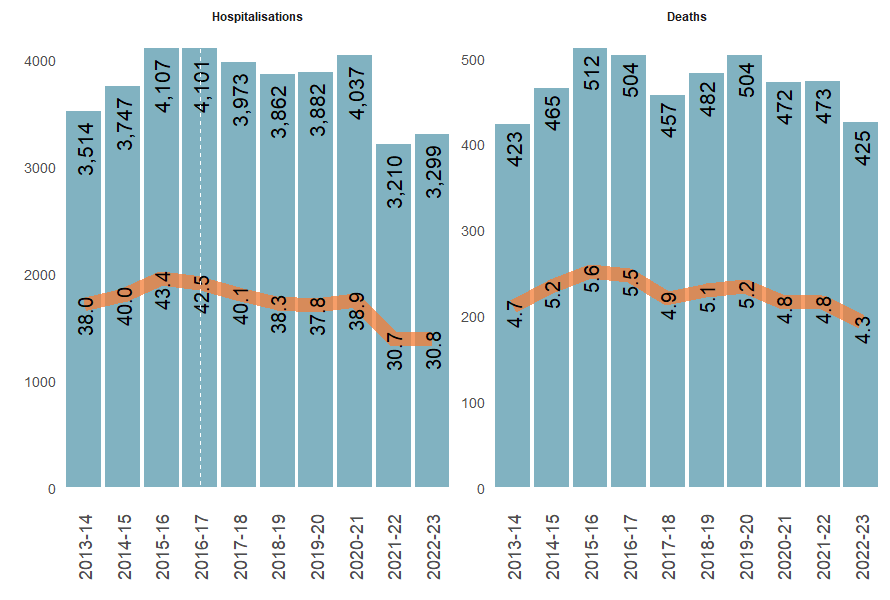
Trends of numbers of women’s injury hospitalisations and deaths showing decrease in accidental poisoning injury hospitalisations since 2017–18 and slight decrease in homicide death rates over last 10 years.

Sources: AIHW National Hospital Morbidity Database, AIHW National Mortality Database, and ABS National, state and territory population.

Notes:

  1. Only includes records where patient was aged 19 and over and patient’s sex recorded as female.
  2. Rates are age-standardised per 100,000 population.
  3. Columns are case counts, the line graph presents age-standardised rate per 100,000 population.
  4. The dashed line presents a break in the time series, see Technical notes for detail.

Most accidental poisoning hospitalisations involved unspecified drugs, medicaments and biological substances

Among women in 2022–23, the 3 most common groups of substances involved in an accidental poisoning hospitalisation were (Figure 23):

  • Other and unspecified drugs, medicaments and biological substances (1,107 hospitalisations, or 33.6%)
  • Antiepileptic, sedative-hypnotic, antiparkinsonism and psychotropic drugs, not elsewhere classified (791 hospitalisations, or 24.0%)
  • Narcotics and psychodysleptics [hallucinogens], not elsewhere classified (476 hospitalisations or 14.4%)

Figure 23: Number and age-standardised rate (per 100,000) of accidental poisoning injury hospitalisations among women by substance type, Australia, 2022–23

Ranked descending by number, type of substance for injury hospitalisations due to accidental poisoning showing other and unspecified drugs, medicaments and biological substances most common method for injury hospitalisations.

Ranked descending by number, type of substance for injury hospitalisations due to accidental poisoning showing other and unspecified drugs, medicaments and biological substances most common method for injury hospitalisations.

Sources: AIHW National Hospital Morbidity Database, and ABS National, state and territory population.

Notes:

  1. Only includes records where patient was aged 19 and over and patient’s sex recorded as female.
  2. Rates are age-standardised per 100,000 population.
  3. Rates where underlying numerator count is under 20 are excluded from display.
  4. Hospitalisation counts under 5 are excluded from display.

The top 3 leading categories of substances associated with accidental poisoning deaths among women in 2022–23 were (Figure 24):

  • Other and unspecified drugs, medicaments and biological substances (241 deaths, or 56.7%)
  • Antiepileptic, sedative-hypnotic, antiparkinsonism and psychotropic drugs, not elsewhere classified (78 deaths, or 18.4%)
  • Alcohol (50 deaths, 11.8%).

The substance category of other and unspecified drugs, medicaments and biological substances cannot be directly compared between hospitalisations and deaths due to different coding practices. For hospitalisations and deaths, this substance category includes records where the injury or death is caused by drugs or biological substances not elsewhere classified. However, the deaths coding practice additionally includes records where death was caused by multiple drugs or biological substances.

Figure 24: Number and age-standardised rate (per 100,000) of accidental poisoning injury deaths among women by substance type, Australia, 2022–23

 Ranked descending by number, type of substance for injury deaths due to accidental poisoning showing other and unspecified drugs, medicaments and biological substances most common substance involved for injury deaths due to accidental poisoning.

 Ranked descending by number, type of substance for injury deaths due to accidental poisoning showing other and unspecified drugs, medicaments and biological substances most common substance involved for injury deaths due to accidental poisoning.

Sources: AIHW National Mortality Database, and ABS National, state and territory population.

Notes:

  1. Only includes records where patient was aged 19 and over and patient’s sex recorded as female.
  2. Rates are age-standardised per 100,000 population.
  3. Rates where underlying numerator count is under 20 are excluded from display.
  4. Death counts under 3 are excluded from display.

Accidental poisoning hospitalisations were more common among women aged 65 years and over and deaths were more common for women aged 40 to 64 years

Women aged 65 and over had the highest rate of injury hospitalisation cause by accidental poisoning (45.1 per 100,000 population) (Figure 25). Injury deaths due to accidental poisoning were highest among women aged 40 to 64 years (6.9 per 100,000 population).

  • Rates of injury hospitalisation were highest among women aged 19 to 24 for substances:

    • Antiepileptic, sedative-hypnotic, antiparkinsonism and psychotropic drugs, not elsewhere classified (11.2 per 100,000 population)
    • Nonopioid analgesics, antipyretics and antirheumatics (4.7 per 100,000 population)
  • Rates of injury hospitalisation were highest among women aged 65 and over for substances:

    • Other and unspecified drugs, medicaments and biological substances (19.6)
    • Narcotics and psychodysleptics [hallucinogens], not elsewhere classified (6.0)
    • Other drugs acting on the autonomic nervous system (4.1)

    Rates per 100,000 population

Figure 25: Number and crude rate (per 100,000) of injury hospitalisations and deaths due to accidental poisoning by substance type and age, Australia, 2022–23

Number and crude rates of injury hospitalisations and deaths due to accidental poisoning by age group and substance type involved showing that the age patterns varied between the different substance type categories. For all poisons, women aged 65 and over had the highest rate of injury hospitalisation and women aged 40 to 64 had the highest rate of injury death.

Number and crude rates of injury hospitalisations and deaths due to accidental poisoning by age group and substance type involved showing that the age patterns varied between the different substance type categories. For all poisons, women aged 65 and over had the highest rate of injury hospitalisation and women aged 40 to 64 had the highest rate of injury death.

Sources: AIHW National Hospital Morbidity Database, AIHW National Mortality Database, and ABS National, state and territory population.

Notes:

  1. Only includes records where patient was aged 19 and over and patient’s sex recorded as female.
  2. Rates are crude per 100,000 population.
  3. Rates where underlying numerator count is under 10 are excluded from display.
  4. Hospitalisation counts under 5 are excluded from display.
  5. Death counts under 3 are excluded from display. Substance type involved is derived from the nominal external cause.

Women hospitalised for accidental poisoning were more likely to spend time in ICU compared to all causes

The proportion of women hospitalised for injury from accidental poisoning who spent time in an Intensive care unit (ICU) and proportion that had spent time on continuous ventilatory support (CVS) were both significantly higher than the average for all injuries among women in 2022–23 (Table 8)

The average length of stay in hospital for accidental poisoning was lower than the average for all injuries among women (2.5 and 3.6 days respectively).

Table 8: Severity measures of accidental poisoning injury hospitalisations among women, Australia, 2022–23

Severity measure

Accidental poisoning injuries

All injuries

Average length of stay (ALOS)

2.5

3.6

Proportion (%) spent time in Intensive Care Unit (ICU)

12.2

2.5

Proportion (%) spent time on Continuous Ventilatory Support (CVS)

7.3

1.0

Proportion (%) died in-hospital

0.5

0.7

Sources: AIHW National Hospital Morbidity Database.

Notes:

  1. Only includes records where patient was aged 19 and over and patient’s sex recorded as female.
  2. Average length of stay (ALOS) includes admissions that are transfers from one hospital to another or transfers from one admitted care type to another within the same hospital, except where care involved rehabilitation procedures.
  3. All injuries includes accidental poisoning in the total calculations.

Most accidental poisoning injuries occur in the home

Excluding records with missing place information, the most common places accidental poisoning injuries among women occurred were:

  • in the home (1,661 hospitalisations, 50.3%)
  • in a health service area (138 hospitalisations, 4.2%)
  • in an aged care facility (98 hospitalisations, 3.0%).

Place of occurrence information was missing or unspecified for 37% of accidental poisoning injury hospitalisations. Almost 9 in 10 (87%) accidental poisoning injury hospitalisations had missing or unspecified information on activity at the time of injury. 

For more information, see supplementary data tables.