

Assault and homicide

Family, domestic and sexual violence (FDSV) is a major health and welfare issue in Australia, occurring across all socioeconomic and demographic groups, but predominantly affecting women and children. These types of violence can have a serious impact on individuals, families and communities and can inflict physical injury, psychological trauma and emotional suffering. These effects can be long-lasting and can affect future generations.

For information, support and counselling contact 1800RESPECT on 1800 737 732 or visit the 1800RESPECT website. See also Find support for a list of support services.

Visit AIHW FDSV website for more detail about assault injuries in the context of family, domestic and sexual violence. Please note that findings from this report may not be comparable to findings presented in the AIHW FDSV website due to differences in the scope used for reporting. Assault and homicide in this report are not restricted to cases where family, domestic or sexual violence is identified.

Intentional violence against another person is classified as assault (injury) or homicide (death). ED presentations are not reported by cause due to the quality of available information. For women in 2022–23, assault was the seventh leading cause of injury hospitalisation and homicide was the ninth leading cause of injury death.

These intentional injuries resulted in:

  • Hospitalisations 2022-23

    7,649 hospitalisations

    4% of all women's injury hospitalisations

    Age-standardised rate of 81.4 per 100,000 population

  • Deaths 2022-23

    63 deaths

    1% of all women's injury deaths

    Age-standardised rate of 0.6 per 100,000 population

Assault injury hospitalisations have increased over the past decade

The age-standardised rate of assault injury hospitalisations among women gradually increased between 2017–18 and 2019–20 followed by a sharp decline during the COVID pandemic period until 2021–22 before returning to an increasing trend in 2022–23 (Figure 17). The homicide death ASR has remained relatively stable over the last 7 years.

Figure 17: Number and age-standardised rate (per 100,000) of assault injury hospitalisations and homicide deaths among women, Australia, 2013–14 to 2022–23
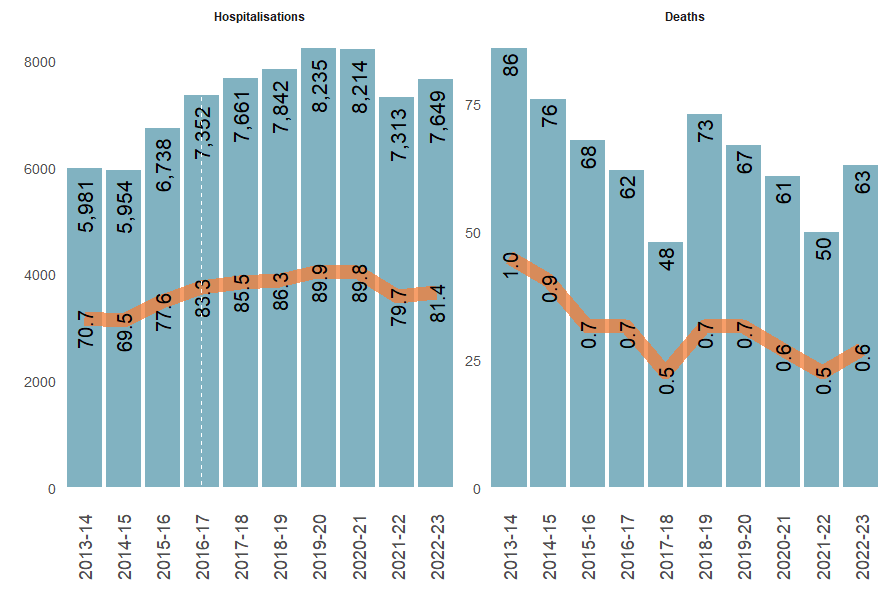
 Trends of numbers of women’s injury hospitalisations and deaths showing small decrease in assault injury hospitalisations since 2017–18 and decrease on homicide death rates over last 10 years.

Sources: AIHW National Hospital Morbidity Database, AIHW National Mortality Database, and ABS National, state and territory population.

Notes:

  1. Only includes records where patient was aged 19 and over and patient’s sex recorded as female.
  2. Rates are age-standardised per 100,000 population.
  3. Columns are case counts, the line graph presents age-standardised rate per 100,000 population.
  4. The dashed line presents a break in the time series, see Technical notes for detail.

Assault by bodily force was the leading type of assault resulting in injury hospitalisation for women

Almost 9 in 10 assault injury hospitalisations among women in 2022–23 were due to some type of physical assault (6,624 hospitalisations or 86.6%), with assault by bodily force the most common assault type reported (4,285 hospitalisations, ASR 369.3 per 100,000 women) (Figure 18).

Figure 18: Number and age-standardised rate (per 100,000 women) of assault injury hospitalisations and homicide deaths, by type of assault, Australia, 2022–23

Ranked descending by number, type of assault for injury hospitalisations and deaths due to assault and homicide showing assault by bodily force most common method for injury hospitalisations and assault by sharp object most common method of homicide injury deaths.

Ranked descending by number, type of assault for injury hospitalisations and deaths due to assault and homicide showing assault by bodily force most common method for injury hospitalisations and assault by sharp object most common method of homicide injury deaths.

Sources: AIHW National Hospital Morbidity Database, AIHW National Mortality Database, and ABS National, state and territory population.

Notes:

  1. Only includes records where patient was aged 19 and over and patient’s sex recorded as female.
  2. Rates are age-standardised per 100,000 population.
  3. Rates where underlying numerator count is under 20 are excluded from display.
  4. Hospitalisation counts under 5 are excluded from display.
  5. Death counts under 3 are excluded from display.
  6. Assault by other substances excludes drugs, medicaments and biological substances.

Spouses or domestic partners perpetrated half of all assault injury hospitalisations for women

Spouses or domestic partners were the leading perpetrators of assault injury hospitalisations among women (3,799 hospitalisations, 49.7%). This was true for all age groups, except women aged 65 years and over, where other family member was the most common perpetrator (Figure 19). Conversely, other family member was the second most common perpetrator of assault injury hospitalisation for all age groups, except women aged 65 years and over, where the second most common perpetrator of assault injury hospitalisations was a spouse or domestic partner. The perpetrator was not specified in 14% of assault injury hospitalisations (1,087 hospitalisations) in 2022–23.

Figure 19: Number and crude rate (per 100,000 population) of assault hospitalisations by perpetrator and age group, Australia, 2022–23

Number and crude rates of injury hospitalisations due to assault by age group and perpetrator showing women aged 65 and over were most commonly reported other family member as the perpetrator and for all other age groups the most commonly reported perpetrator was spouse or domestic partner

Number and crude rates of injury hospitalisations due to assault by age group and perpetrator showing women aged 65 and over were most commonly reported other family member as the perpetrator and for all other age groups the most commonly reported perpetrator was spouse or domestic partner

Sources: AIHW National Hospital Morbidity Database, and ABS National, state and territory population.

Notes:

  1. Only includes records where patient was aged 19 and over and patient’s sex recorded as female.
  2. Rates are crude per 100,000 population.
  3. Rates where underlying numerator count is under 10 are excluded from display.
  4. Hospitalisation counts under 5 are excluded from display.
  5. Perpetrator is derived from the nominal external cause.

The most common injury was open wounds to the head and neck

Almost 3 in 5 (59%) injury hospitalisations due to assault among women were for one of the following three types of injury:

  • Open wounds

    1,617 or 21.1% of women's injury hospitalisations in 2022–23

  • Fractures

    1,527 or 20.0% of women's injury hospitalisations in 2022–23

  • Superficial injuries

    1,381 or 18.1% of women's injury hospitalisations in 2022–23

The head and neck was the leading site of injury for assault injury hospitalisations among women (4,412 hospitalisations, 57.7%) and was the most common body part injured for all types of injury except other specified and/or multiple injuries (Figure 20).

Figure 20: Number of assault injury hospitalisations among women by type of injury and body part injured, Australia, 2022–23

Number of body part injured by type of injury heatmap table showing open wound to the head, superficial injury to the head, and unspecified injury to the head were most common injuries women were hospitalised with from an assault.

Number of body part injured by type of injury heatmap table showing open wound to the head, superficial injury to the head, and unspecified injury to the head were most common injuries women were hospitalised with from an assault.

Sources: AIHW National Hospital Morbidity Database, and ABS National, state and territory population.

Notes:

  1. Only includes records where patient was aged 19 and over and patient’s sex recorded as female.
  2. Rates are age-standardised per 100,000 population.
  3. Rates where underlying numerator count is under 20 are excluded from display.
  4. Hospitalisation counts under 5 are excluded from display.
  5. Type of injury and body part injured are both derived from the principal diagnosis.

Where place was specified, the home was the commonest recorded place where women were injured

About half (49%) of assault injury hospitalisations had information recorded on the place of occurrence of the assault. Excluding hospitalisations where the place of occurrence was unspecified or missing (3,897 hospitalisations, 51.0%), the most recorded place of occurrence for assault injuries among women was in the home (2,584 hospitalisations, 33.8%). 

Hospitalised assault injuries were generally less severe than average

Based on multiple hospitalisation severity measures, assault injuries were generally less severe than the average for all injuries among women (Table 7).

Table 7: Severity measures of assault injury hospitalisations among women, Australia, 2022–23

Severity measure

Assault injuries

All injuries

Average length of stay (ALOS)

1.6

3.6

Proportion (%) spent time in Intensive Care Unit (ICU)

0.8

2.5

Proportion (%) spent time on Continuous Ventilatory Support (CVS)

0.4

1.0

Proportion (%) died in-hospital

0.1

0.7

Sources: AIHW National Hospital Morbidity Database.

Notes:

  1. Only includes records where patient was aged 19 and over and patient’s sex recorded as female.
  2. Average length of stay (ALOS) includes admissions that are transfers from one hospital to another or transfers from one admitted care type to another within the same hospital, except where care involved rehabilitation procedures.
  3. All injuries includes assault in the total calculations.

Half of women with assault injuries received social work care during hospitalisation

Social work (allied health) was the most common intervention received with almost half (47%) of assault injury hospitalisations receiving this service during their hospital stay.  On average, women hospitalised for assault injuries received fewer interventions than the average for all causes of injury (1.3 and 2.5 interventions respectively). 

  • Assault 1.3 All injury 2.5

    Interventions during hospitalisation

    On average, women hospitalised for assault injuries received fewer interventions during hospitalisation than for all causes of injury.

  • Assault hospitalisations vs deaths

    Women aged under 40 years are most likely to be hospitalised for assault injuries, women aged 65 and over are most likely to die by homicide

Women aged 25 to 39 years were most likely to be hospitalised for assault injuries while women aged 65 years and over were most likely to die by homicide

In 2022–23, women aged 25 to 39 years had the highest rate of assault injury hospitalisation (126.8 per 100,000 population), followed by women aged 19 to 24 (114.3 per 100,000 population) (Figure 21). Women aged 65 and over had the highest rate of homicide (0.8 per 100,000 population) despite having the lowest rate of assault injury hospitalisation (15.5 per 100,000 population).

Figure 21: Number and crude rate (per 100,000) of assault injury hospitalisations and homicide deaths by and age group, Australia, 2022–23
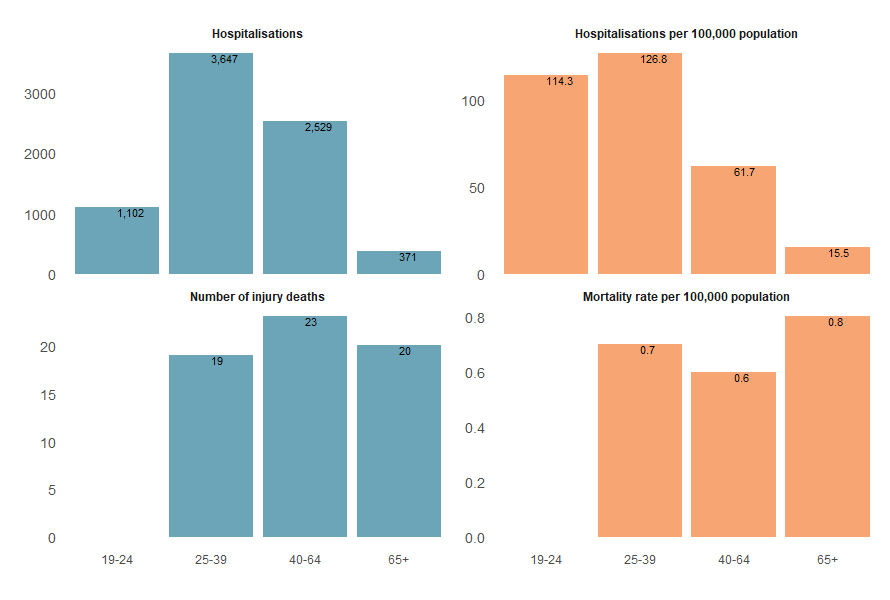
Bar chart of crude rate of assault injury hospitalisations and homicide deaths by age group showing older age groups having higher rates of death by homicide and younger age groups having higher rates of injury hospitalisations due to assault.

Sources: AIHW National Hospital Morbidity Database, AIHW National Mortality Database, and ABS National, state and territory population.

Notes:

  1. Only includes records where patient was aged 19 and over and patient’s sex recorded as female.
  2. Rates are crude per 100,000 population.
  3. Rates where underlying numerator count is under 10 are excluded from display.
  4. Hospitalisation counts under 5 are excluded from display.
  5. Death counts under 3 are excluded from display.

Women aged 19 to 24 years experienced higher rates of injury hospitalisation due to sexual assault

The rate of sexual assault injury hospitalisation decreased with increasing age. Women aged 19 to 24 years were most likely to have sexual assault recorded during their assault injury hospitalisations (5.4 per 100,000 women) compared with other age groups in 2022–23. The same pattern was observed among women’s assault injury hospitalisations from other, maltreatment or legal interventions: the highest rates were for women aged 19 to 24 years (13.4 per 100,000 population) and rates decreased with increasing age.

  • Physical assault, the most common category of assault hospitalisations among women, had no age-related pattern in 2022–23.

Women aged 25 to 29 years had the highest rate of hospitalised injury due to physical assault (110.6 per 100,000 population) compared with other age groups, closely followed by women aged 19 to 24 years who had the second highest rate (95.5 per 100,000 population).

For more information, see supplementary data tables.