

Other unintentional causes
Other unintentional causes describes unintentional injury hospitalisations and deaths where the principal cause of injury was not captured in any other external cause category, or where there may not have been enough information to specify the cause of injury. Other unintentional causes was the second leading cause of injury hospitalisation and the sixth-ranked cause of death among women in 2022–23. These injuries resulted in:
-
Hospitalisations 2022–23
19,406 hospitalisations
9% of all injury hospitalisations
Age-standardised rate of 182.4 hospitalisations per 100,000 population
-
Deaths 2022-23
130 deaths
2% of all injury deaths
Age-standardised rate of < 0.1 deaths per 100,000 population
Injury hospitalisation rate due to other unintentional causes increased
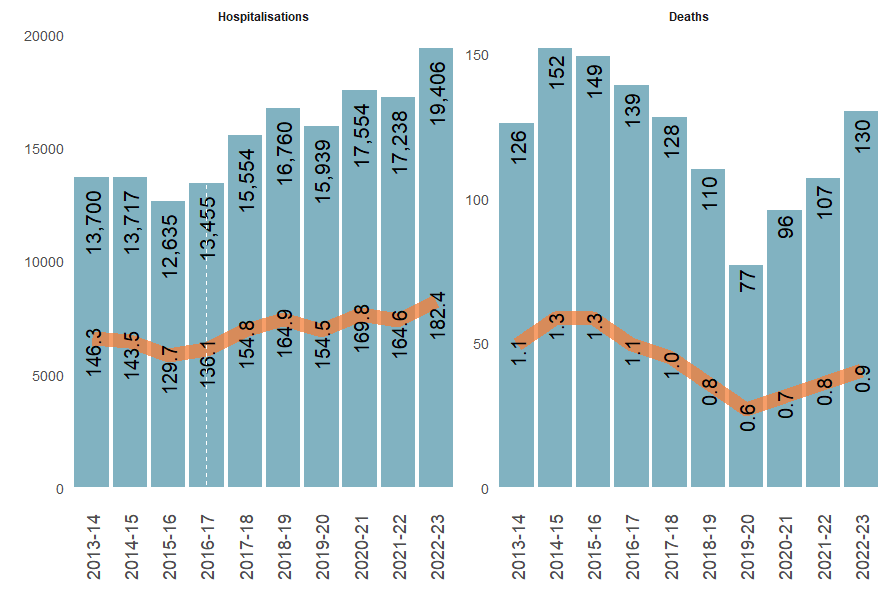
The age-standardised rate (ASR) of injury hospitalisations among women due to other unintentional causes has generally increased over the past decade with some fluctuations in the overall upwards trend (Figure 34). The ASR of injury death for women due to other unintentional causes peaked at 1.3 per 100,000 population in 2014–15 before dropping to 0.6 per 100,000 in 2019-20, the lowest ASR in the last ten years. The deaths ASR has steadily increased from 2019-20 to 2022–23.
Figure 34: Number and age-standardised rate (per 100,000) of injury hospitalisations and deaths among women due to other unintentional causes, Australia, 2013–14 to 2022–23
Sources: AIHW National Hospital Morbidity Database, AIHW National Mortality Database, and ABS National, state and territory population.
Notes:
- Only includes records where patient was aged 19 and over and patient’s sex recorded as female.
- Rates are age-standardised per 100,000 population.
- Columns are case counts, the line graph presents age-standardised rate per 100,000 population.
- The dashed line presents a break in the time series, see Technical notes for detail.
Most injury hospitalisations and deaths due to other causes were due to an unspecified factor
Other unintentional causes are comprised of 2 ICD-10-AM cause codes:
- Exposure to other specified factors (X58)
- Exposure to unspecified factor (X59).
Across all age groups, exposure to unspecified factor (X59) accounted for most injury hospitalisations and deaths among women due to other unintentional causes (Figure 35).
Figure 35: Number and crude rate (per 100,000) of injury hospitalisations and deaths among women due to other unintentional causes by age group, Australia, 2022-23
Injury hospitalisations and deaths due to other unintentional causes by age group showing exposure to unspecified factor as most common specific cause of injury hospitalisations and death for all age groups.
Sources: AIHW National Hospital Morbidity Database, AIHW National Mortality Database, and ABS National, state and territory population.
Notes:
- Only includes records where patient was aged 19 and over and patient’s sex recorded as female.
- Rates are crude per 100,000 population.
- Rates where underlying numerator count is under 10 are excluded from display.
- Hospitalisation counts under 5 are excluded from display.
- Death counts under 3 are excluded from display.
- Type of other unintentional cause was derived from the nominal external cause.
Injuries to the head and neck were less common compared to all injuries among women
Injuries to the head and neck were less common among hospitalisations due to other unintentional causes (1,639 hospitalisations, 8.4%) compared to all injuries (45,119 hospitalisations, 20.8%) (Table 11). Injuries to the hip and lower limb was the leading body part injured for women hospitalised for other unintentional causes (6,819 hospitalisations, 35.1%) and was more common compared with all hospitalised injuries among women (53,463 hospitalisations, 24.6%).
Body part | Proportion (%) for Other unintentional injuries | Proportion (%) for all injuries |
|---|---|---|
Head and neck | 8.4 | 20.8 |
Trunk | 8.2 | 14.7 |
Shoulder and upper limb | 21.7 | 17.8 |
Wrist and hand | 16.5 | 9.5 |
Hip and lower limb | 35.1 | 24.6 |
Ankle and foot | 8.9 | 4.1 |
Injuries not described in terms of body location | 0.8 | 7.7 |
Other, multiple and incompletely specified | 0.3 | 0.8 |
Sources: AIHW National Hospital Morbidity Database.
Notes:
- Only includes records where patient was aged 19 and over and patient’s sex recorded as female.
- All injuries includes other unintentional causes in the calculations.
- Hip and lower limb excludes ankle and foot.
- Shoulder and upper limb exclude wrist and hand.
- Trunk includes thorax, abdomen, lower back, lumbar spine and pelvis.
Injury hospitalisations for women due to other unintentional causes were less severe than overall average
Injuries for women due to other unintentional causes were on average less severe than all injury hospitalisations among women in 2022–23 (Table 12). The proportion of women hospitalised for injury due to other unintentional causes that spent time in an Intensive Care Unit (ICU) was around 4 times lower than the proportion observed for all injury hospitalisations among women.
Severity measure | Other unintentional injuries | All injuries |
|---|---|---|
Average length of stay (ALOS) | 2.1 | 3.6 |
Proportion (%) spent time in Intensive Care Unit (ICU) | 0.6 | 2.5 |
Proportion (%) spent time on Continuous Ventilatory Support (CVS) | <0.1 | 1.0 |
Proportion (%) died in-hospital | 0.2 | 0.7 |
Sources: AIHW National Hospital Morbidity Database.
Notes:
- Only includes records where patient was aged 19 and over and patient’s sex recorded as female.
- Average length of stay (ALOS) includes admissions that are transfers from one hospital to another or transfers from one admitted care type to another within the same hospital, except where care involved rehabilitation procedures.
- All injuries includes other unintentional causes in the total calculations.
For more information, see supplementary data tables.