


Falls
Deaths due to falls increased
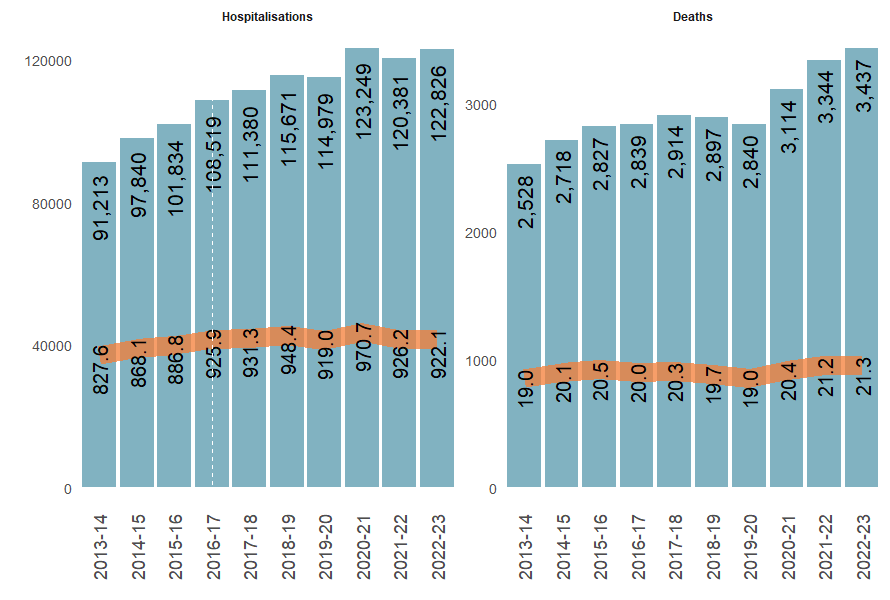
Over the past decade, age-standardised rates for fall injury deaths among women have generally increased, apart from a drop in 2019–20 likely due to the impact of COVID-19 restrictions. Death rates due to falls are currently the highest of the last decade (Figure 14).
Like deaths, injury hospitalisation rates due to falls experienced a drop in 2019–20 before peaking in 2020–21.
The number of women hospitalised or dying due to falls related injuries has steadily increased over the past decade, with deaths in particular accelerating in the last 3 financial years.
Figure 14: Number and age-standardised rate (per 100,000) of injury hospitalisations and deaths due to falls among women, Australia, 2013–14 to 2022–23
Sources: AIHW National Hospital Morbidity Database, AIHW National Mortality Database, and ABS National, state and territory population.
Notes:
- Only includes records where patient was aged 19 and over and patient’s sex recorded as female.
- Rates are age-standardised per 100,000 population.
- Columns are case counts, the line graph presents age-standardised rate per 100,000 population.
- The dashed line presents a break in the time series, see Technical notes for detail.
Falls occurring on the same level are the leading type of fall resulting in an injury hospitalisation for women
In 2022–23, slipping tripping or stumbling on the same level was the most common fall type for injury hospitalisations (46,302 hospitalisations, ASR 348.7 per 100,000 population) and remained the most common fall type for all age groups (Figure 15).
60% of all unintentional fall deaths for women in 2022–23 were caused by an unspecified fall with the next most common cause of falls death being slipping tripping or stumbling on the same level followed by fall on and from stairs and steps.
Figure 15: Number and age-standardised rate (per 100,000) of injury hospitalisations and deaths due to falls by type of fall, Australia, 2022–23
Ranked list of specific types of fall for hospitalisations and deaths due to falls showing fall on same level from slipping, tripping and stumbling most common for injury hospitalisations and unspecified fall most common for fall injury deaths.
body part injured by type of injury heatmap table showing fractures to hip and lower limb, shoulder and upper limb, and the trunk were most common injuries women were hospitalised with from a fall.

Australia’s population is ageing, and women represent an increasing proportion of Australians aged 65 years and over (AIHW 2024a). As they age, women aged 65 years and over face an increased risk of falls due to multiple factors including musculoskeletal decline, osteoporosis, cognitive decline such as dementia (Lary et al. 2021), as well as their longer life expectancy compared to men (AIHW 2024b). For fall-related injuries among older Australians, please refer to AIHW report Falls in older Australians.
The overall rate of fall hospitalisations increased with age. Women aged 65 years and over accounted for 73% of all fall-related hospitalisations among women in 2022–23 (89,584 hospitalisations, 3,740.4 per 100,000 population) and were over 15 times more likely to be hospitalised for a falls injury than young women (2,318 hospitalisations, 240.4 per 100,000 population). The age patterns of injury hospitalisations varied by the specific fall types, with almost all types of falls showing that rate of injury hospitalisations either increased or decreased with age (Table 6). Fall from cliff, fall while being carried or supported by other persons and other fall from one level to another were the only types of fall where no age-related pattern was observed in 2022–23.
Women aged 65 years and over accounted for almost all deaths due to unintentional falls (3,437 deaths, 97%) in 2022-23, while no women aged 19 to 24 years died from an unintentional fall in the same year.
Type of fall | Age pattern of rate | Age group with highest rate (crude rate per 100,000) |
|---|---|---|
Fall on same level from slipping, tripping and stumbling (W01) |
| 65+ (1,415.1) |
Other fall on same level (W18) |  Increases | 65+ (916.4) |
Unspecified fall (W19) | Increases | 65+ (826.8) |
Fall on and from stairs and steps (W10) | Increases | 65+ (228.9) |
Fall involving bed (W06) | Increases | 65+ (145.3) |
Fall involving chair (W07) | Increases | 65+ (88.4) |
Other fall from one level to another (W17) |  No age-related pattern | 65+ (37.2) |
Fall involving ice-skates, skis, roller-skates, skateboards, scooters and other pedestrian conveyances (W02) |  Decreases | 19-24 (24.3) |
Fall involving wheelchair (W05) | Increases | 65+ (22.5) |
Fall on and from ladder (W11) | Increases | 65+ (22.3) |
Other fall on same level due to collision with, or pushing by, another person (W03) | Decreases | 19-24 (19.0) |
Fall from, out of or through building or structure (W13) | Increases | 65+ (7.2) |
Fall involving other furniture (W08) | Increases | 65+ (3.0) |
Fall involving playground equipment (W09) | Decreases | 19-24 (2.6) |
Diving or jumping into water causing injury other than drowning or submersion (W16) | Decreases | 19-24 (2.3) |
Fall while being carried or supported by other persons (W04) | No age-related pattern | 19-24 (2.0) |
Fall from cliff (W15) | No age-related pattern | 19-24 (1.7) |
Fall on same level involving ice and snow (W00) | Increases | 65+ (0.6) |
All fall types (W00-W19) | Increases | 65+ (3,740.4) |
Sources: AIHW National Hospital Morbidity Database and ABS National, state and territory population.
Notes:
- Only includes records where patient was aged 19 and over and patient’s sex recorded as female.
- Rates are crude per 100,000 population.
- Rates where underlying numerator count is under 10 are excluded from display.
- Some fall types were exclude from display due to small case counts.
Women living with dementia experienced heightened risks of falls
The rate of dementia increases rapidly with age and nearly two-thirds (63%) of Australians with dementia are women (AIHW 2024c). Dementia impacts a person’s balance and gait control and people living with dementia are almost 3 times more likely to fall compared to cognitively healthy individuals (AIHW 2024d; Ordoobado et al. 2024). For more detail on injuries among people, including women, living with dementia, please refer to the recent AIHW report on Hospitalised falls among people living with dementia.