


First Nations women
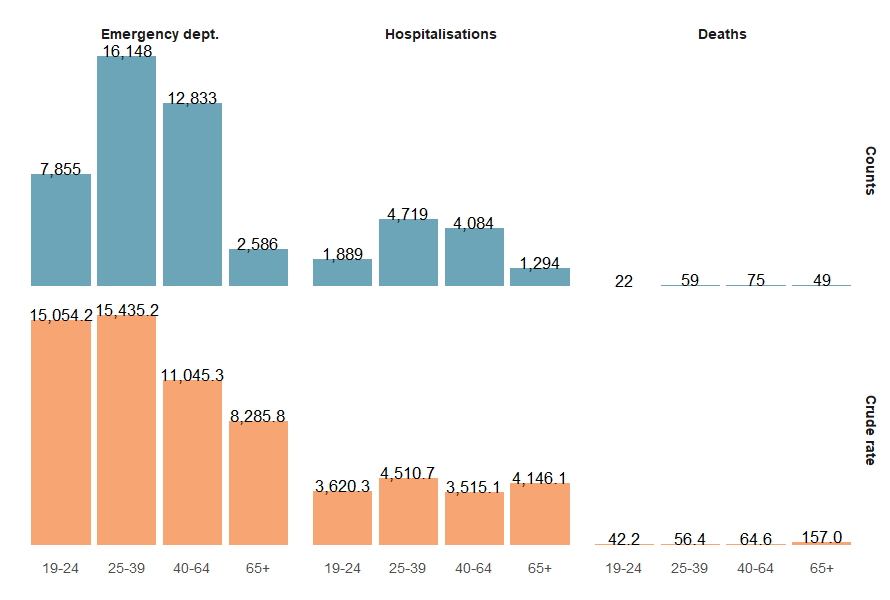
First Nations women aged 25 to 39 years had the highest rates of injury hospitalisations (4,510.7 per 100,000 population) and ED presentations (15,435.2 per 100,000 population) (Figure 38). For injury deaths, First Nations women aged 65 years and over had the highest rates at 157 per 100,000 population.
Figure 38: Number and crude rate (per 100,000) of injury hospitalisations, deaths and ED presentations for First Nations women by age group, Australia, 2022–23
Sources: AIHW National Non-Admitted Patient Emergency Department Care Database, AIHW National Hospital Morbidity Database, AIHW National Mortality Database, and ABS National, state and territory population.
Notes:
- Only includes records where patient was aged 19 and over and patient’s sex recorded as female.
- Rates are crude per 100,000 population.
- Rates where underlying numerator count is under 10 are excluded from display.
- Hospitalisation counts under 5 are excluded from display.
- Death counts under 3 are excluded from display.
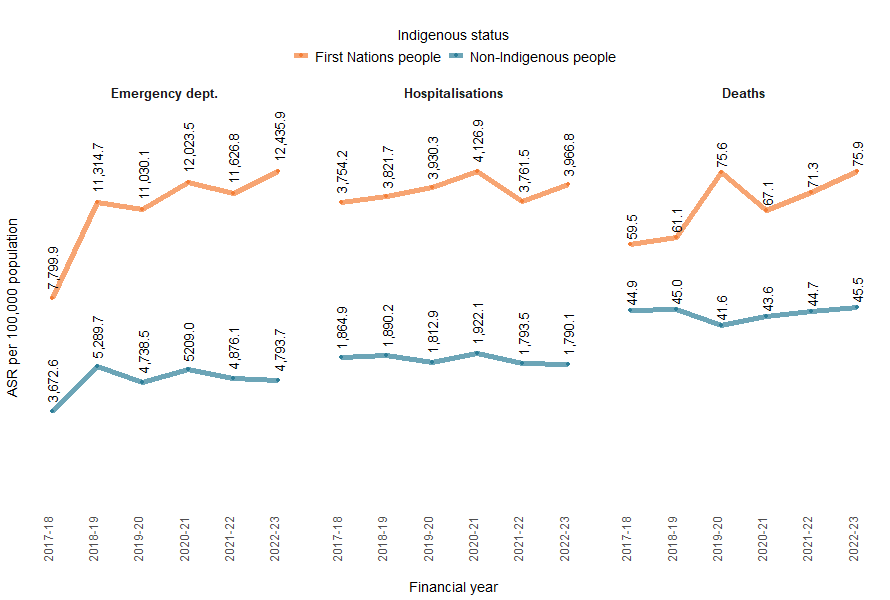
Rates of injury were higher among First Nations women than non-Indigenous women
These gaps have widened over the last 6 years (Figure 39).
Figure 39: Age-standardised rate (per 100,000) of injury hospitalisations, ED presentations and deaths for women by Indigenous status, 2017–18 to 2022–23
Sources: AIHW National Non-Admitted Patient Emergency Department Care Database, AIHW National Hospital Morbidity Database, AIHW National Mortality Database, and ABS National, state and territory population.
Notes:
- Only includes records where patient was aged 19 and over and patient’s sex recorded as female.
- Rates are age-standardised per 100,000 population.
- Rates where underlying numerator count is under 20 are excluded from display.
Assault was the leading cause of injury hospitalisation among First Nations women
Assault was the leading cause of injury hospitalisation among First Nations women in 2022–23 (3,661 hospitalisations). First Nations women disproportionately contributed to almost half (47.8%) of assault hospitalisations for all women. In 2022–23, 7 First Nations women died from homicide.
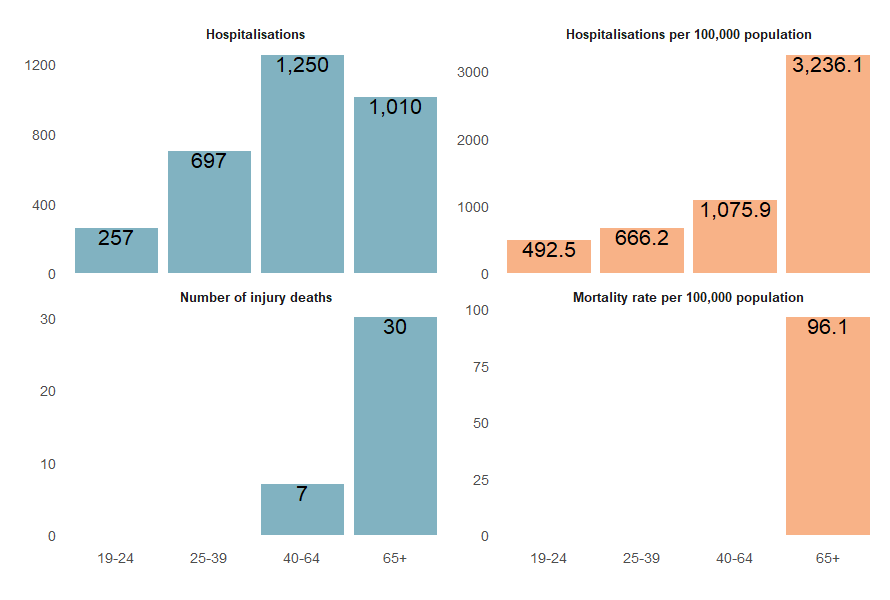
The rate of fall injury hospitalisation increased with age for First Nations women. Deaths due to falls were limited to the two oldest age groups, 40 to 64 year old women and women aged 65 years and over (Figure 40).
Figure 40: Number and crude rate (per 100,000) of injury hospitalisations and deaths due to falls among First Nations women by age group, Australia, 2022–23
Sources: AIHW National Hospital Morbidity Database, AIHW National Mortality Database, and ABS National, state and territory population.
Notes:
- Only includes records where patient was aged 19 and over and patient’s sex recorded as female.
- Rates are crude per 100,000 population.
- Rates where underlying numerator count is under 10 are excluded from display.
- Hospitalisation under 5 are excluded from display.
- Death counts under 3 are excluded from display.
Falls on the same level were the most common cause of fall injury hospitalisations and collectively made up more than half (1,859 hospitalisations or 57.8%) of all fall injury hospitalisations for First Nations women.
First Nations women experienced higher rates of injury hospitalisations for almost all types of falls, except for falls on and from a ladder where higher rates were observed for non-Indigenous women than First Nations women (ASR 10.2 and 8.5 per 100,000 women respectively).
Accidental poisoning hospitalisation rate among First Nations women was highest for those aged 40-64
Accidental poisoning is the second leading cause of injury deaths among First Nations women (41 deaths, ASR 14.7 per 100,000 population) and the eighth leading cause of hospitalisation (226 hospitalisations, ASR 75.3 per 100,000 population).
Figure 41: Number and crude rate (per 100,000) of injury hospitalisations and deaths due to accidental poisoning among First Nations women by age group, Australia, 2022–23
Injury hospitalisations and deaths due to accidental poisoning for First Nations women by age group showing First Nations women aged 40 to 64 with highest rate of injury death and injury hospitalisation.

Figure 42: Number and crude rate (per 100,000) of intentional self-harm injury hospitalisations and deaths by suicide for First Nations women, Australia, 2022–23
Injury hospitalisations due to intentional self-harm and deaths due to suicide by age group for First Nations women showing First Nations women aged 25 to 39 with highest death by suicide rate and First Nations women aged 19 to 24 with highest intentional self-harm injury hospitalisation rate.

First Nations women were more likely to be injured in transport accidents as a pedestrian
Transport accidents were the fourth leading cause of injury death among First Nations women (35 deaths, 17%) and the fifth leading cause of injury hospitalisation among First Nations women in 2022–23 (861 hospitalisations, 7%).
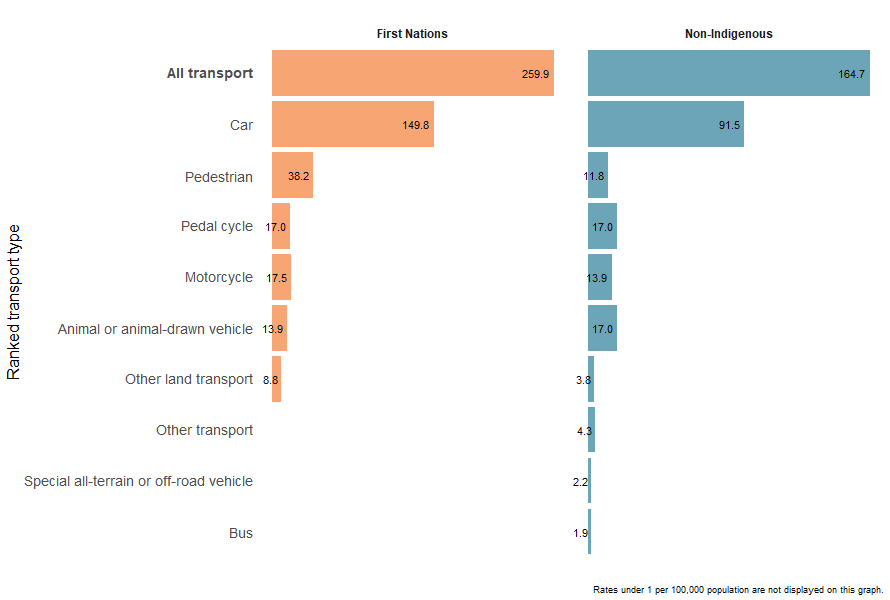
The car was the most common vehicle type involved, making up almost two-thirds (59%) of all transport-related injury hospitalisations for First Nations women. First Nations women were more likely to be hospitalised from a transport-related injury as a pedestrian than non-Indigenous women (ASR 38.2 and 11.8 per 100,000 population respectively) (Figure 43). However, non-Indigenous women were more likely than First Nations women to be hospitalised from transport accident injuries as an occupant of an animal or animal-drawn vehicle (ASR 17.0 and 13.9 per 100,000 population respectively). First Nations and non-Indigenous women shared the same rate of transport injury hospitalisation for pedal cycles (ASR 17.0 per 100,000 population).
Figure 43: Age-standardised rates (per 100,000) of transport accident injury hospitalisation by vehicle type and Indigenous status, Australia, 2022–23
Sources: AIHW National Hospital Morbidity Database, and ABS National, state and territory population.
Notes:
- Only includes records where patient was aged 19 and over and patient’s sex recorded as female.
- Rates are age-standardised per 100,000 population.
- Rates where underlying numerator count is under 20 are excluded from display.
- Hospitalisation under 5 are excluded from display.
For more information, see supplementary data tables.