

Transport
This article describes unintentional transport injuries resulting in hospitalisation or death. Intentional transport injuries are included under Self-harm injuries and suicide or Assault and homicide. External causes of injury are not currently able to be ascertained reliably from emergency department data. For more detail, please see the Technical notes.
Transport accidents were the third leading cause of injury hospitalisation and the fifth leading cause of injury deaths among women in 2022–23. Transport accidents in 2022–23 resulted in:
-
Hospitalisations 2022–23
17,471 hospitalisations
8% of all injury hospitalisations
Age-standardised rate of 170.4 per 100,000 population
-
Deaths 2022-23
340 deaths
6% of all injury deaths
Age-standardised rate of 3.2 per 100,000 population
Most recent transport hospitalisation rates are the lowest in a decade
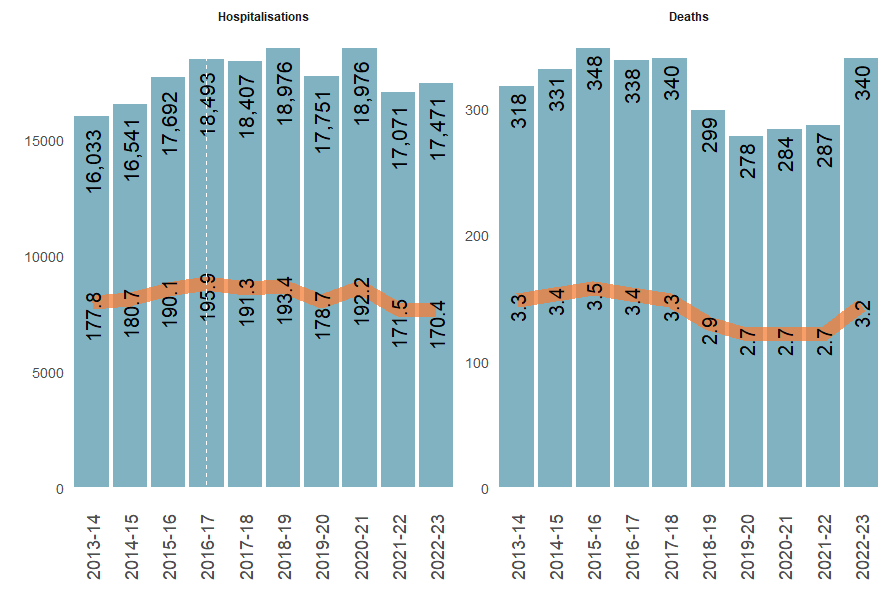
Rates of injury hospitalisation due to transport accidents among women have fluctuated since 2017-18, peaking in 2018-19 with an age-standardised rate (ASR) of 193.4 per 100,000 population and dropping in 2022–23 to the lowest recorded ASR in the last 10 years of 170.4 per 100,000 population (Figure 29).
For transport deaths, the highest ASR was observed in 2015–16 (3.5 per 100,000 population) and declined to an ASR of 2.7 per 100,000 population in 2019-20 and remained unchanged until 2022–23 where the ASR increased up to 3.2 per 100,000 population.
Figure 29: Number and age-standardised rate (per 100,000) of transport injury hospitalisations and deaths among women, Australia, 2013–14 to 2022–23
Sources: AIHW National Hospital Morbidity Database, AIHW National Mortality Database, and ABS National, state and territory population.
Notes:
- Only includes records where patient was aged 19 and over and patient’s sex recorded as female.
- Rates are age-standardised per 100,000 population.
- Columns are case counts, the line graph presents age-standardised rate per 100,000 population.
- The dashed line presents a break in the time series, see Technical notes for detail.
Cars accounted for over half of all transport accident injury hospitalisations and deaths
-
Transport injuries
Cars were the biggest causes of women's transport injury hospitalisations and deaths. The bars show the percentages of women's transport injuries caused by cars.
In 2022–23, over half of all transport-related injury hospitalisations and deaths were for women occupying cars at the time of the transport accident (9,770 hospitalisations or 55.9% and 209 deaths or 61.5%) (Figure 30). The next most common vehicle types involved in hospitalised injury for women were pedal cycles (1,775 hospitalisations, 10.1%) followed by animal or animal-drawn vehicle (1,652 hospitalisations, 9.5%). The distribution of vehicle types differs between women and the general Australian population and for detailed breakdowns on transport accident injuries within Australia, please refer to the recent AIHW report on Injury in Australia: Transport accidents.
Figure 30: Number and age-standardised rate (per 100,000) of injury hospitalisations and deaths due to transport accidents among women by vehicle type, Australia, 2022–23
Vehicle type for injury hospitalisations and deaths due to transport accidents ranked descending by vehicle type showing car, pedal cycle and animal or animal-drawn vehicle most common vehicle involved in injury hospitalisations and car, pedestrian and other land transport most common vehicle types involved for injury deaths due to transport accidents.
Sources: AIHW National Hospital Morbidity Database, AIHW National Mortality Database, and ABS National, state and territory population.
Notes:
- Only includes records where patient was aged 19 and over and patient’s sex recorded as female.
- Rates are age-standardised per 100,000 population.
- Rates where underlying numerator count is under 20 are excluded from display.
- Hospitalisation counts under 5 are excluded from display.
- Death counts under 3 are excluded from display.
- Type of vehicle was derived from the nominal external cause.
Most transport injury hospitalisations were due to collision with a car, pick-up truck or van
A car colliding with a car, pick-up truck or van was the most common transport accident type resulting in injury hospitalisation for women in 2022–23 (5,925 hospitalisation, 33.9%) (Figure 31). Pedestrians were also most likely to be hospitalised for injury from a collision with a car, pick-up truck or van, but for all other specified land vehicles, non-collision accidents was the leading accident type.
Figure 31: Number of transport injury hospitalisations among women by vehicle type and counterpart, Australia, 2022–23
Number of injury hospitalisations due to transport accidents by vehicle type involved and counterpart showing car, pick-up truck or van the most common counterpart involved for most vehicle types and the next most common was a non-collision accident.
Sources: AIHW National Hospital Morbidity Database.
Notes:
- Only includes records where patient was aged 19 and over and patient’s sex recorded as female.
- Hospitalisation counts under 5 are excluded from display.
- Type of vehicle and counterpart were both derived from the nominal external cause.
Fracture to the trunk of the body was the most common injury for transport-related hospitalisations
Women were most likely to be hospitalised due to a transport accident for an injury to their:
-
Trunk (thorax, abdomen, lower back, lumbar spine & pelvis)
5,658 hospitalisations, 32%, or ASR 54.3 per 100,000 population
-
Head and neck
4,934 hospitalisations, 28%, or ASR 49.5 per 100,000 population
-
Shoulder and upper limb (excluding wrist and hand)
2,922 hospitalisations, 17%, or ASR 28.4 per 100,000 population
Fracture was the leading type of injury for women hospitalised due to transport accidents in 2022–23, more specifically a fracture to (Figure 32):
- the trunk (thorax, abdomen, lower back, lumbar spine & pelvis) (2,617 hospitalisations, 15.0%)
- the shoulder and upper limb (2,010 hospitalisations, 11.5%)
- the hip and lower limb (1,471 hospitalisations, 8.4%).
Almost 20% of all transport injury hospitalisations (3,464 hospitalisations) had missing or insufficient information on the type of injury sustained. This unspecified group was the second most common type of injury recorded for transport injuries, with injuries to:
- the head and neck (1,489 hospitalisations, 8.5%)
- the trunk (thorax, abdomen, lower back, lumbar spine & pelvis) (1,446 hospitalisations, 8.3%)
- the shoulder and upper limb (excluding wrist and hand) (231 hospitalisations, 1.3%).
Figure 32: Number and age-standardised rate (per 100,000) of transport accident injury hospitalisations among women by type of injury and body part injured, Australia, 2022–23
Body part injured by type of injury heatmap table showing fractures to the trunk, to the shoulder and upper limb and to the hip and lower limb were the most common injuries women were hospitalised with due to a transport accident.
Sources: AIHW National Hospital Morbidity Database, and ABS National, state and territory population.
Notes:
- Only includes records where patient was aged 19 and over and patient’s sex recorded as female.
- Rates are age-standardised per 100,000 population.
- Type of injury and body part injured are both derived from the principal diagnosis.
- Injuries not described in terms of body location are excluded from display.
- Counts under 5 are excluded from display.
- Rates where underlying numerator count is under 20 are excluded from display.
Women hospitalised for transport accident injury were more likely to spend time in ICU or time on CVS
The proportion of women hospitalised for transport injuries that spent time in an Intensive Care Unit (ICU) or on Continuous Ventilatory Support (CVS) were higher than the average for all causes of injury hospitalisation among women in 2022–23 (Table 10). However, the average length of stay (ALOS) and proportion of in-hospital deaths were both lower.
Over a third (38%) of transport injuries received physiotherapy care during their hospitalisation and was the most common intervention received for all age groups.
Severity measure | Transport injuries | All injuries |
|---|---|---|
Average length of stay (ALOS) | 3.1 | 3.6 |
Proportion (%) spent time in Intensive Care Unit (ICU) | 3.7 | 2.5 |
Proportion (%) spent time on Continuous Ventilatory Support (CVS) | 1.6 | 1.0 |
Proportion (%) died in-hospital | 0.5 | 0.7 |
Sources: AIHW National Hospital Morbidity Database.
Notes:
- Only includes records where patient was aged 19 and over and patient’s sex recorded as female.
- Average length of stay (ALOS) includes admissions that are transfers from one hospital to another or transfers from one admitted care type to another within the same hospital, except where care involved rehabilitation procedures.
- All injuries includes transport in the total calculations.
Women aged 19 to 24 years were most likely to die or be hospitalised from transport accident injuries
Women aged 19 to 24 years had the highest rate of injury hospitalisation and death from transport accidents (253.1 per 100,000 population) in 2022–23 (Figure 33).
The overall rate of transport-related injury hospitalisation decreases with age but there is an uptick in the oldest age group, women aged 65 and over. The age patterns of injury hospitalisations vary between the different vehicle types. The rate of hospitalised injury for pedal cyclists and bus occupants mostly increased with age, rates for animal or animal-drawn vehicles and motorcycles generally decreased with age, and the rates for car occupants and pedestrians were like the overall pattern, decreases with age but rises slightly for women aged 65 years and over.
Figure 33: Number and crude rate (per 100,000) of transport-related injury hospitalisations and deaths by age group and type of vehicle, Australia, 2022–23
Injury hospitalisations and deaths due to transport accidents by age group showing women aged 19 to 24 having highest rates if injury hospitalisation and injury death for most vehicle types and there was some variation across the vehicle types.
Sources: AIHW National Hospital Morbidity Database, AIHW National Mortality Database, and ABS National, state and territory population.
Notes:
- Only includes records where patient was aged 19 and over and patient’s sex recorded as female.
- Rates are crude per 100,000 population.
- Rates where underlying numerator count is under 10 are excluded from display.
- Hospitalisation counts under 5 are excluded from display.
- Death counts under 3 are excluded from display.
For more information, see supplementary data tables.