


Cancer incidence by country and region of birth for selected cancers
Non-Hodgkin lymphoma
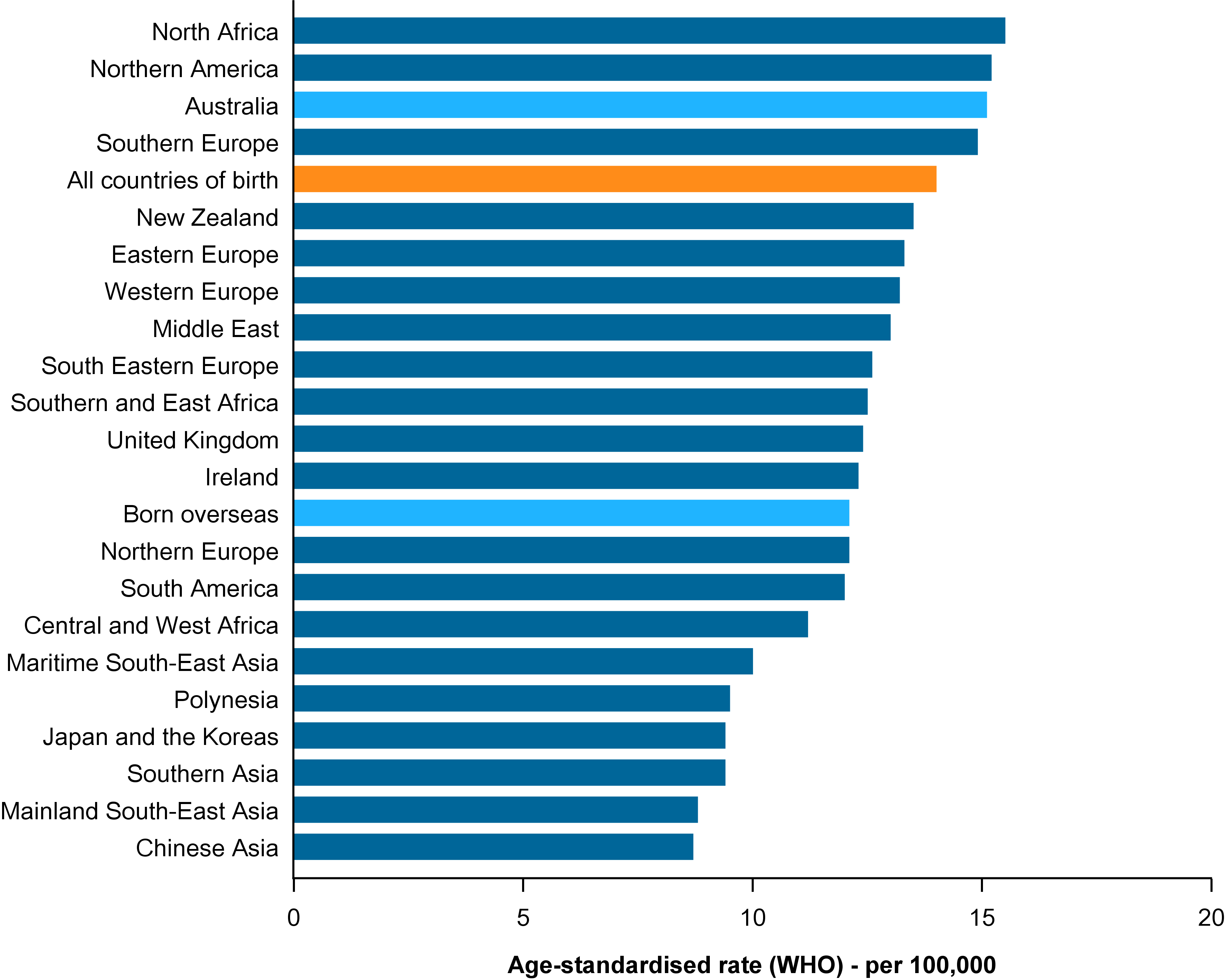
Non-Hodgkin lymphoma was the sixth most common cancer diagnosed for the 2006–2020 period for the Australia-born and overseas-born populations. The Hodgkin-lymphoma incidence rate for the period was around 15 cases per 100,000 people for the Australia-born population while for the overseas-born population it was lower at 12 cases per 100,000 people.
People born in Asian countries had lower incidence rates for non-Hodgkin lymphoma
The regions of birth (ROBs) with relatively high non-Hodgkin lymphoma incidence rates of more than 15 cases per 100,000 people were North Africa (15.5), Northern America (15.2), and Australia (15.1). Southern Europe was also one of the ROBs in the highest tier of rates in 2006–2020 at 14.9 cases per 100,000 people (Figure 16).
The incidence rate of non-Hodgkin lymphoma for the overseas-born population was lower than the Australia-born population. The lower incidence rate for the overseas-born population is influenced by the relatively low incidence for Asian ROBs. Asian ROB non-Hodgkin lymphoma incidence rates ranged from 8.7 (Chinese Asia) to 10 (Maritime South-East Asia) cases per 100,000 people. Polynesia-born people were the only ROB apart from Asian ROBs with non-Hodgkin lymphoma incidence rates below 10 cases per 100,000 people (with the Polynesia-born rate at 9.5 cases per 100,000 people) (Figure 16).
Figure 16: Non-Hodgkin lymphoma age-standardised incidence rates, by region of birth: persons, Australia, 2006–2020
Notes:
- Rates are age-standardised to the WHO World Standard Population and expressed cases per 100,000 persons.
- Includes regions of birth with on average 20,000 people living in Australia between 2006 and 2020 and 20 or more non-Hodgkin lymphoma cases diagnosed for the period. Excludes the regions of Central Asia and Melanesia which are discussed separately in Cancer incidence for selected countries and regions of birth. Also excludes regions of birth where non-Hodgkin lymphoma was not in the leading 20 cancers for the period.
- Born overseas includes born in any country except for Australia. All countries of birth rates are the national rates for Australia and includes the population born in Australia and all other countries.
Source: Australian Cancer Database 2020
Greece, Canada, Italy, Cyprus, Australia and France were the countries of birth with relatively high non-Hodgkin lymphoma incidence
There were six countries of birth (COBs) with relatively high non-Hodgkin lymphoma incidence rates of more than 15 cases per 100,000 people for 2006–2020 (Greece, Canada, Italy, Cyprus, Australia and France). Of these COBs, and referring to the rates estimated for the actual country the populations migrated from, only Greece did not have relatively high rates of non-Hodgkin lymphoma (rates within the country of Canada for 2022 was estimated at 12 cases per 100,000 people, Italy 12, Cyprus 11 and France (metropolitan) 11) (IARC 2022). It was estimated in 2022 that Greece had a non-Hodgkin lymphoma incidence rate of 7.4 cases per 100,000 people and this is much less than the Greece-born population living in Australia, which had a rate of 17.6 cases per 100,000 people for 2006–2020 (Figure 17).
The Greece-born population is one of the older populations within Australia (median age of 74 while the median age for the overseas-born population was 45, both as reported in the 2021 Census). The 2021 Census also noted that around 70% of the Greece-born population arrived in Australia in 1970 or earlier, the comparable percentage for the total overseas-born population was close to 13% (ABS 2021a).
Both reportable COBs from the North Africa ROB (that is, Egypt and Sudan) had non-Hodgkin lymphoma incidence rates of 14.7 cases per 100,000 people.
The COBs with non-Hodgkin lymphoma incidence rates below 8 cases per 100,000 people in 2006–2020 were Fiji (7.8), Bangladesh (7.3), Republic of Korea (7.1), Myanmar (7.0) and Taiwan (6.3). All of these COBs are from Asian ROBs with the exception of Fiji (Figure 17).
Fiji’s low rates influence the Polynesia-born ROBs lower rates (9.5 cases per 100,000 people) with the Samoa-born rate of 14.3 cases much closer to the Australian national rate (that is, all countries of birth in Australia) of 14 cases per 100,000 people. Indonesia-born people had the highest non-Hodgkin lymphoma rate of Asian COBs at 13.4 cases per 100,000 people, followed by Afghanistan-born (12.1), Japan-born (11.8) and Thailand-born (10.4) (Figure 17).
Figure 17: Non-Hodgkin lymphoma age-standardised incidence rates, by country of birth: persons, Australia, 2006–2020

Notes:
- Rates are age-standardised to the WHO World Standard Population and expressed cases per 100,000 persons.
- Includes countries of birth with on average 20,000 people living in Australia between 2006 and 2020 and 20 or more non-Hodgkin lymphoma cases diagnosed for the period. Excludes countries of birth where non-Hodgkin lymphoma was not in the leading 20 cancers for the period.
- Born overseas includes born in any country except for Australia. All countries of birth rates are the national rates for Australia and includes the population born in Australia and all other countries.
Source: Australian Cancer Database 2020
Kidney cancer
Asian regions of birth had lower rates of kidney cancer
For kidney cancer in 2006–2020, some regions of birth (ROBs) with higher incidence were comprised of countries of birth (COBs) with a wide range of rates. It was however apparent that Asian ROBs were more likely to have lower kidney cancer incidence rates.
The kidney cancer incidence rate for the Australia-born population in 2006–2020 was 10.4 cases per 100,000 people, overseas-born was 8.6 and the Australian national rate (that is, all countries of birth) was 9.8 cases per 100,000 people.
The ROBs with kidney cancer incidence rates below 7 cases per 100,000 people for 2006–2020 were Maritime South-East Asia (6.8), Southern Asia (6.6), Southern and East Africa (6.6), Chinese Asia (5.9), Polynesia (5.9), Japan and the Koreas (5.9), and Mainland South-East Asia (4.3).
The ROBs with the highest kidney cancer incidence rates were Central and West Africa and South America (both at 12.1 cases per 100,000 people). The Central and West Africa rate is based on a small number of cases (38) and should be treated with caution. The South America-born kidney cancer incidence rates are discussed below.
Figure 18: Kidney cancer age-standardised incidence rates, by region of birth: persons, Australia, 2006–2020

Notes:
- Rates are age-standardised to the WHO World Standard Population and expressed cases per 100,000 persons.
- Includes regions of birth with on average 20,000 people living in Australia between 2006 and 2020 and 20 or more kidney cancer cases diagnosed for the period. Excludes the regions of Central Asia and Melanesia which are discussed separately in Cancer incidence for selected countries and regions of birth. Also excludes regions of birth where kidney cancer was not in the leading 20 cancers for the period.
- Born overseas includes born in any country except for Australia. All countries of birth rates are the national rates for Australia and includes the population born in Australia and all other countries.
Source: Australian Cancer Database 2020
About the higher South American region of birth higher kidney cancer incidence rates
The South America region of birth (ROB) includes 15 COBs, around 13 have populations living in Australia but only two have population sizes large enough to be reported within this paper. These two are Chile-born and Brazil-born and for the 2006–2020 period they represent just under 47% of the South America-born population living in Australia.
The Chile-born kidney cancer incidence rate was 11.6 cases per 100,000 people and the Brazil-born rate was 7.9 cases per 100,000 people. Both are below the South America-born rate of 12.1 cases meaning the remaining unreportable COBs combined had a rate greater than 12.1 cases per 100,000 people. The Chile-born rate was one of the higher kidney cancer rates for the 2006–2020 period.
The Russian-Federation, Chile and Egypt countries of birth had the highest kidney cancer incidence rates
There were three COBs with kidney cancer incidence rates that were about 11 or more cases per 100,000 people or more. These COBs were the Russian Federation (15.8), Chile (11.6) and Egypt (11.4).
In 2022, the general population living in the countries relating to the above-mentioned COBs had estimated kidney cancer incidence rates of 11.8, 7.6 and 2.4 cases per 100,000 people respectively. The Russian Federation kidney cancer rate was the 6th highest of the countries reported (IARC 2022).
The Egypt-born population in Australia has much higher kidney cancer incidence than the country of Egypt
As noted earlier, the Egypt-born kidney cancer incidence was amongst the highest rates by country of birth (COB) in Australia. The estimated rate for the country of Egypt in 2022 was only 2.4 cases per 100,000 people. It is one of several cancers where the incidence rates for the Egypt-born population for the 2006–2020 period were very different from the rates for the country of Egypt in 2022 and was also amongst the higher rates compared to other countries of birth for those living in Australia.
The 2021 Census notes that around 62% of the Egypt-born population were of Egyptian ancestry, 10% of Greek ancestry, 5.2% of Italian, 4.0% of English and 3.8% of Australian ancestry (ABS 2021b). The extent the ancestry of the Egypt-born population differs from the country of Egypt, may contribute to differences in rates between the country and country of birth.
Differences in incidence rates between people born overseas and living in Australia and the respective country of origin may be due to a variety of factors. Within Australia, kidney cancer incidence rates have been increasing. Part of these increases may be due to the increase of incidental diagnosis of renal cell carcinomas (the most common type of kidney cancer). These tumours are smaller and their diagnosis provides a better prognosis (Al-Marhoon M et al. 2011). As with all international comparisons of incidence rates, differences in cancer detection between countries are likely to have some impact on incidence rate differences.
Most countries of birth with lower kidney cancer incidence rates were within Asia
In 2006–2020, the COBs with comparatively low kidney cancer incidence rates of around 6 cases per 100,000 people or less were Hong Kong (5.9), Serbia and Montenegro (5.9), Singapore (5.8), Zimbabwe (5.7), Fiji (5.6), Pakistan (5.3), Papua New Guinea (5.2), Vietnam (4.3), Japan (4.2), Cambodia (3.6), Taiwan (2.2) and Thailand (2.0). Most of these COBs were within Asia but Asian COBs did not all necessarily have low rates of kidney cancer.
The Afghanistan-born and Bangladesh-born population had the highest kidney cancer rate of the Asian COBs for 2006–2020 (10.8 and 9.6 cases per 100,000 people respectively) but these are smaller populations with a smaller number of cases for the period (42 and 40 cases respectively) and a higher degree of uncertainty (95% confidence interval of 6,5 to 16.2 and 5.4 to 15 cases per 100,000 people respectively).
Figure 19: Kidney cancer age-standardised incidence rates, by country of birth: persons, Australia, 2006–2020

Notes:
- Rates are age-standardised to the WHO World Standard Population and expressed cases per 100,000 persons.
- Includes countries of birth with on average 20,000 people living in Australia between 2006 and 2020 and 20 or more kidney cancer cases diagnosed for the period. Excludes countries of birth where kidney cancer was not in the leading 20 cancers for the period.
- Born overseas includes born in any country except for Australia. All countries of birth rates are the national rates for Australia and includes the population born in Australia and all other countries.
Source: Australian Cancer Database 2020
Pancreatic cancer
Mainland Europe regions of birth more commonly had higher pancreatic cancer rates
For the 2006–2020 period, pancreatic cancer was the eighth most commonly diagnosed cancer in Australia. For this period, Australia-born and overseas-born incidence rates were both around 8 cases per 100,000 people.
Pancreatic cancer incidence rates by region of birth (ROB) ranged between 4.9 and 13.1 cases per 100,000 people but the majority of regions of birth (ROBs) ranged between 7 and 10 cases per 100,000 people.
Central and West Africa’s rate of 13.1 cases per 100,000 people is based on a small number of cases (26) so it should be interpreted with caution. The regions of birth with comparatively higher rates were often in mainland Europe and ranged between 9.1 (Southern Europe) and 10.4 (Eastern Europe) cases per 100,000 people. North Africa-born, Middle East-born and South America-born pancreatic cancer incidence rates were similar to mainland Europe pancreatic cancer incidence rates (9.8, 9.7 and 9.5 cases per 100,000 people respectively).
Asian ROBs had the lowest pancreatic cancer incidence rates
The ROBs with the lowest pancreatic cancer incidence rates were all Asian ROBs. The rates ranged between 4.9 (Southern Asia) and 7.3 cases per 100,000 people (Japan and the Koreas). The Ireland born population also had comparatively low pancreatic cancer incidence rates for 2006–2020 at 7.3 cases per 100,000 people.
Figure 20: Pancreatic cancer age-standardised incidence rates, by region of birth: persons, Australia, 2006–2020

Notes:
- Rates are age-standardised to the WHO World Standard Population and expressed cases per 100,000 persons.
- Includes regions of birth with on average 20,000 people living in Australia between 2006 and 2020 and 20 or more pancreatic cancer cases diagnosed for the period. Excludes the regions of Central Asia and Melanesia which are discussed separately in Cancer incidence for selected countries and regions of birth. Also excludes regions of birth where pancreatic cancer was not in the leading 20 cancers for the period.
- Born overseas includes born in any country except for Australia. All countries of birth rates are the national rates for Australia and includes the population born in Australia and all other countries.
Source: Australian Cancer Database 2020
Malta, France and Hungary had higher pancreatic cancer incidence rates as did these populations living in Australia
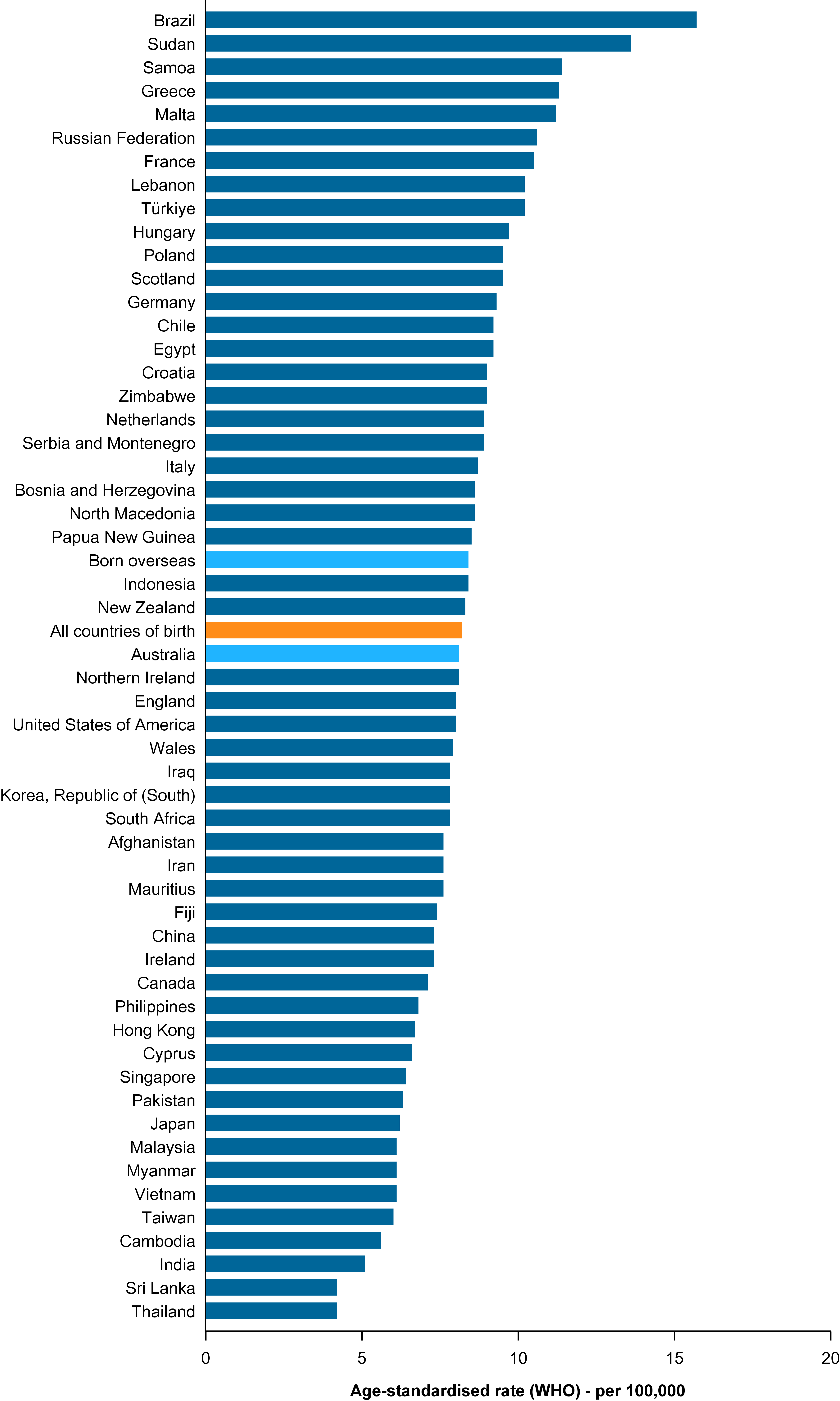
In 2006–2020, the countries of birth (COBs) with relatively high pancreatic cancer incidence rates were Brazil, Sudan, Samoa, Greece and Malta (15.7, 13.6, 11.4, 11.3, and 11.2 cases per 100,000 people respectively). Rates for Brazil and Sudan are based on smaller counts of cases (22 and 23 respectively) so should be treated with caution.
In 2022, the countries of Hungary, Japan, France (metropolitan), and Malta were among the 10 countries with the highest pancreatic cancer incidence rates estimated for 2022 (rates ranged between 9.0 to 10.4 cases per 100,000 people) (IARC 2022). Hungary-born, France-born and Malta-born populations living in Australia all had higher pancreatic cancer incidence rates for 2006–2020 (11.2, 10.5 and 9.7 cases per 100,000 people respectively). However, the Japan-born population living in Australia was amongst the COBs with comparatively low pancreatic cancer incidence rates in Australia for 2006–2020 (6.2 cases per 100,000 people).
Taiwan-born, Cambodia-born, India-born, Sri Lanka-born and Thailand-born people had the lowest rates of pancreatic cancer
Of the fourteen COBs with pancreatic cancer incidence rates below 7 cases per 100,000 people, only Cyprus (6.6 cases per 100,000 people) was not an Asian COB. The country of Cyprus in 2022 was amongst the COBs with comparatively high rates of pancreatic cancer, estimated at 8.6 cases per 100,000 people.
The COBs with pancreatic cancer incidence at or below 6 cases per 100,000 people were Taiwan (6.0), Cambodia (5.6), India (5.1), Sri Lanka (4.2) and Thailand (4.2). Of the Asian COBs, the following had relatively high pancreatic cancer incidence rates: Indonesia (8.4 cases per 100,000 people), Republic of Korea (7.8) and Afghanistan (7.6 cases per 100,000 people).
Figure 21: Pancreatic cancer age-standardised incidence rates, by country of birth: persons, Australia, 2006–2020
Notes:
- Rates are age-standardised to the WHO World Standard Population and expressed cases per 100,000 persons.
- Includes countries of birth with on average 20,000 people living in Australia between 2006 and 2020 and 20 or more pancreatic cancer cases diagnosed for the period. Excludes the regions of Central Asia and Melanesia which are discussed separately in Cancer incidence for selected countries and regions of birth. Also excludes countries of birth where pancreatic cancer was not in the leading 20 cancers for the period.
- Born overseas includes born in any country except for Australia. All countries of birth rates are the national rates for Australia and includes the population born in Australia and all other countries.
Source: Australian Cancer Database 2020
Thyroid cancer
Thyroid cancer incidence rates have been increasing in Australia. Increasing rates of thyroid cancer are likely to be the result of an increase in medical surveillance and the introduction of new diagnostic techniques, such as neck ultrasonography (Vaccarella et al. 2016).
Thyroid cancer is more common in females and the disparity between the Australia-born and overseas-born populations is most evident in female populations (Table 5). Therefore, the majority of discussion within this section focusses on thyroid cancer incidence for females.
| Population | 2006–2010 | 2011–2015 | 2016–2020 | 2006–2020 |
|---|---|---|---|---|
Australia-born | ||||
Males | 3.8 | 5.0 | 5.8 | 4.9 |
Females | 10.8 | 13.2 | 14.6 | 13.0 |
Persons | 7.3 | 9.1 | 10.2 | 9.0 |
Born overseas | ||||
Males | 3.8 | 5.2 | 6.2 | 5.2 |
Females | 13.2 | 15.9 | 17.1 | 15.6 |
Persons | 8.6 | 10.7 | 11.8 | 10.5 |
All countries of birth | ||||
Males | 3.8 | 5.1 | 5.9 | 5.0 |
Females | 11.6 | 14.1 | 15.5 | 13.9 |
Persons | 7.7 | 9.6 | 10.8 | 9.5 |
Notes:
- Rates are age-standardised to the WHO World Standard Population and expressed cases per 100,000 population (that is, per 100,000 females for females, per 100,000 males for males and per 100,000 people for persons).
- Born overseas includes born in any country except for Australia. All countries of birth rates are the national rates for Australia and includes the population born in Australia and all other countries.
Source: Australian Cancer Database 2020
Females in the Middle East and Asian regions of birth had high thyroid cancer incidence rates
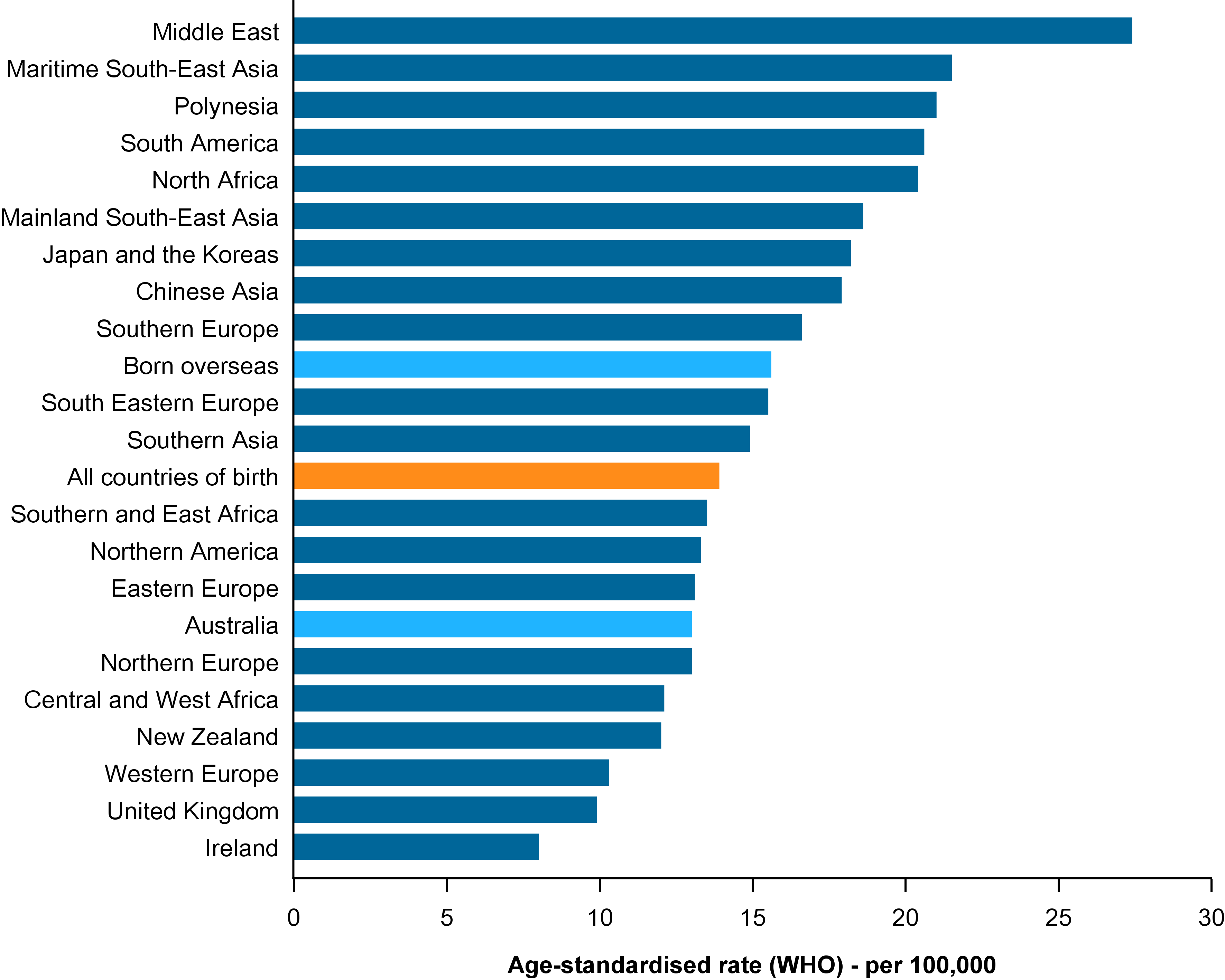
The Regions of Birth (ROBs) with thyroid cancer incidence rates at or above 20 cases per 100,000 females in 2006–2020 were the Middle East (27.4), Maritime South-East Asia (21.5), Polynesia (21.0), South America (20.6) and North Africa (20.4).
Ireland and the United Kingdom were the only ROBs for which thyroid cancer incidence was 10 cases per 100,000 females or less.
Figure 22: Thyroid cancer age-standardised incidence rates, by region of birth: females, Australia, 2006–2020
Notes:
- Rates are age-standardised to the WHO World Standard Population and expressed cases per 100,000 females.
- Includes regions of birth with on average 20,000 people living in Australia between 2006 and 2020 and 20 or more thyroid cancer cases diagnosed in females for the period. Excludes the regions of Central Asia and Melanesia which are discussed separately in Cancer incidence for selected countries and regions of birth. Also excludes regions of birth where thyroid cancer was not in the leading 20 cancers for females for the period.
- Born overseas includes born in any country except for Australia. All countries of birth rates are the national rates for Australia and includes the population born in Australia and all other countries.
Source: Australian Cancer Database 2020
Lebanon-born, Iraq-born and Philippines-born females had the highest rates of thyroid cancer
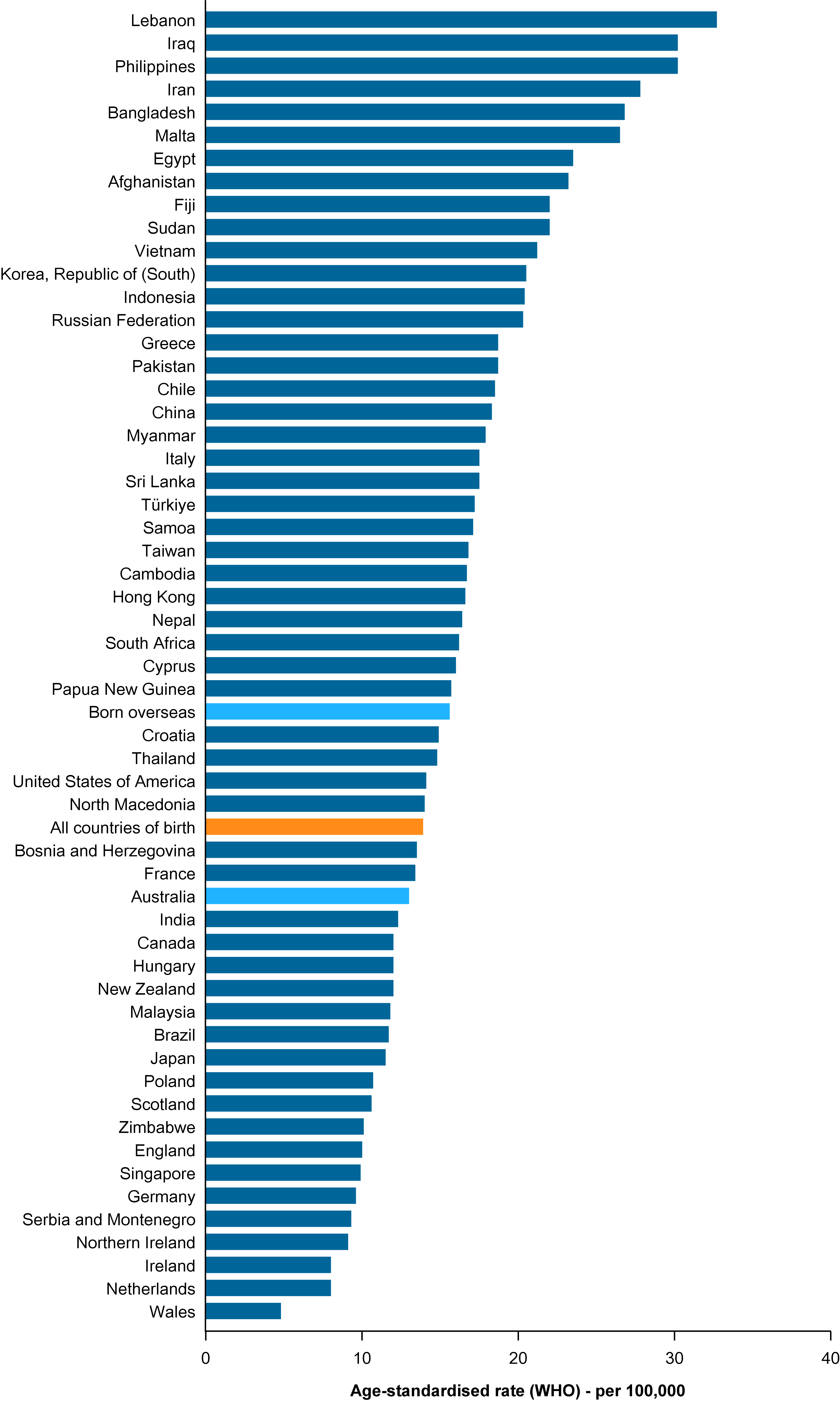
The countries of birth (COBs) with thyroid cancer incidence rates of around 20 cases per 100,000 females or more in 2006-2020 were Lebanon (32.7), Iraq (30.2), Philippines (30.2), Iran (27.8), Bangladesh (26.8), Malta (26.5), Egypt (23.5), Afghanistan (23.2), Sudan (22.0), Fiji (22.0), Vietnam (21.2), Republic of Korea (20.5), Indonesia (20.4) and the Russian Federation (20.3).
The higher rates of thyroid cancer for those born in the Maritime South-East Asia region is influenced by higher rates within the Indonesia-born and Philippines-born populations
There can be a large range of thyroid cancer incidence rates within a ROB. Maritime South-East Asia had the second highest rate of thyroid cancer incidence for females but the rate was strongly influenced by the Philippines-born (30.2 cases per 100,000 females) and Indonesia-born (20.4 cases per 100,000 females) populations. Singapore-born and Malaysia-born populations however, were two of only a few Asian COBs where thyroid cancer incidence rates were comparatively low for females in 2006-2020.
High rates of thyroid cancer for the Middle East populations living in Australia are less apparent within the actual countries
The Middle East ROB had relatively high thyroid cancer incidence rates for females. For instance, Lebanon-born, Iraq-born and Iran-born females were all above 27 cases per 100,000 females for 2006–2020. Türkiye-born females thyroid cancer incidence rates were also fairly high (17.2 cases per 100,000 females).
Thyroid cancer incidence rates in Australia have been increasing for many years. In 2000, the Australian crude thyroid cancer incidence rate was 8.2 cases per 100,000 females and it peaked in 2019 at 19.3 cases per 100,000 females. Increasing rates of thyroid cancer are likely to be the result of an increase in medical surveillance and the introduction of new diagnostic techniques, such as neck ultrasonography (Vaccarella et al. 2016).
These increasing rates highlight the potential impact that detection can have within a country, but also should be considered in international comparisons. Lebanon, for example, in 2022 is estimated to have a rate of 7.5 cases per 100,000 females for thyroid cancer, Iraq 7.0, Iran 6.1 and Türkiye at 24.6. The rates within each of these countries contrasts with that occurring in Australia for the respective COBs. The extent that this may be related to diagnostic capabilities or differences in the populations living in Australia within the respective homelands cannot be determined with the information available.
Cyprus-born females have much lower thyroid cancer incidence than the general population living in Cyprus
In 2022, Cyprus, Republic of Korea, China, Hungary, and Türkiye were among the countries with comparatively high thyroid cancer incidence rates. All of these had rates above 23 cases per 100,000 females, and China and Republic of Korea had rates above 30, and Cyprus above 50, cases per 100,000 females.
For 2006–2020 thyroid cancer incidence rates for females for the Cyprus-born female population was 16 cases per 100,000 females, for the Republic of Korea-born it was 20.5, China-born it was 18.3, Hungary-born it was 12.0 and Türkiye-born it was 17.2 cases per 100,000 females. While some may have thyroid cancer incidence similar to the national rate (that is, all countries of birth) of 13.9 cases per 100,000 females, these COBs are not in the highest tier of thyroid cancer incidence.
The countries of birth with among the lowest thyroid cancer incidence rates were generally from Europe
The COBs with thyroid cancer incidence of 10 or less cases per 100,000 females for 2006–2020 were England, Singapore, Germany, Serbia and Montenegro, Northern Ireland, Ireland, Netherlands, Mauritius, and Wales. The Singapore-born and Mauritius-born female populations were the only non-European COBs with these lower thyroid cancer rates.
Figure 23: Thyroid cancer age-standardised incidence rates, by country of birth: females, Australia, 2006–2020
Notes:
- Rates are age-standardised to the WHO World Standard Population and expressed cases per 100,000 females.
- Includes countries of birth with on average 20,000 people living in Australia between 2006 and 2020 and 20 or more thyroid cancer cases diagnosed in females for the period. Excludes the countries of birth where thyroid cancer was not in the leading 20 cancers for females for the period.
- Born overseas includes born in any country except for Australia. All countries of birth rates are the national rates for Australia and includes the population born in Australia and all other countries.
Source: Australian Cancer Database 2020
Males from the North Africa and Middle East regions of birth had the highest thyroid cancer incidence rates
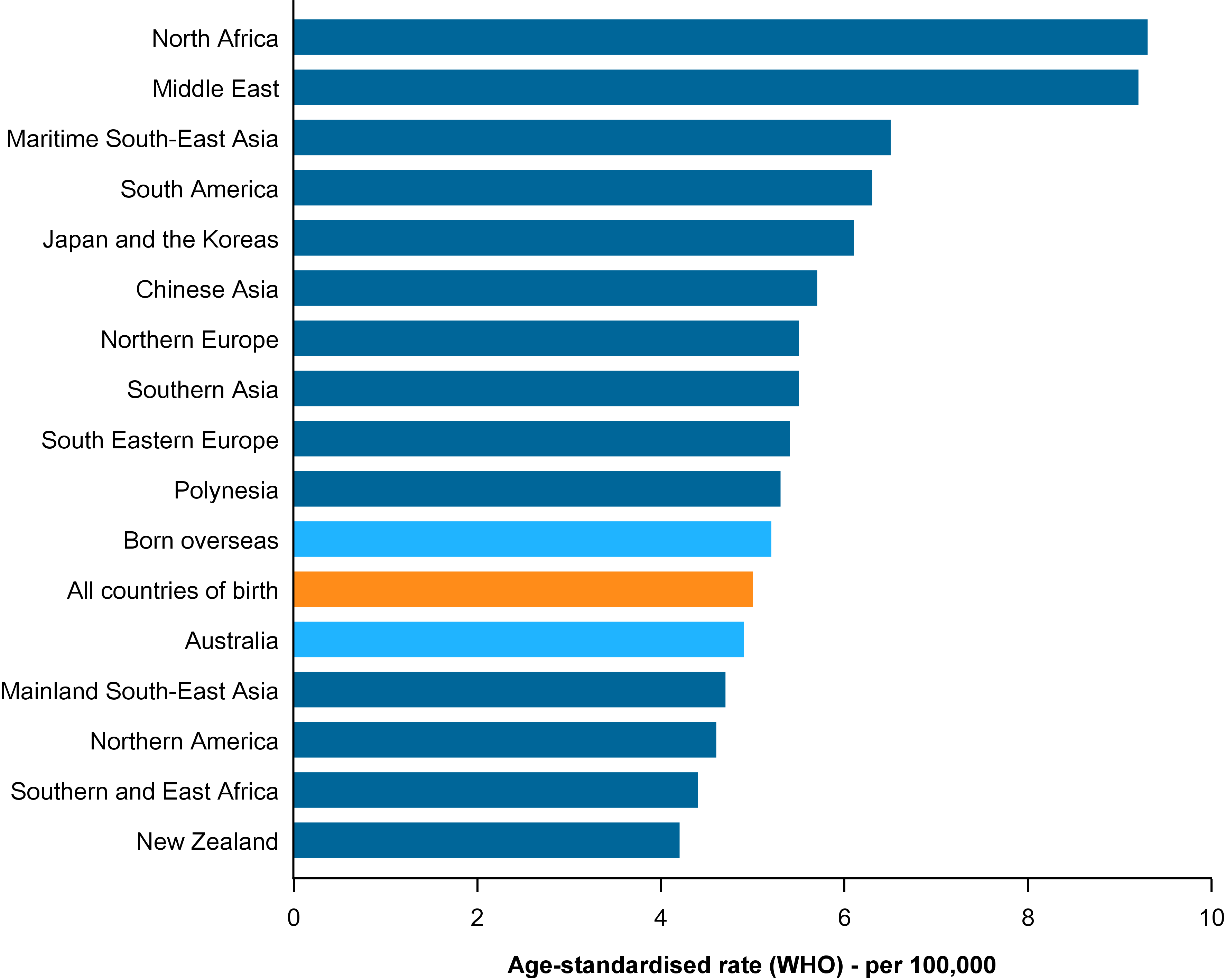
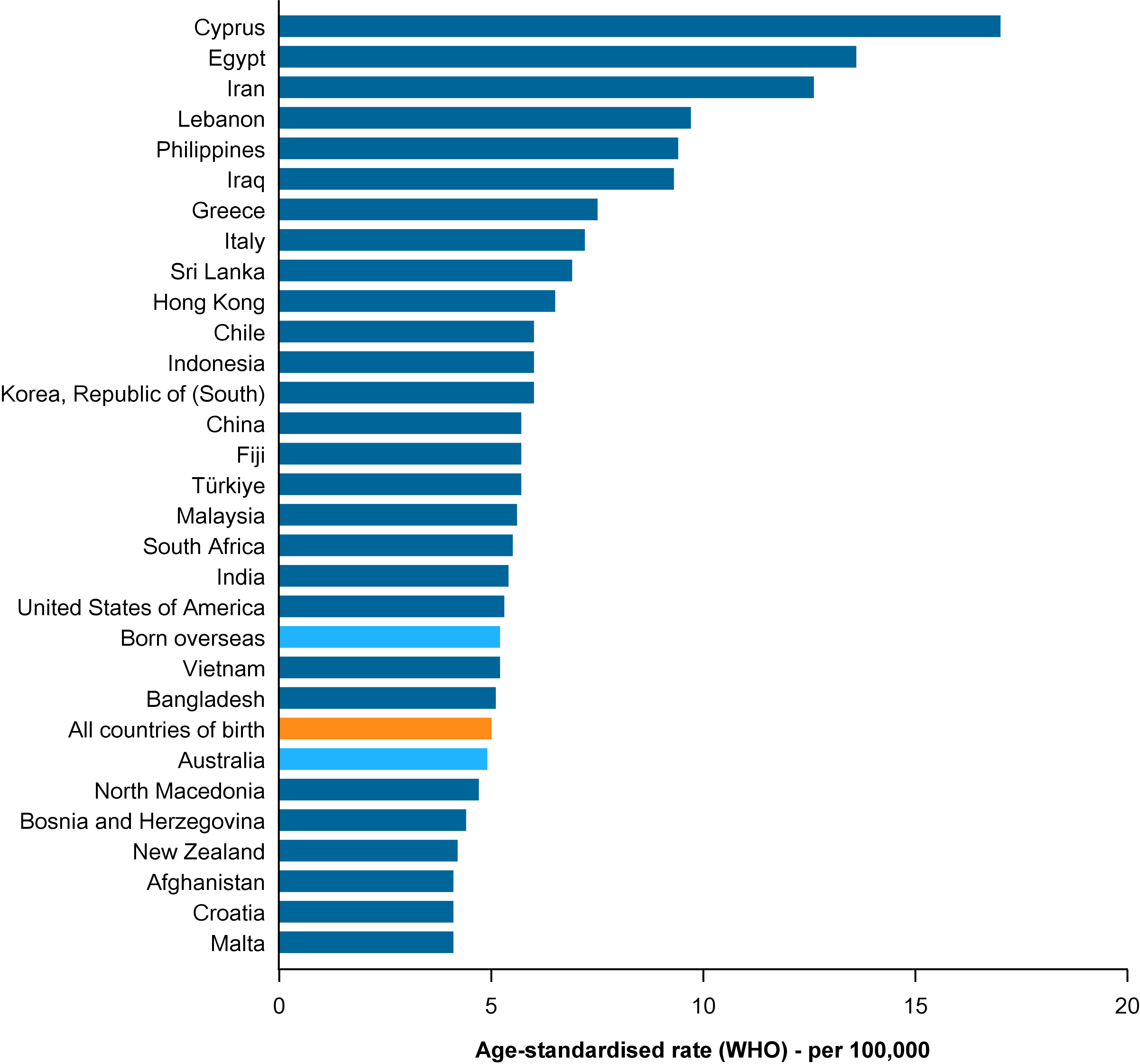
There were only two ROBs where male thyroid cancer incidence rates exceeded 9 cases per 100,000 males for 2006–2020. These ROBs were North Africa (9.3) and the Middle East (9.2). All other ROBs had less than 7 cases per 100,000 males for 2006–2020. The COBs with thyroid cancer incidence greater than 9 cases per 100,000 males were Cyprus (17.0), Egypt (13.6), Iran (12.6), Lebanon (9.7), Philippines (9.4) and Iraq (9.3). All other COBs were less than 8.0 cases per 100,000 males.
In 2022, the country of Cyprus was estimated to have the second higher rate of thyroid cancer in the world for males (12.0 cases per 100,000 males). While Cyprus-born males had the highest rate of thyroid cancer for males in Australia, this is based on a small number of cases (24) and a small population (average for 2006–2020 of 10,105 males) and has considerable uncertainty regarding rates (95% confidence interval with 0 to 41 cases per 100,000 males).
Figure 24: Thyroid cancer age-standardised incidence rates, by region of birth: males, 2006–2020
Notes:
- Rates are age-standardised to the WHO World Standard Population and expressed cases per 100,000 males.
- Includes regions of birth with on average 20,000 people living in Australia between 2006 and 2020 and 20 or more thyroid cancer cases diagnosed in males for the period. Excludes the regions of Central Asia and Melanesia which are discussed separately in Cancer incidence for selected countries and regions of birth. Also excludes regions of birth where thyroid cancer was not in the leading 20 cancers for males for the period.
- Born overseas includes born in any country except for Australia. All countries of birth rates are the national rates for Australia and includes the population born in Australia and all other countries.
Source: Australian Cancer Database 2020
Thyroid cancer incidence rates for males are quite similar for most countries of birth
The thyroid cancer incidence rate for males in Australia (that is, all countries of birth) for 2006–2020 was 5 cases per 100,000 males. Of the 31 COBs with at least 20 cases of thyroid cancer for males in 2006–2020, 25 were within a range of 4.1 to 7.5 cases per 100,000 males.
Figure 25: Thyroid cancer age-standardised incidence rates, by country of birth: males, 2006–2020
Notes:
- Rates are age-standardised to the WHO World Standard Population and expressed per 100,000 males.
- Includes countries of birth with on average 20,000 people living in Australia between 2006 and 2020 and 20 or more thyroid cancer cases diagnosed in males for the period. Excludes the countries of birth where thyroid cancer was not in the leading 20 cancers for males for the period.
- Born overseas includes born in any country except for Australia. All countries of birth rates are the national rates for Australia and includes the population born in Australia and all other countries.
Source: Australian Cancer Database 2020
Liver cancer
Liver cancer incidence rates have been increasing in Australia for many years. Both the Australia-born and overseas-born populations have these increases recorded but the Australia-born incidence rate increases have been greater. Following this, the difference between Australia-born and overseas-born liver cancer rates has decreased (Table 7).
Liver cancer is more common in males and the disparity between the incidence rates for Australia-born and overseas-born populations was more evident in the male populations (Table 6). The majority of discussion within this section will focus on liver cancer incidence for males.
| Population | 2006–2010 | 2011–2015 | 2016–2020 | 2006–2020 |
|---|---|---|---|---|
Australia-born | ||||
Males | 5.5 | 7.4 | 8.7 | 7.3 |
Females | 1.9 | 2.3 | 2.9 | 2.4 |
Persons | 3.6 | 4.8 | 5.7 | 4.8 |
Born overseas | ||||
Males | 9.1 | 10.1 | 9.8 | 9.7 |
Females | 2.8 | 3.3 | 3.2 | 3.2 |
Persons | 5.9 | 6.6 | 6.4 | 6.3 |
All countries of birth |
|
|
|
|
Males | 6.8 | 8.4 | 9.1 | 8.2 |
Females | 2.2 | 2.7 | 3.0 | 2.7 |
Persons | 4.4 | 5.4 | 5.9 | 5.3 |
Notes:
- Rates are age-standardised to the WHO World Standard Population and expressed cases per 100,000 population (that is, per 100,000 females for females, per 100,000 males for males and per 100,000 people for persons).
- Born overseas includes born in any country except for Australia. All countries of birth rates are the national rates for Australia and includes the population born in Australia and all other countries.
Source: Australian Cancer Database 2020
Males born in Mainland South-East Asia had high liver cancer incidence rates
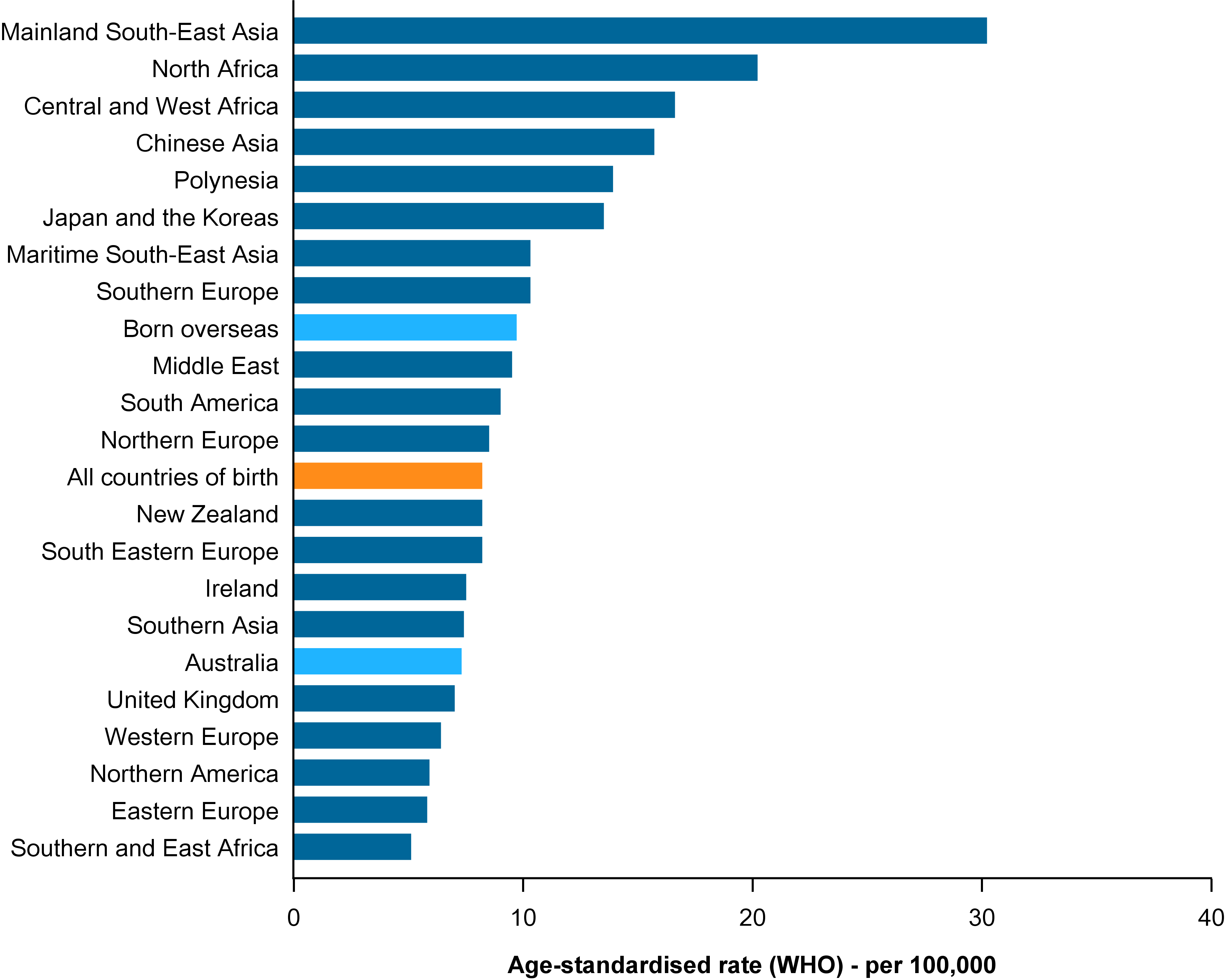
There were four regions of birth (ROBs) with liver cancer incidence rates above 15 cases per 100,000 males in 2006–2020. These were Mainland South-East Asia (30.2), North Africa (20.2), Central and West Africa (16.6) and Chinese Asia (15.7). The liver cancer incidence rate for Mainland South-East Asia-born males was around four times the rate of the Australia-born male population (7.3 cases per 100,000 males). For Mainland South-East Asia-born, North Africa-born, Chinese Asia-born and Polynesia-born populations, liver cancer was the fourth most commonly diagnosed cancer for the male population for 2006–2020 while for the Australian male population it was eleventh.
Almost all Asian ROBs had higher liver cancer incidence rates for males than the Australia-born male population with only the incidence rate for Southern Asia of 7.4 cases per 100,000 males being similar to the male Australia-born liver cancer incidence.
There were three ROBs with liver cancer below 6 cases per 100,000 males in 2006–2020 and these were Northern America (5.9), Eastern Europe (5.8) and Southern and East Africa (5.1).
Figure 26: Liver cancer age-standardised incidence rates, by region of birth, males, 2006–2020
Notes:
- Rates are age-standardised to the WHO World Standard Population and expressed cases per 100,000 males.
- Includes regions of birth with on average 20,000 people living in Australia between 2006 and 2020 and 20 or more liver cancer cases diagnosed in males for the period. Excludes the regions of Central Asia and Melanesia which are discussed separately in Cancer incidence for selected countries and regions of birth. Also excludes regions of birth where liver cancer was not in the leading 20 cancers for males for the period.
- Born overseas includes born in any country except for Australia. All countries of birth rates are the national rates for Australia and includes the population born in Australia and all other countries.
Source: Australian Cancer Database 2020
Liver cancer was the most commonly diagnosed cancer for the Cambodia-born male population
The countries of birth (COBs) with liver cancer incidence rates above 15 cases per 100,000 males in 2006–2020 were Cambodia (32.8), Sudan (32.7), Vietnam (30.8), Myanmar (24.0), Thailand (23.7), Taiwan (20.7), Egypt (17.1) and China (16.7). All of these COBs are within one of the ROBs with liver cancer incidence also above 15 cases per 100,000 males.
In 2022, the countries of Republic of Korea, China, Thailand, Vietnam, Egypt and Cambodia all had estimated liver cancer incidence rates above 22 cases per 100,000 males and were countries with amongst the highest male liver cancer rates in the world (IARC 2022). While not among the highest tier of liver cancer incidence rates for COBs as mentioned in the above paragraph, the rate of liver cancer for Republic of Korea-born males in 2006–2020 was 14.3 cases per 100,000 males and amongst the higher rates in Australia.
The Cambodia-born male population was the only population in Australia for which liver cancer was the most commonly diagnosed cancer for males in 2006–2020 and it was the second most commonly diagnosed cancer for the Sudan-born male population.
The COBs with liver cancer rates less than 6 cases per 100,000 males were Mauritius (5.5), Cyprus (4.9), Netherlands (4.7), Canada (4.7), Poland (3.9) and South Africa (3.4).
Figure 27: Liver cancer age-standardised incidence rates, by country of birth, males, 2006–2020

Notes:
- Rates are age-standardised to the WHO World Standard Population and expressed cases per 100,000 males.
- Includes countries of birth with on average 20,000 people living in Australia between 2006 and 2020 and 20 or more liver cancer cases diagnosed in males for the period. Excludes the countries of birth where liver cancer was not in the leading 20 cancers for males for the period.
- Born overseas includes born in any country except for Australia. All countries of birth rates are the national rates for Australia and includes the population born in Australia and all other countries.
Source: Australian Cancer Database 2020
For females, Mainland South-East Asia born females had the highest rates of liver cancer
For females, the Australia-born liver cancer rate was 2.4 cases per 100,000 females, for overseas-born it was 3.2 cases per 100,000 females and the Australian rate was 2.7 cases per 100,000 females. For the 2006–2020 period, liver cancer was not in the leading 20 cancer types for Australia-born females. However, for the 2016–2020 period, liver cancer was the 19th most commonly diagnosed cancer for Australia-born females (2.9 cases per 100,000 females).
For females, the COBs with highest liver cancer incidence were all from the Mainland South-East Asia region of birth. The rates for these COBs were 11.9, 8.5, 6.5 and 6.3 cases per 100,000 females (Cambodia-born, Vietnam-born, Thailand-born and Myanmar-born female populations respectively). These were the only COBs with liver cancer incidence rates above 6 cases per 100,000 females (Figure 29).
Females born in the Republic of Korea, Papua New Guinea, Egypt and China all had liver cancer incidence rates twice the Australian-born female population for 2006–2020 (5.7, 5.3, 4.9 and 4.8 cases per 100,000 females respectively) (Figure 29).
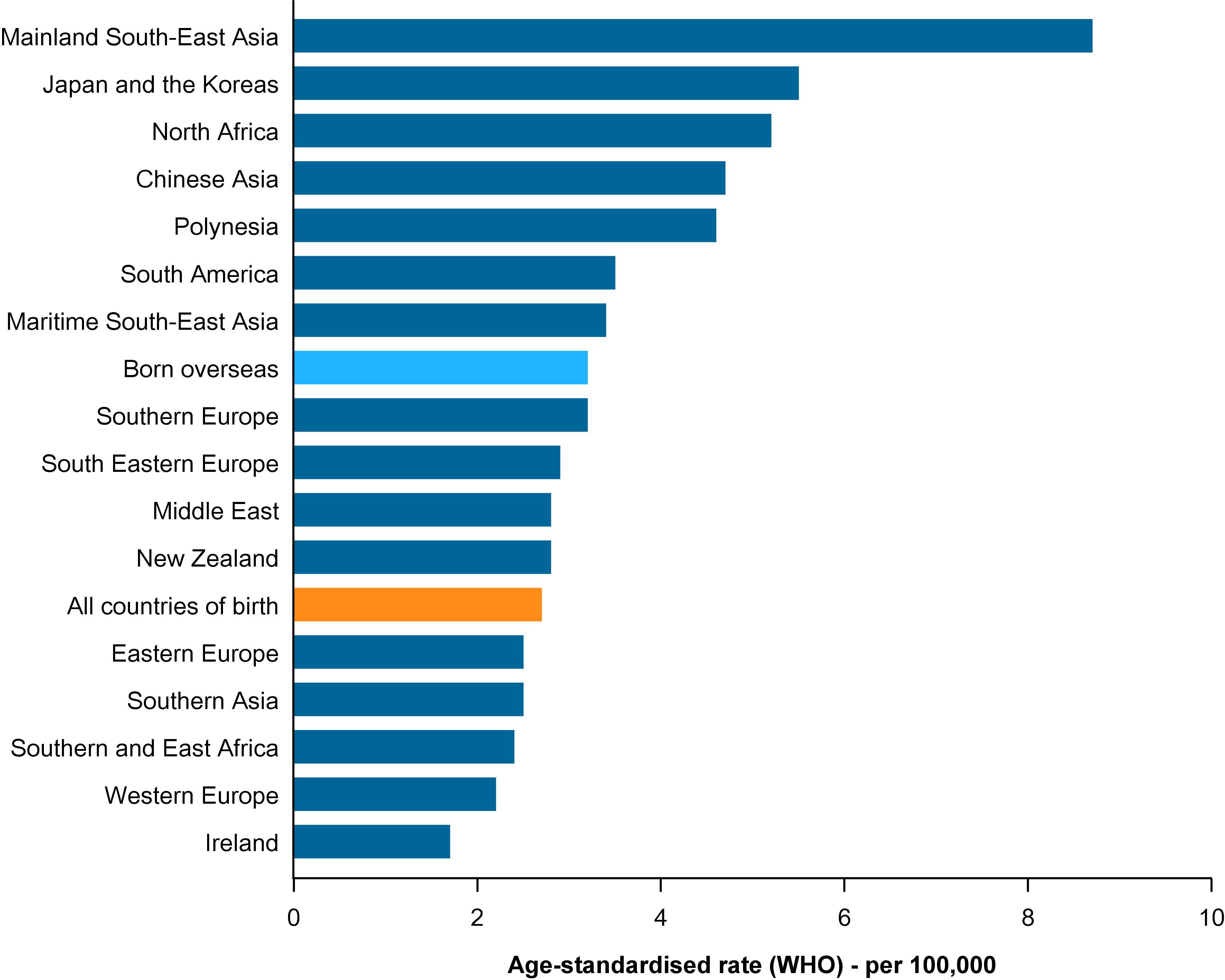
The ROBs with liver cancer incidence rates at or below the Australian rate for 2006–2020 were Southern and East Africa, Western Europe and Ireland (2.4, 2.2 and 1.7 cases per 100,000 females respectively). Of the Asian ROBs, Southern Asia had the lowest liver cancer incidence rate for females at 2.5 cases per 100,000 females (Figure 28).
Figure 28: Liver cancer age-standardised incidence rates, by region of birth: females, Australia, 2006–2020
Notes:
- Rates are age-standardised to the WHO World Standard Population and expressed cases per 100,000 females.
- Includes regions of birth with on average 20,000 people living in Australia between 2006 and 2020 and 20 or more liver cancer cases diagnosed in females for the period. Excludes the regions of Central Asia and Melanesia which are discussed separately in Cancer incidence for selected countries and regions of birth. Also excludes regions of birth where liver cancer was not in the leading 20 cancers for females for the period.
- Born overseas includes born in any country except for Australia. All countries of birth rates are the national rates for Australia and includes the population born in Australia and all other countries.
Source: Australian Cancer Database 2020
Figure 29: Liver cancer age-standardised incidence rates, by country of birth: females, Australia, 2006–2020

Notes:
- Rates are age-standardised to the WHO World Standard Population and expressed cases per 100,000 females.
- Includes countries of birth with on average 20,000 people living in Australia between 2006 and 2020 and 20 or more liver cancer cases diagnosed in females for the period. Excludes the countries of birth where liver cancer was not in the leading 20 cancers for females for the period.
Source: Australian Cancer Database 2020
Stomach cancer
Stomach cancer incidence rates for the overseas-born population were higher than the Australia-born population in 2006–2020 for both males and females. Between 2006–2010 and 2016–2020, there were decreases in the rates for those born overseas and almost no change in the rates for those born in Australia which indicates that the decreases during this period for Australia (that is, all countries of birth) is likely to be more influenced by changes in the overseas-born population (Table 8).
| Population | 2006–2010 | 2011–2015 | 2016–2020 | 2006–2020 |
|---|---|---|---|---|
Australia-born |
|
|
|
|
Males | 7.6 | 7.4 | 7.3 | 7.4 |
Females | 3.5 | 3.4 | 3.5 | 3.5 |
Persons | 5.4 | 5.3 | 5.3 | 5.3 |
Born overseas |
|
|
|
|
Males | 10.9 | 9.9 | 8.6 | 9.7 |
Females | 5.5 | 5.0 | 4.7 | 5.0 |
Persons | 8.1 | 7.4 | 6.6 | 7.3 |
All countries of birth |
|
|
|
|
Males | 8.8 | 8.3 | 7.8 | 8.2 |
Females | 4.2 | 4.0 | 3.9 | 4.0 |
Persons | 6.3 | 6.0 | 5.8 | 6.0 |
Notes:
- Rates are age-standardised to the WHO World Standard Population and expressed cases per 100,000 population (that is, per 100,000 females for females, per 100,000 males for males and per 100,000 people for persons).
- Born overseas includes born in any country except for Australia. All countries of birth rates are the national rates for Australia and includes the population born in Australia and all other countries.
Source: Australian Cancer Database 2020
People born in the Japan and the Koreas region of birth had relatively high rates of stomach cancer
In 2006–2020, the Japan and the Koreas region of birth (ROB) had stomach cancer incidence rates of 16 cases per 100,000 people, well above other regions of birth (ROBs). Japan and the Republic of Korea are amongst the countries with the highest rates of stomach cancer in the world, and in 2022 were estimated by IARC to have rates of more than 27 cases per 100,000 people (IARC 2022).
The other ROBs with stomach cancer incidence rates above 8 cases per 100,000 people in 2006–2020 were Polynesia (9.8), South Eastern Europe (9.5), China (9.1), South America (8.9), Southern Europe (8.5) and Eastern Europe (8.2).
Southern Asia, Northern America, Maritime South-East Asia and Northern Europe were the only ROBs with stomach cancer incidence rates below 5 cases per 100,000 people in 2006–2020 (4.3, 4.1, 3.9 and 3.5 respectively).
Stomach cancer incidence rates within a ROB are frequently comprised of quite different stomach cancer incidence rates. Some of these are discussed within the following section on stomach cancer incidence by country of birth (COB).
Figure 30: Stomach cancer age-standardised incidence rates, by region of birth: persons, Australia, 2006–2020

Notes:
- Rates are age-standardised to the WHO World Standard Population and expressed cases per 100,000 persons.
- Includes regions of birth with on average 20,000 people living in Australia between 2006 and 2020 and 20 or more stomach cancer cases diagnosed for the period. Excludes the regions of Central Asia and Melanesia which are discussed separately in Cancer incidence for selected countries and regions of birth. Also excludes regions of birth where stomach cancer was not in the leading 20 cancers for the period.
- Born overseas includes born in any country except for Australia. All countries of birth rates are the national rates for Australia and includes the population born in Australia and all other countries.
Source: Australian Cancer Database 2020
The Samoa-born, Afghanistan-born, Republic of Korea-born and Japan-born populations had high stomach cancer rates
There were 17 countries of birth (COBs) with stomach cancer incidence rates above 8 cases per 100,000 people in 2006–2020. The leading 10 of these were the Samoa-born (21.1), Afghanistan-born (15.7), Republic of Korea-born (15.2), Japan-born (14.4), North Macedonia-born (12.6), Chile-born (12.0), Russian Federation-born (12.0), Greece-born (10.0), Croatia-born (9.9) and China-born populations (9.9).
Stomach cancer was the fifth most commonly diagnosed cancer for the Afghanistan-born, Republic of Korea-born, Japan-born, North Macedonia-born, Chile-born and Croatia-born populations for 2006–2020 while it was the thirteenth most commonly diagnosed cancer for the Australia-born population for the same period. For the general populations living in these countries in 2022, it was estimated that stomach cancer was the second most commonly diagnosed cancer in Afghanistan, third for the Republic of Korea and Japan, fourth for Chile, fifth for North Macedonia and sixth for Croatia.
Stomach cancer incidence rates for countries within a region of birth can vary considerably
The five COBs with the lowest stomach cancer incidence rates for 2006–2020 were Singapore, Thailand, Philippines, Indonesia and Sri Lanka (3.7, 3.6, 3.6, 3.3 and 2.9 cases per 100,000 people respectively). The ROBs these COBs are from include the Maritime South-East Asia, Mainland South-East Asia, and Southern Asia regions of birth.
Maritime South-East Asia-born rates for 2006–2020 had consistently lower stomach cancer incidence and Malaysia-born had a comparatively high rate of 4.5 cases per 100,000 people.
The Polynesia-born population had a stomach cancer incidence rate of 9.8 cases per 100,000 people. However, it includes very different incidence rates with the Samoa-born population stomach cancer incidence rate of 21.1 cases per 100,000 people being much higher than the Fiji-born population incidence rate of 5.1 cases per 100,000 people.
The Brazil-born population only had 5 cases of stomach cancer for 2006–2020 and no rates were calculated due to the low count. However, stomach cancer ranked twentieth most commonly diagnosed cancer for the Brazil-born population while for the Chile-born population it was the fifth most commonly diagnosed cancer and also amongst the higher rates of stomach cancer incidence in Australia. In 2022, stomach cancer incidence for the country of Chile was estimated to be 14.2 cases per 100,000 people while the Brazil equivalent rate was 7.6 cases per 100,000 (IARC 2022).
Figure 31: Stomach cancer age-standardised incidence rates, by country of birth: persons, Australia, 2006–2020

Notes:
- Rates are age-standardised to the WHO World Standard Population and expressed cases per 100,000 persons.
- Includes countries of birth with on average 20,000 people living in Australia between 2006 and 2020 and 20 or more stomach cancer cases diagnosed for the period. Excludes the countries of birth where stomach cancer was not in the leading 20 cancers for the period.
- Born overseas includes born in any country except for Australia. All countries of birth rates are the national rates for Australia and includes the population born in Australia and all other countries.
Source: Australian Cancer Database 2020
Bladder cancer
Overseas-born bladder cancer incidence has been decreasing over time while Australia-born incidence has remained more stable. This is particularly evident in males for which the overseas-born rate was higher than Australia in 2006–2010 and by 2016–2020 it had moved to around the same as the Australia-born and overseas-born population (Table 9). The decreasing incidence for the overseas-born population may be due to a variety of factors, including population composition change.
Bladder cancer is more common in males and, with male bladder cancer incidence rates more than 3 times the female rates, The majority of discussion within this section will focus on bladder cancer incidence for males.
| Population | 2006–2010 | 2011–2015 | 2016–2020 | 2006–2020 |
|---|---|---|---|---|
Australia-born |
|
|
|
|
Males | 10.5 | 10.7 | 10.4 | 10.6 |
Females | 3.1 | 2.9 | 3.0 | 3.0 |
Persons | 6.4 | 6.5 | 6.4 | 6.4 |
Born overseas |
|
|
|
|
Males | 12.2 | 11.1 | 10.1 | 11.0 |
Females | 3.0 | 2.8 | 2.4 | 2.7 |
Persons | 7.4 | 6.8 | 6.1 | 6.7 |
All countries of birth |
|
|
|
|
Males | 11.2 | 10.9 | 10.4 | 10.8 |
Females | 3.0 | 2.9 | 2.8 | 2.9 |
Persons | 6.8 | 6.6 | 6.3 | 6.5 |
Notes:
- Rates are age-standardised to the WHO World Standard Population and expressed cases per 100,000 population (that is, per 100,000 females for females, per 100,000 males for males and per 100,000 people for persons).
- Born overseas includes born in any country except for Australia. All countries of birth rates are the national rates for Australia and includes the population born in Australia and all other countries.
Source: Australian Cancer Database 2020
The Middle East and European regions of birth had the highest rates of bladder cancer
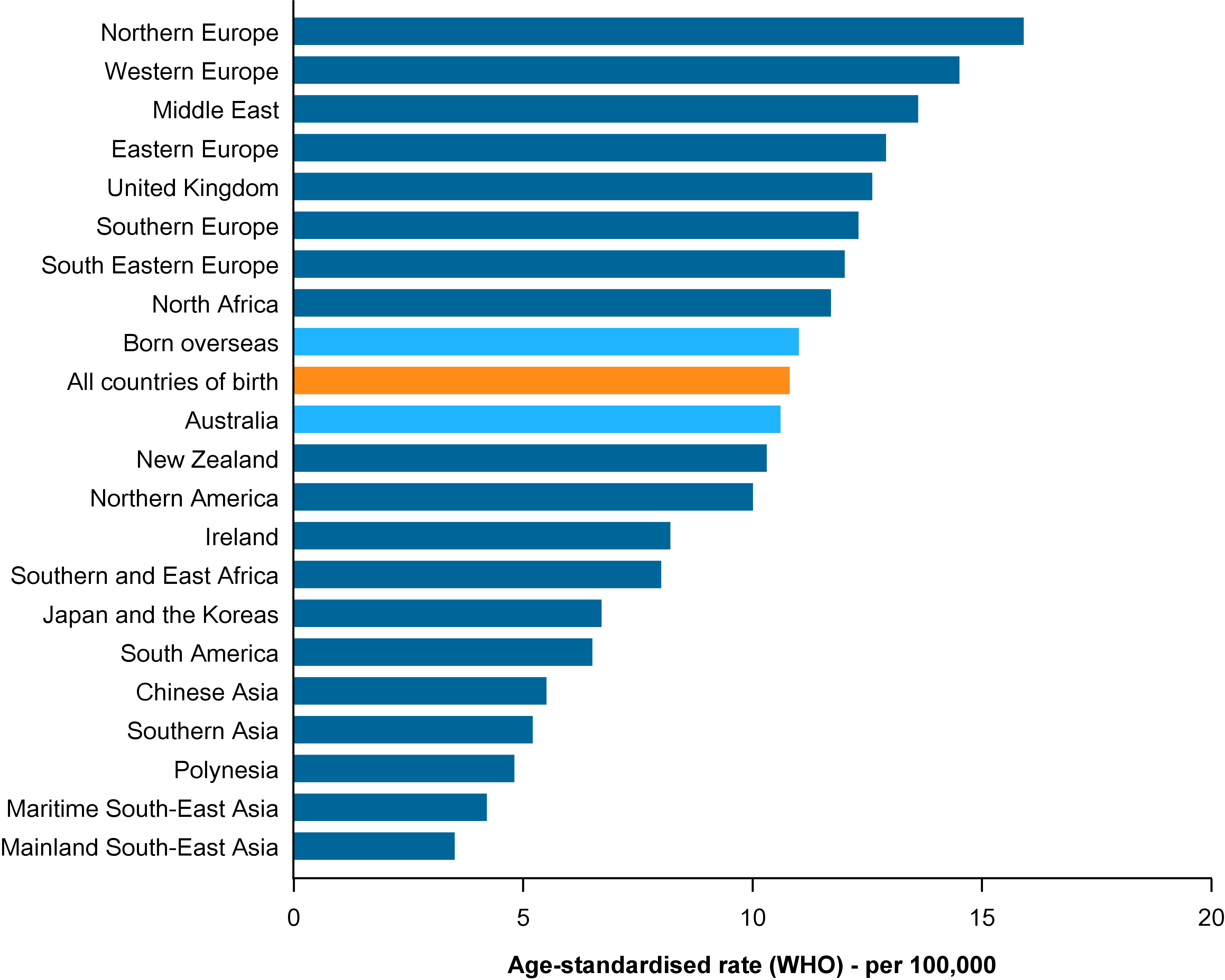
The regions of birth (ROBs) with bladder cancer incidence rates at or above 12 cases per 100,000 males in 2006–2020 were Northern Europe (15.9), Western Europe (14.5), Middle East (13.6), Eastern Europe (12.9), United Kingdom (12.6), Southern Europe (12.3) and South Eastern Europe (12.0). Ireland was the only European ROB with bladder cancer incidence rates below 12 cases per 100,000 males (8.2 cases per 100,000 people).
Asian regions of birth had lower rates of bladder cancer
Asian ROBs had the lowest bladder cancer incidence for males in 2006–2020, ranging from 3.5 cases per 100,000 males for Mainland South-East Asia to 6.7 cases per 100,000 males for Japan and the Koreas. Also within this lower range of incidence were the Polynesia ROB and South America ROB at 4.8 and 6.5 cases per 100,000 males respectively.
Figure 32: Bladder cancer age-standardised incidence rates, by region of birth: males, Australia, 2006–2020
Notes:
- Rates are age-standardised to the WHO World Standard Population and expressed cases per 100,000 males.
- Includes regions of birth with on average 20,000 people living in Australia between 2006 and 2020 and 20 or more bladder cancer cases diagnosed in males for the period. Excludes the regions of Central Asia and Melanesia which are discussed separately in Cancer incidence for selected countries and regions of birth. Also excludes regions of birth where bladder cancer was not in the leading 20 cancers for males for the period.
- Born overseas includes born in any country except for Australia. All countries of birth rates are the national rates for Australia and includes the population born in Australia and all other countries.
Source: Australian Cancer Database 2020
France-born, Lebanon-born and Greece-born males had the highest rates of bladder cancer
There were 16 countries of birth (COBs) with bladder incidence rates above 12 cases per 100,000 people and all of these were from Europe or the Middle East. The COBs with the highest bladder cancer incidence rates for males were France-born, Lebanon-born, Greece-born, Hungary-born, Scotland-born, Netherlands-born and Germany-born male populations (22.2, 16.4, 15.1, 14.6, 14.4, 14.1 and 14.0 cases per 100,000 males respectively).
In 2022, almost all of the 30 countries with the leading rates of bladder cancer were from Europe or the Middle East (IARC 2022) and the only exception to this was Egypt. Within Australia, the bladder cancer incidence rate for the Egypt-born population was 11.7 cases per 100,000 males. This is greater than all of the non-European COBs and non-Middle Eastern COBs, but it is not in the highest tier of bladder cancer incidence in Australia.
The COBs with the lowest bladder cancer incidence rates were in the Asian regions. The highest bladder cancer incidence rate for an Asian country of birth (COB) in 2006–2020 was for the Hong Kong-born male population (6.5 cases per 100,000 males). The only COBs in regions other than Asia with rates equal to or lower than this were the Fiji-born and Chile-born male populations (4.6 and 5.5 cases per 100,000 males respectively).
Figure 33: Bladder cancer age-standardised incidence rates, by country of birth: males, Australia, 2006–2020

Notes:
- Rates are age-standardised to the WHO World Standard Population and expressed cases per 100,000 males.
- Includes countries of birth with on average 20,000 people living in Australia between 2006 and 2020 and 20 or more bladder cancer cases diagnosed in males for the period. Excludes the countries of birth where bladder cancer was not in the leading 20 cancers for males for the period.
- Born overseas includes born in any country except for Australia. All countries of birth rates are the national rates for Australia and includes the population born in Australia and all other countries.
Source: Australian Cancer Database 2020
Western Europe, Eastern Europe and the United Kingdom had the highest bladder cancer incidence for females
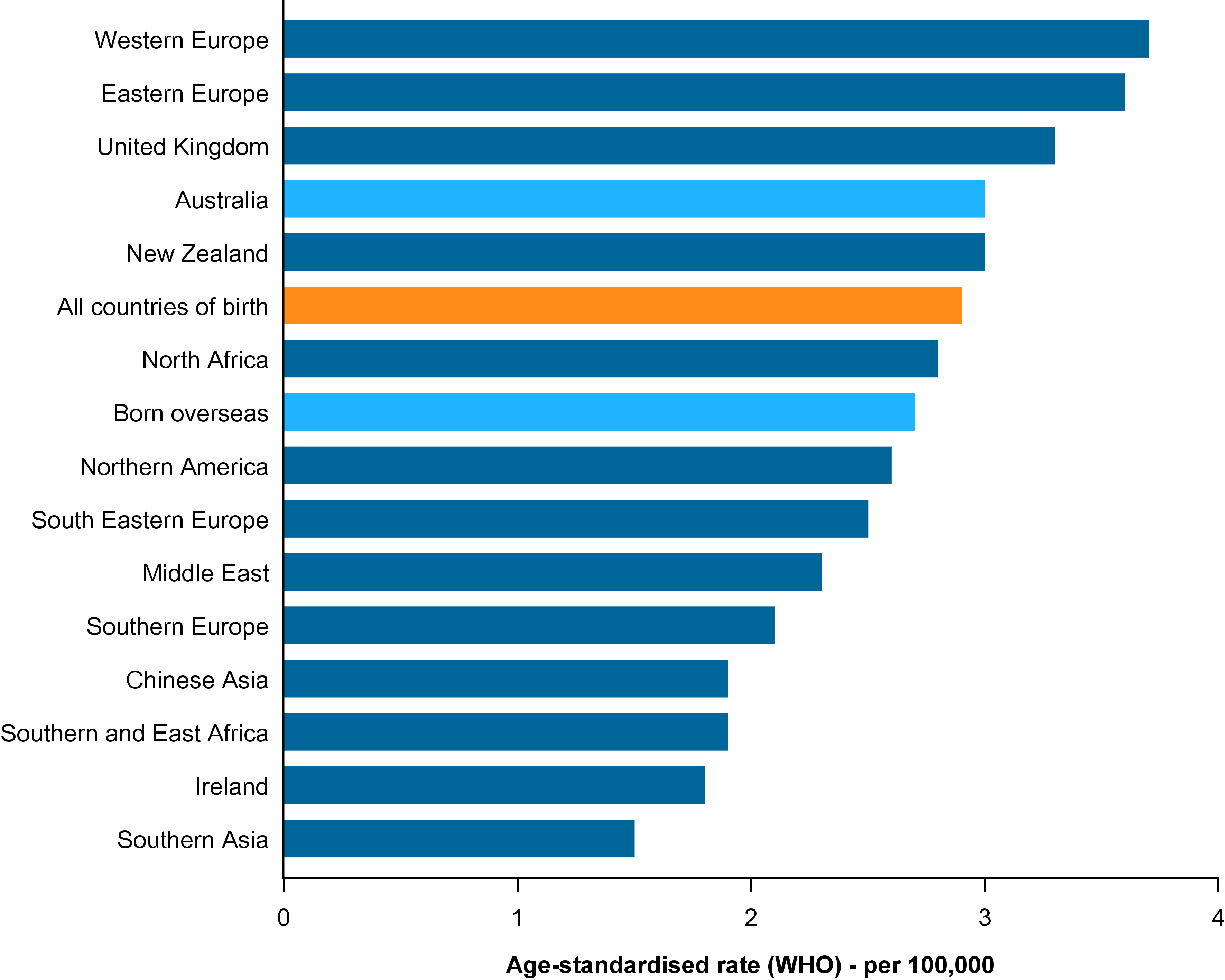
With fewer cases than for males, discussion of bladder cancer incidence for females by ROB is limited to fewer reportable ROBs. Like bladder cancer incidence in males, in 2006–2020 Asian ROBs were more likely have lower bladder cancer incidence for females but the differences were smaller. While Eastern Europe, Western Europe and United Kingdom ROBs had the highest rates of bladder cancer for females, the overall range of bladder cancer incidence was relatively low (3.7 cases per 100,000 females for Western Europe to 1.5 cases per 100,000 females for Southern Asia).
Figure 34: Bladder cancer age-standardised incidence rates, by region of birth: females, Australia, 2006–2020
Notes:
- Rates are age-standardised to the WHO World Standard Population and expressed cases per 100,000 females.
- Includes countries of birth with on average 20,000 people living in Australia between 2006 and 2020 and 20 or more bladder cancer cases diagnosed in females for the period. Excludes the countries of birth where bladder cancer was not in the leading 20 cancers for females for the period.
- Born overseas includes born in any country except for Australia. All countries of birth rates are the national rates for Australia and includes the population born in Australia and all other countries.
Source: Australian Cancer Database 2020
Uterine cancer
Polynesia-born females had the highest rate of uterine cancer
Uterine cancer was the fifth most commonly diagnosed cancer for females born in Australia for 2006–2020. The incidence rate for the female population born in Australia and the population born overseas were similar, at around 14 cases per 100,000 females.
The highest rate of uterine cancer by region of birth (ROB) was for the Polynesia-born region of birth (ROB). This ROB had uterine cancer incidence rates of 41 cases per 100,000 females and was more than double the next closest region of birth of Northern America at 19 cases per 100,000 females.
Uterine cancer by region of birth is provided below but analysis focuses on country of birth (COB) as the rates vary by COB and individual regions of birth (ROBs) are less frequently representative of the countries of birth (COBs) within them. For example, that the Polynesia-born uterine high cancer incidence is high is true for both reportable COBs but the rates for the two COBs are far apart (discussed below).
Figure 35: Uterine cancer age-standardised incidence rates, by region of birth: females, Australia, 2006–2020

Notes:
- Rates are age-standardised to the WHO World Standard Population and expressed cases per 100,000 females.
- Includes regions of birth with on average 20,000 people living in Australia between 2006 and 2020 and 20 or more uterine cancer cases diagnosed for the period. Excludes the regions of Central Asia and Melanesia which are discussed separately in Cancer incidence for selected countries and regions of birth. Also excludes regions of birth where uterine cancer was not in the leading 20 cancers for females for the period.
- Born overseas includes born in any country except for Australia. All countries of birth rates are the national rates for Australia and includes the population born in Australia and all other countries.
Source: Australian Cancer Database 2020
Samoa-born females had the highest rate of uterine cancer
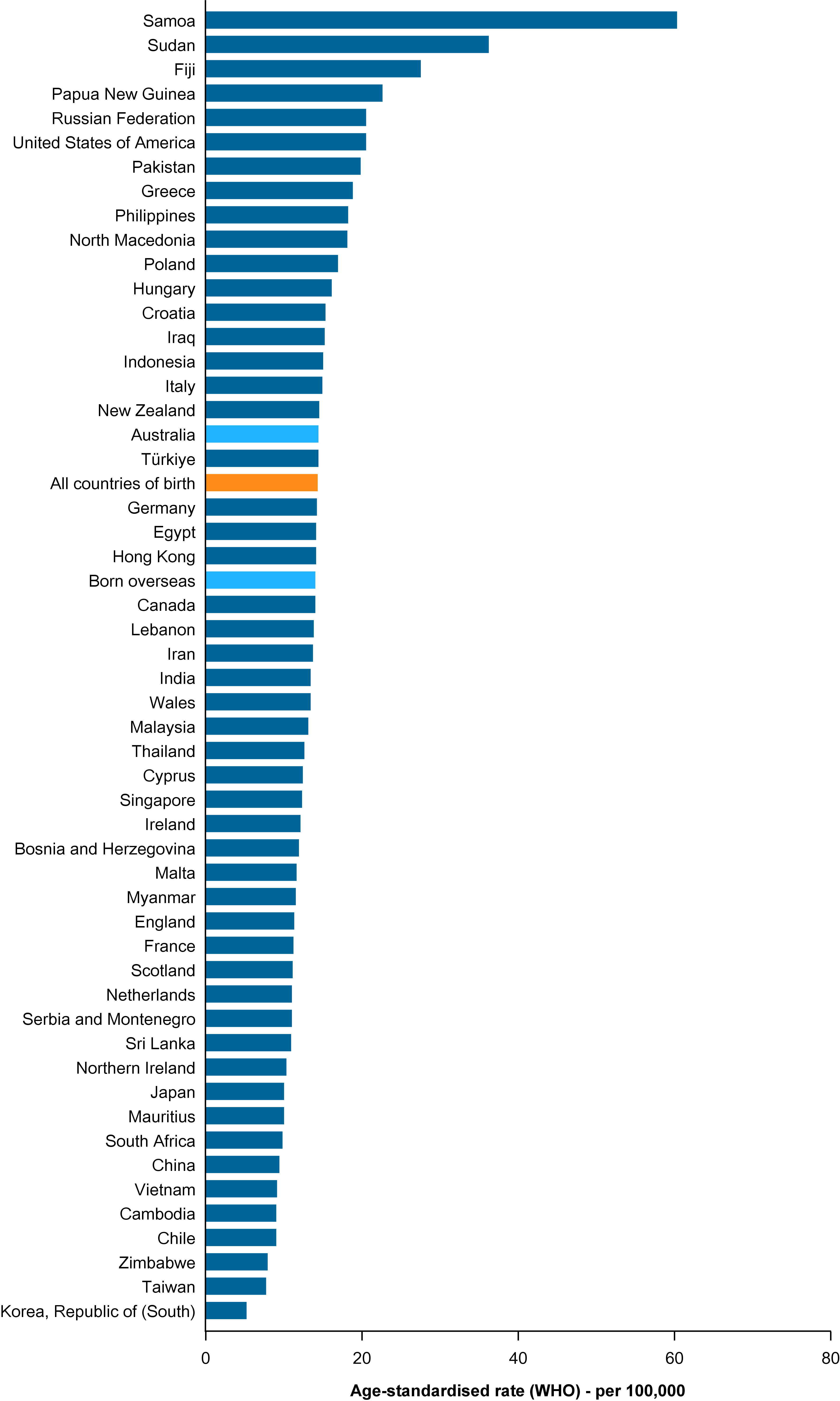
The very high Samoa-born uterine cancer incidence rate of 60 cases per 100,000 females influenced the high Polynesia-born results but, at 28 cases per 100,000 females, the Fiji-born rates were also high compared to most countries of birth (COBs).
The very high Samoa-born uterine cancer incidence rate is largely influenced by the high rate of 80 cases per 100,000 females in 2016–2020, compared with 39 and 50 cases per 100,000 females reported in the periods 2006–2010 and 2011–2015 respectively. All of these are comparatively high rates but there is often volatility of rates where population sizes are relatively small. In 2022, it is estimated that the uterine cancer incidence rate in the country of Samoa was 26 cases per 100,000 females and this was the highest rate in the world (IARC 2022).
The Russian Federation and United States of America were amongst the countries of birth with higher uterine cancer incidence
Other COBs with the uterine cancer incidence rates above 20 cases per 100,000 females in 2016–2020 were Sudan (36), Papua New Guinea (23), Russian Federation (21) and United States of America (21). The populations living in countries of the Russian Federation and United States of America were also estimated to have relatively high uterine cancer incidence in 2022 (21 and 23 cases per 100,000 females respectively).
Papua New Guinea-born cancer incidence rates are discussed within the Melanesia section of this report. While the Sudan-born population is smaller in numbers, the higher uterine cancer incidence rates for 2006–2020 are also apparent within the 95% confidence interval (24.3 to 51.7 cases per 100,000 females).
Eastern European countries of birth had higher rates of uterine cancer
The populations living in the countries of Belarus, Lithuania, Slovakia, Russian Federation and Ukraine all had uterine cancer incidence estimated rates of 19 cases or more in 2022 (IARC 2022). These are all amongst the higher rates for 2022 and also all part of the Eastern Europe ROB which had amongst the higher uterine cancer rates in Australia (17.8 cases per 100,000 females for 2006–2020).
The reportable COBs from Eastern Europe were the Russian Federation, Poland and Hungary. The uterine cancer incidence rates for these COBs for 2006–2020 were 20.5, 16.9 and 16.1 cases per 100,000 females for 2006–2020 and were COBs either within or close to the higher tiers of uterine cancer incidence.
Southern East Africa countries of birth uterine cancer rates were amongst the lower uterine cancer rates
Only Mainland South-East Asia-born, South America-born and Japan and the Koreas-born females had uterine cancer incidence rates below 10 cases per 100,000 females.
There were 11 COBs with uterine cancer incidence rates that were around 10 cases per 100,000 females or below for 2006–2020. Three of these were from the Southern and East Africa ROB (Mauritius 10.0, South Africa 9.8 and Zimbabwe 7.9) and this ROB had a uterine cancer incidence rate of 10.5 cases per 100,000 people. The remainder of these COBs were Japan (10.0), China (9.4), Vietnam (9.1), Cambodia (9.0), Chile (9.0), Taiwan (7.7), Afghanistan (6.5) and the Republic of Korea (5.2).
Lower uterine cancer incidence occurs across a variety of countries and regions of birth and includes inside and outside of Asia. The highest uterine cancer incidence rate for Asia-born females in 2006–2020 was for the Philippines-born female population (18.2 cases per 100,000 females), Indonesia (15.0 cases per 100,000 people) and Hong Kong (14.1 cases per 100,000 people).
Figure 36: Uterine cancer age-standardised incidence rates, by country of birth: females, Australia, 2006–2020
Notes:
- Rates are age-standardised to the WHO World Standard Population and expressed cases per 100,000 females.
- Includes countries of birth with on average 20,000 people living in Australia between 2006 and 2020 and 20 or more uterine cancer cases diagnosed for the period. Excludes countries of birth where uterine cancer was not in the leading 20 cancers for females for the period.
- Born overseas includes born in any country except for Australia. All countries of birth rates are the national rates for Australia and includes the population born in Australia and all other countries.
Source: Australian Cancer Database 2020
Ovarian cancer and serous carcinomas of the fallopian tube
In this section we refer to ovarian cancer and serous carcinomas of the fallopian tube as ovarian cancer. Cancer data commentary number 5 provides information about the use of this cancer grouping.
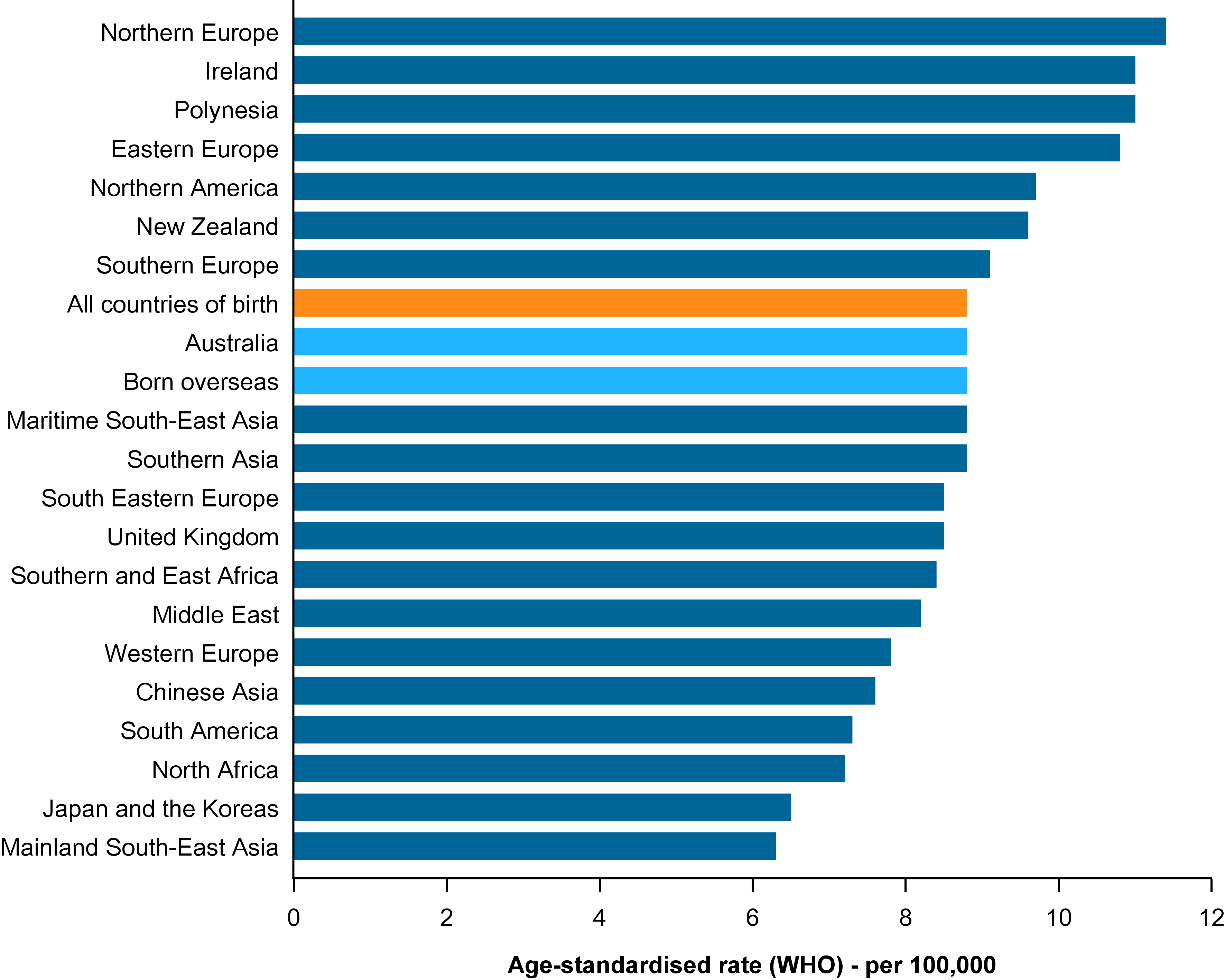
In 2006–2020, ovarian cancer incidence rates by region of birth (ROB) ranged between 11.4 cases per 100,000 females (Northern Europe) to 6.3 cases per 100,000 females (Mainland South-East Asia). The Australia-born, overseas-born and Australia (that is, all countries of birth combined) ovarian cancer incidence rates were all 8.8 cases per 100,000 females.
The regions of birth (ROBs) of Northern Europe, Polynesia, Ireland and Eastern Europe all had ovarian cancer and serous carcinomas of the fallopian tube incidence rates above 10 cases per 100,000 females (11.4, 11.0, 11.0 and 10.8 cases per 100,000 females respectively for 2006–2020). In 2022, the (United Nations) regions with the highest estimated rates of ovarian cancer were Eastern Europe, Northern Europe and Polynesia (11.0, 9.1 and 9.0 cases per 100,000 females) (IARC 2022).
There were two ROBs with ovarian cancer incidence rates below 7 cases per 100,000 females in 2006–2020. These ROBs were Japan and the Koreas (6.5) and Mainland South-East Asia (6.3).
Figure 37: Ovarian cancer and serous carcinomas of the fallopian tubes age-standardised incidence rates, by region of birth: females, Australia, 2006–2020
Notes:
- Rates are age-standardised to the WHO World Standard Population and expressed cases per 100,000 females.
- Includes regions of birth with on average 20,000 people living in Australia between 2006 and 2020 and 20 or more ovarian cancer and serous carcinomas of the fallopian tube cases diagnosed for the period. Excludes the regions of Central Asia and Melanesia which are discussed separately in Cancer incidence for selected countries and regions of birth. Also excludes regions of birth where ovarian cancer and serous carcinomas of the fallopian tube was not in the leading 20 cancers for females for the period.
- Born overseas includes born in any country except for Australia. All countries of birth rates are the national rates for Australia and includes the population born in Australia and all other countries.
Source: Australian Cancer Database 2020
With ovarian cancer incidence rates ranging less than many other cancers discussed and many of the higher incidence rates arising from smaller counts and smaller populations with higher uncertainty, the ovarian cancer incidence rates by country of birth are not discussed in this paper but are available within the Data section and data visualisation.
Cervical cancer
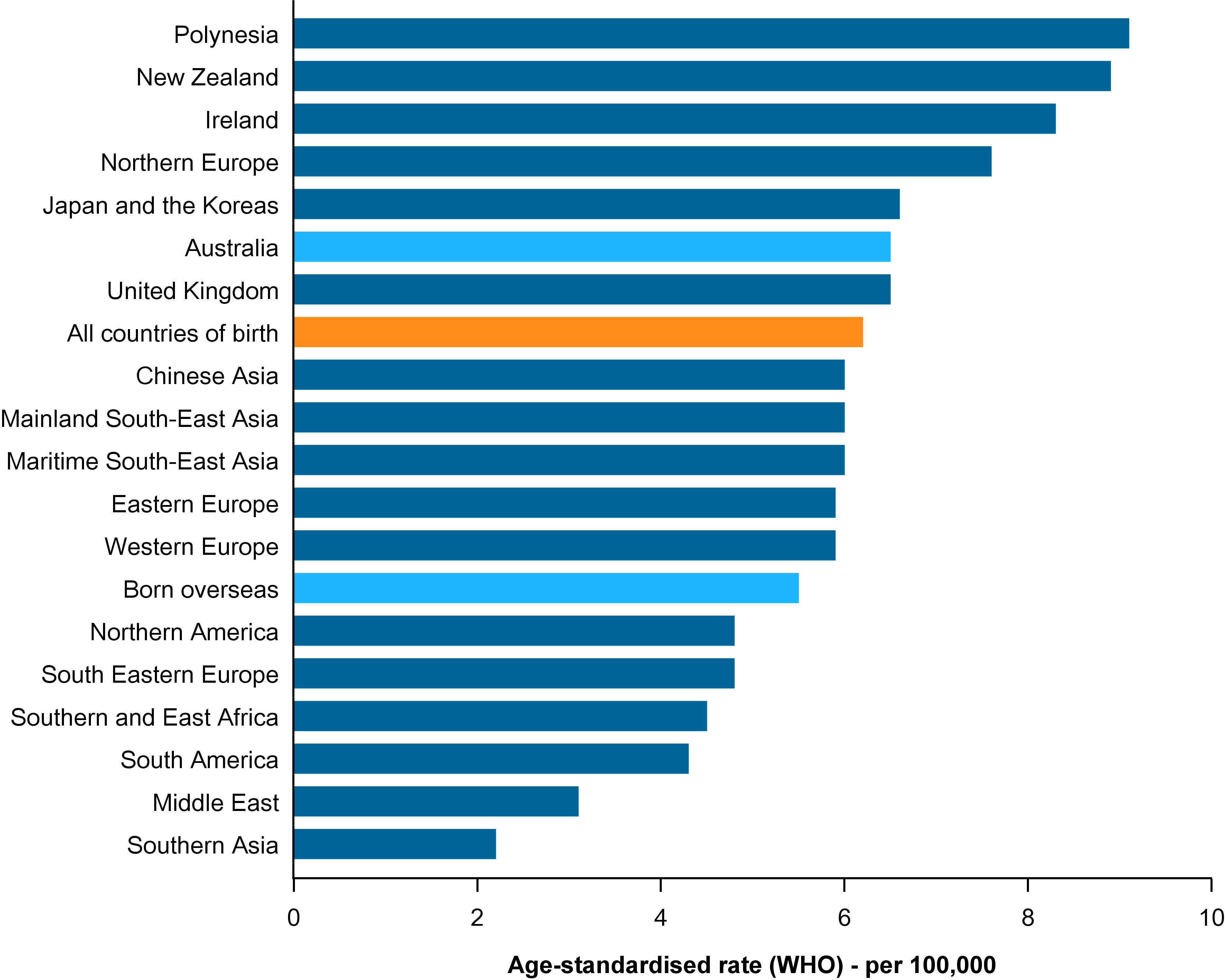
In 2006–2020, cervical cancer incidence rates by region of birth (ROB) ranged between 2.2 cases per 100,000 females (Southern Asia) and 9.1 cases per 100,000 females (Polynesia). The Australia-born incidence rate of 6.5 cases per 100,000 females was higher than the overseas-born rate of 5.5 cases per 100,000 females.
The regions of birth (ROBs) with cervical cancer incidence rates of 8 or more cases per 100,000 females were Polynesia (9.1), New Zealand (8.9) and Ireland (8.3).
The ROBs with cervical cancer incidence rates at or below 4.5 cases per 100,000 females in 2006–2020 were Southern and East Africa (4.5), South America (4.3), Middle East (3.1) and Southern Asia (2.2).
Figure 38: Cervical cancer age-standardised incidence rates, by region of birth: females, Australia, 2006–2020
Notes:
- Rates are age-standardised to the WHO World Standard Population and expressed cases per 100,000 females.
- Includes regions of birth with on average 20,000 people living in Australia between 2006 and 2020 and 20 or more cervical cancer cases diagnosed for the period. Excludes the regions of Central Asia and Melanesia which are discussed separately in Cancer incidence for selected countries and regions of birth. Also excludes regions of birth where cervical cancer was not in the leading 20 cancers for females for the period.
- Born overseas includes born in any country except for Australia. All countries of birth rates are the national rates for Australia and includes the population born in Australia and all other countries.
Source: Australian Cancer Database 2020
Populations from Southern Asia had the lowest cervical cancer incidence
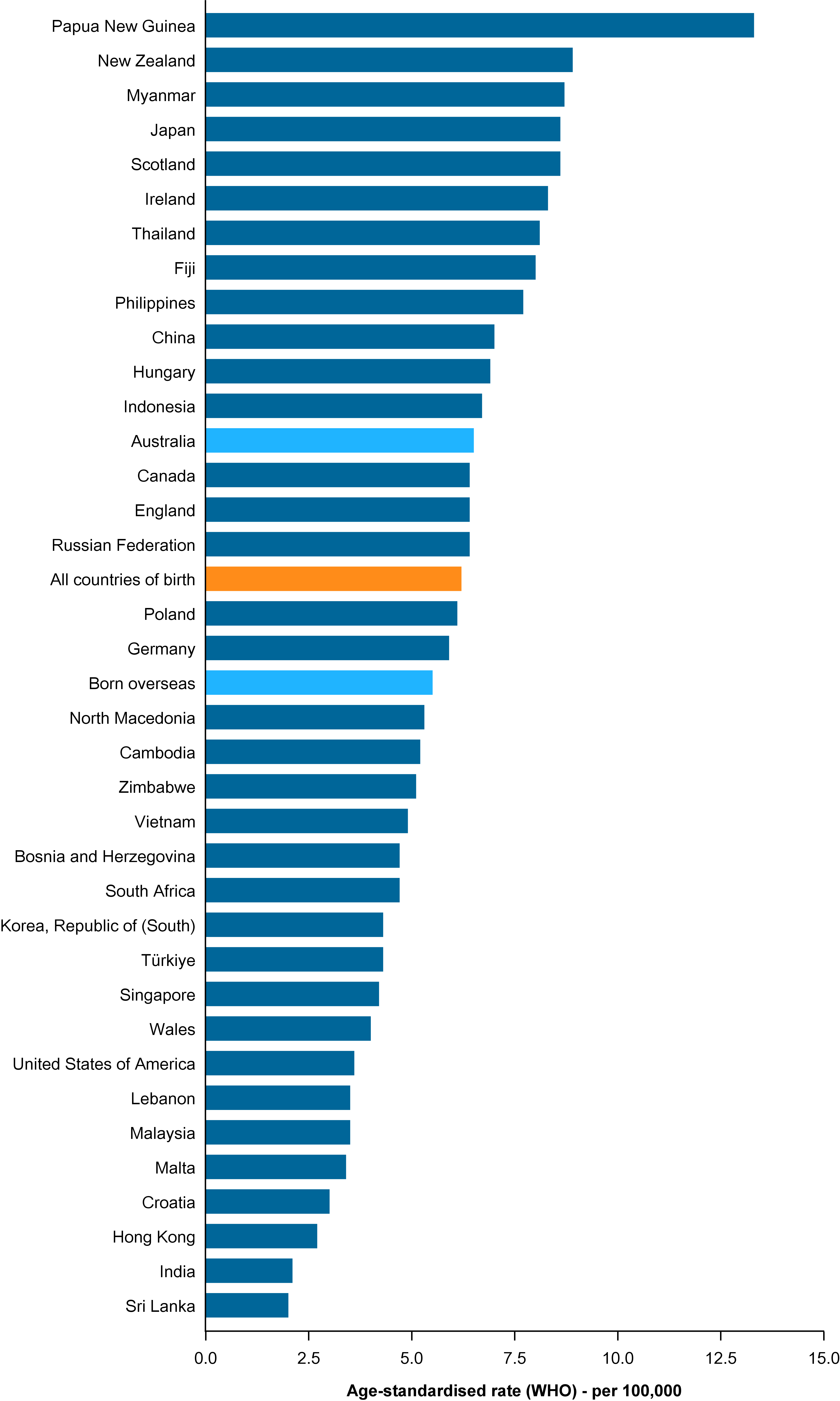
The rates within Australia by country of birth (COB) for the 2006–2020 period ranged between 2.0 (Sri Lanka) and 13.3 (Papua New Guinea) cases per 100,000 females. The Papua New Guinea incidence is discussed within the section on Melanesia.
The countries of birth (COBs) with rates of cervical cancer below 3.5 cases per 100,000 females in 2006–2020 were from a variety of ROBs. The COBs included the Malaysia-born (3.5), Lebanon-born (3.5), Malta-born (3.4), Croatia-born (3.0), Hong Kong-born (2.7), India-born (2.1) and Sri Lanka-born (2.0).
Cervical cancer incidence rates for overseas-born populations are often lower than the country in which the populations were born
For the COBs with relatively low cervical cancer incidence, the estimates for 2022 of cervical cancer incidence rates for the actual countries were 10.3 (Malaysia), 3.6 (Lebanon), 4.2 (Malta), 8.3 (Croatia), 17.7 (India), 9.2 (Sri Lanka) cases per 100,000 females in 2022 (IARC 2022). The cervical cancer rates for populations within Australia are often less than the country the people were born in.
There are many possible factors which may contribute to differences between the cancer incidence for the country and the respective populations within Australia. Regarding differences that may be attributable to cervical cancer detection and prevention, Australia has a national cervical cancer screening program which can lead to lower cervical cancer incidence rates through detection (and the potential for treatment) of precancerous changes in cervical cells. Also, in 2007 a Human Papillo Virus (HPV) vaccination program was introduced in Australia for school age children around 12 to 13 years of age. With HPV being a leading risk factor for cervical cancer, the vaccination should lead to further decreases in cervical cancer incidence within Australia over time as proportionally more of the population are vaccinated.
Figure 39: Cervical cancer age-standardised incidence rates, by country of birth: females, Australia, 2006–2020
Notes:
- Rates are age-standardised to the WHO World Standard Population and expressed cases per 100,000 females.
- Includes countries of birth with on average 20,000 people living in Australia between 2006 and 2020 and 20 or more cervical cancer cases diagnosed for the period. Excludes the countries of birth where cervical cancer was not in the leading 20 cancers for females for the period.
- Born overseas includes born in any country except for Australia. All countries of birth rates are the national rates for Australia and includes the population born in Australia and all other countries.
Source: Australian Cancer Database 2020
Nasopharyngeal cancer
Nasopharyngeal cancer incidence rates were higher in eastern and south-eastern Asian COBs
Nasopharyngeal cancer is rare in Australia at 0.3 cases per 100,000 persons for 2006–2020 and does not rank within the top 20 cancers. However, for some countries of birth shown in Figure 28 it ranks within the top 20 cancers.
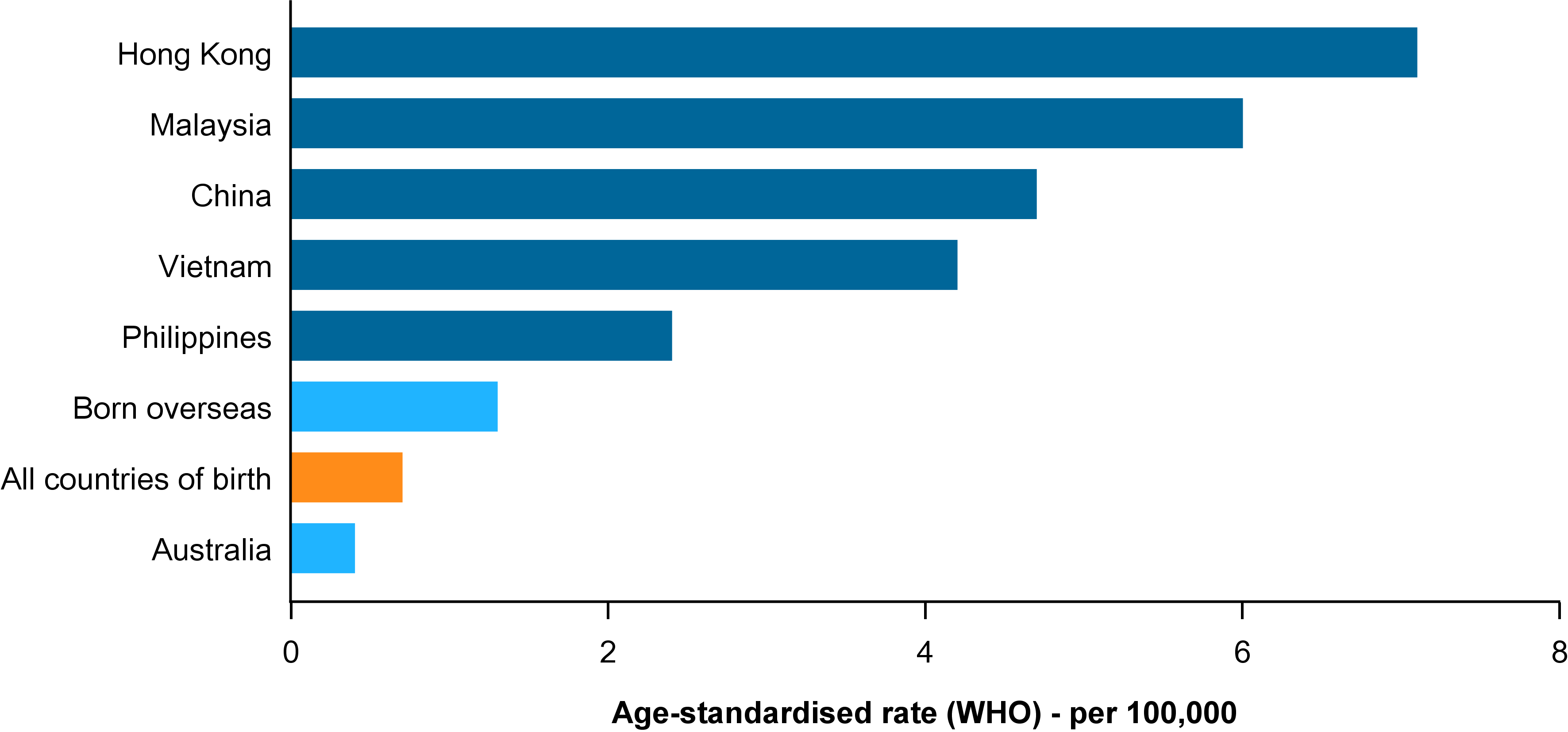
Nasopharyngeal cancer is more common in males. For Australia-born males, nasopharyngeal cancer was rare (0.4 cases per 100,000 males) and well below the incidence rates of the leading 20 cancers. However, for Hong Kong-born males, nasopharyngeal cancer was the seventh most commonly diagnosed cancer for 2006–2020 with an incidence rate of 7.1 cases per 100,000 males.
Nasopharyngeal cancer also ranks within the leading 20 cancers for the Hong Kong-born, Malaysia-born, China-born and Vietnam-born female populations. Here the rates for 2006–2020 were lower than males (2.4, 1.8, 1.5 and 1.3 cases per 100,000 females respectively) but much greater than the Australia-born rate of 0.1 cases per 100,000 females.
Nasopharyngeal cancer is most common in eastern and southern China (including Hong Kong), Singapore, Vietnam and the Philippines. The American Cancer Society noted that people of south China have a lower risk of nasopharyngeal cancers if they move to another area that has lower rates of nasopharyngeal cancer (like the United States or Japan), but their risk is still higher than for people who are native to areas with lower risk. Over time, their risk seems to go down as it does in new generations (ACS 2022).
Figure 40: Nasopharyngeal cancer age-standardised incidence rates, by country of birth: males, Australia, 2006–2020
Notes:
- Rates are age-standardised to the WHO World Standard Population and expressed cases per 100,000 males.
- Includes countries of birth with on average 20,000 people living in Australia between 2006 and 2020 and 20 or more nasopharyngeal cancer cases diagnosed in males for the period. Excludes the countries of birth where nasopharyngeal cancer was not in the leading 20 cancers for males for the period.
- Born overseas includes born in any country except for Australia. All countries of birth rates are the national rates for Australia and includes the population born in Australia and all other countries.
Source: Australian Cancer Database 2020