


Specialist homelessness services client pathways: analysis insights:
Specialist homelessness services client pathways: Clients experiencing persistent homelessness in 2019–20
Web article
Last updated:
Topic: Homelessness services
Citation
AIHW (Australian Institute of Health and Welfare) (2023) Specialist homelessness services client pathways: Clients experiencing persistent homelessness in 2019–20, AIHW, Australian Government, accessed 9 July 2026.
PDF | 436kB
This article is part of Specialist homelessness services client pathways: analysis insights
Children and young people
- Specialist homelessness services client pathways: Children on care and protection orders in 2014–17
- Specialist homelessness services client pathways: Young clients aged 18 to 24 in 2018–20
- Specialist homelessness services client pathways: Young clients aged under 18 in 2011–13
- Specialist homelessness services client pathways: Young clients presenting alone in 2015–16
Client vulnerabilities
- Specialist homelessness services client pathways: Clients exiting custodial arrangements in 2014–17
- Specialist homelessness services client pathways: Clients with mental health issues in 2015–16
- Specialist homelessness services client pathways: Clients with problematic drug or alcohol use in 2015–16
Indigenous Australians
Specialist homelessness services clients
Family, domestic and sexual violence
- Specialist homelessness services client pathways: Female clients experiencing family and domestic violence and persistent homelessness in 2020–21
- Specialist homelessness services client pathways: Female clients experiencing family and domestic violence and returning to homelessness in 2020–21
- Specialist homelessness services client pathways: Female clients with family and domestic violence experience in 2015–16
Client housing situation
Repeat homelessness
- Specialist homelessness services client pathways: Clients experiencing persistent homelessness in 2019–20 This page
- Specialist homelessness services client pathways: Clients returning to homelessness in 2019–20
Introduction
A larger share of the homeless population in most countries is homeless for only a short period before finding a more stable housing solution, however, there are a smaller, and visible share of the homeless population that experiences longer or multiple episodes of homelessness (OECD 2020). See Repeat homelessness for more information about people experiencing repeat cycles of homelessness.
Clients of Specialist Homelessness Services (SHS) experiencing persistent homelessness are defined as those who have been homeless for more than 7 months in the preceeding 24-month period (that is, at least 30% of the time). The number of persistently homeless SHS clients increased from 29,500 clients in 2018–19 to 35,200 clients in 2021–22 (AIHW 2022). Of these clients, 48% experienced persistent homelessness for the first time in 2021–22, while more than half (52%) had experienced persistent homelessness in previous years (AIHW unpublished):
- 28% experienced persistent homelessness in both the 2020–21 and 2021–22 periods,
- 11% experienced persistent homelessness in 3 consecutive time periods from 2019–20 to 2021–22,
- 11% experienced persistent homelessness in 4 consecutive time periods from 2018–19 to 2021–22, and
- 2% experienced persistent homelessness before but did not experience this for consecutive years.
It is important to note that these results are restricted to people who received support from an SHS agency and their housing situation was only assessed when they were receiving support. The data does not describe all people experiencing homelessness, nor the housing situation of people when they are not receiving SHS support. People experiencing persistent homelessness can cycle in and out of crisis and short term accommodation without reaching a permanent and stable housing outcome.
In 2021–22, overnight accommodation was provided to almost 83,200 SHS clients; over 23,900 (29%) of these clients were experiencing persistent homelessness. Of the 7.8 million total nights of accommodation provided during 2021–22, around 5.0 million (64%) were provided to clients experiencing persistent homelessness in 2021–22 (AIHW unpublished).
Longitudinal analyses have been undertaken for the 2019–20 persistent homelessness cohort (PHL cohort). This cohort was defined as clients who received SHS support at any time during 2019–20, and who:
- had at least one month of homelessness during July 2019 to June 2020, and
- were homeless for more than 7 months out of 24 months prior to their last supported month during 2019–20.
The number of clients experiencing persistent homelessness in the pathways study cohort (26,900) was less than the number of persistent homeless clients reported using annual data (30,300) (AIHW 2022). The difference was because the pathway analyses used more stringent quality requirements for client information. Therefore, some clients with less accurate information were excluded from the pathways analyses.
See Introduction to the SHS longitudinal data for details on the longitudinal analyses undertaken.
A comparison cohort (non-persistent homelessness) was created, comprising of clients that received SHS support at any time during 2019–20 and:
- had at least one month of homelessness during July 2019 to June 2020, and
- were not homeless for more than 7 months out of 24 months preceding their last supported month in 2019–20.
More information on the how comparison cohorts were derived can be found in the Methodology section.
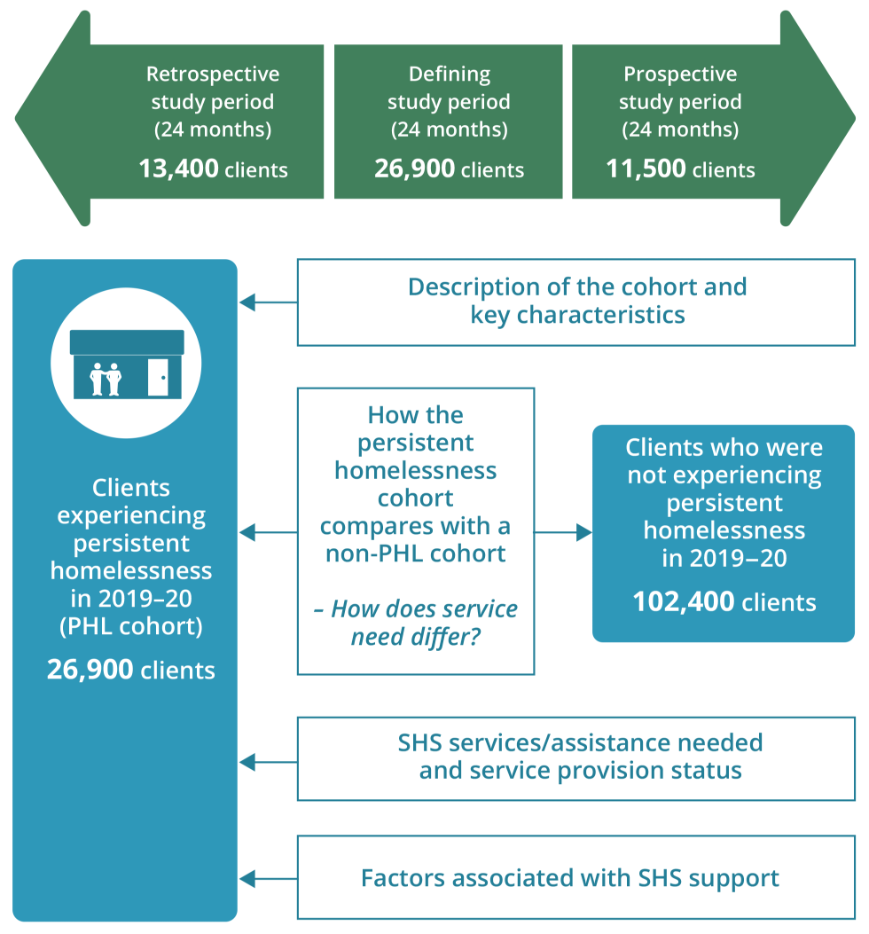
The longitudinal SHS data for the period 2015–22 were used to examine characteristics and service use patterns of the 2019–20 persistent homelessness cohort compared with the 2019–20 non-persistent homelessness cohort (Figure Persistent.1).
The defining study period for these cohorts is the 24 months prior to the last support for each client between July 2019 and June 2020. The retrospective study period is the 24 months before the start of each client’s 24 month defining study period, and the prospective study period is the 24 months after the end of each client’s 24 month defining study period.
Key findings
- In 2019–20, 56% of clients who experienced persistent homelessness were female and 51% were under 25 years old.
- Around half (51%) of the persistent homelessness cohort had been couch-surfing and one-third (33%) were rough sleeping at some time during the defining period.
- In 2019–20, clients experiencing persistent homelessness were around 4 times more likely to need assistance for physical disability services compared with the non-persistent cohort.
- The persistent homelessness cohort were more likely to receive accommodation (of any type) (74%) compared with the non-persistent cohort (47%), especially medium-term accommodation.
Figure Persistent.1: Clients experiencing persistent homelessness cohort, longitudinal analysis overview
Key characteristics of the 2019–20 persistent homelessness cohort
Almost 26,900 SHS clients experienced persistent homelessness in 2019–20; during the defining study period, these clients had the following characteristics (Figure Persistent.2, Table PHL1920.1, Table PHL1920.2):
- A majority (56% or 15,100 clients) were female.
- Around half (51% or 13,600 clients) were under 25 years old.
- Almost one-third (32% or 8,500 clients) were Indigenous Australians.
- Around half (51% or 18,800) had been couch-surfing at some time during the defining period and one-third (33% or 8,800) were rough sleeping at some time during the defining period.
- Around half of the clients (50% or 13,400 clients) had received SHS support previously (in the 24-month retrospective period) and 43% (11,500 clients) continued to need support in the 24-month prospective period.
- Over half (55% or 14,800 clients) had 3 or more SHS periods of support during the defining study period, 19% had two support periods and 26% had only one support period.
- Around one in ten (9.5% or 2,600 clients) had exited a foster care/child safety placement or other care institution.
- Three-quarters (74% or 19,800 clients) had received accommodation in the defining period (of any type, short, medium or long-term).