Specialist homelessness services client pathways: analysis insights:
Specialist homelessness services client pathways: Young clients aged 18 to 24 in 2018–20
Web article
Last updated:
Topic: Homelessness services
Citation
AIHW (Australian Institute of Health and Welfare) (2023) Specialist homelessness services client pathways: Young clients aged 18 to 24 in 2018–20, AIHW, Australian Government, accessed 26 July 2026.
PDF | 563kB
This article is part of Specialist homelessness services client pathways: analysis insights
Children and young people
- Specialist homelessness services client pathways: Children on care and protection orders in 2014–17
- Specialist homelessness services client pathways: Young clients aged 18 to 24 in 2018–20 This page
- Specialist homelessness services client pathways: Young clients aged under 18 in 2011–13
- Specialist homelessness services client pathways: Young clients presenting alone in 2015–16
Client vulnerabilities
- Specialist homelessness services client pathways: Clients exiting custodial arrangements in 2014–17
- Specialist homelessness services client pathways: Clients with mental health issues in 2015–16
- Specialist homelessness services client pathways: Clients with problematic drug or alcohol use in 2015–16
Indigenous Australians
Specialist homelessness services clients
Family, domestic and sexual violence
- Specialist homelessness services client pathways: Female clients experiencing family and domestic violence and persistent homelessness in 2020–21
- Specialist homelessness services client pathways: Female clients experiencing family and domestic violence and returning to homelessness in 2020–21
- Specialist homelessness services client pathways: Female clients with family and domestic violence experience in 2015–16
Client housing situation
Introduction
Youth homelessness can have a profound impact on the lives of young people in Australia and as such children and young people are a priority homelessness cohort (see Children and young people for more detailed information about young people and homelessness).
Longitudinal analyses have been undertaken for a cohort of young clients aged 18 to 24 who received specialist homelessness services sometime in 2018–20 (Figure Young1820.1; See Introduction to the SHS longitudinal data for details on the longitudinal analyses undertaken).
A comparison cohort (2018–20 non-young) was created, comprising of clients who received SHS support at any time during 2018–20 and who were aged 25 years and over.
More information on the how comparison cohorts were derived can be found in the Methodology section.
The defining study period is the 24 months from the start of the first support period for each client between July 2018 and June 2020. The retrospective study period for this cohort is the 84 months (or 7 years) before the start of the defining study period.
Key findings
- Nearly two-thirds (64%) of SHS clients aged 18 to 24 who received support in 2018–20 were female.
- Almost half (45%) of the 2018–20 young cohort had a current mental health issue during the defining period.
- Around two-thirds (63%) of the 2018–20 young cohort were homeless at some time in the defining period and 41% had been couch surfing at some time.
- 2018–20 young cohort clients were more likely to have family-related issues as reasons for seeking assistance, such as relationship/family breakdown.
- Over 4 in 5 young clients were not employed sometime in the defining period.
- Young clients aged 18 to 24 in 2018–20 were over 4 times more likely than the comparison cohort to need training assistance or pregnancy assistance.
Figure Young1820.1: Young cohort 2018–20, longitudinal analysis overview
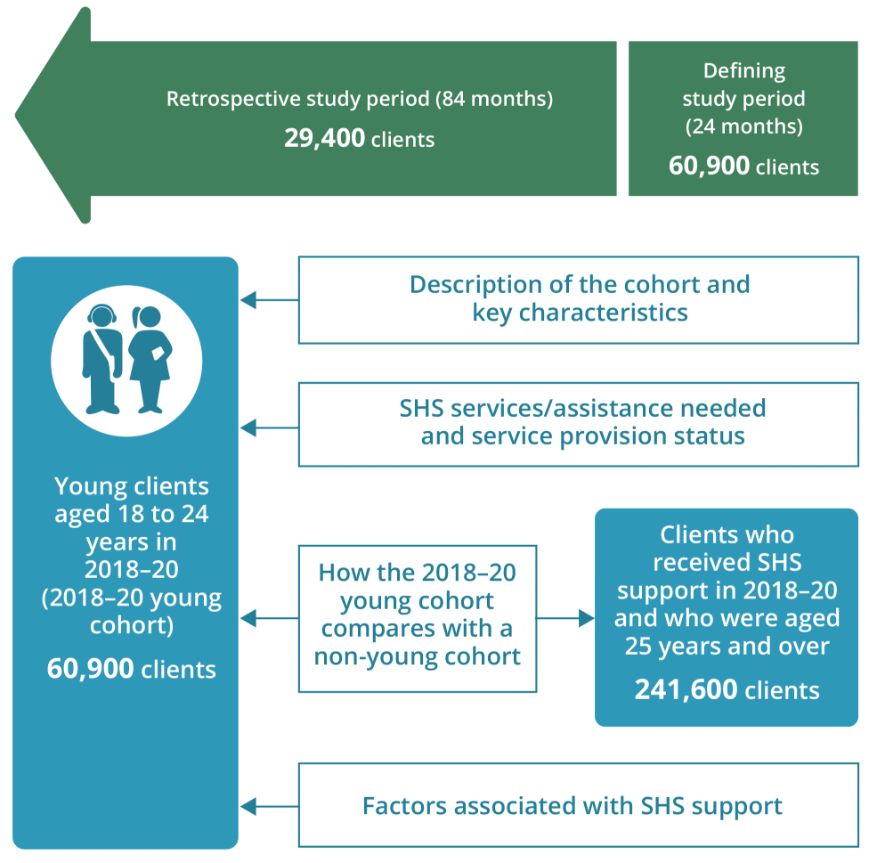
Source: AIHW analysis of SHS longitudinal data 2011–22, Table Young1820.1.
Key characteristics of the 2018–20 young cohort
Over 60,900 young clients aged 18 to 24 received SHS services in 2018–20; these clients had the following key characteristics (Figure Young1820.2, Table Young1820.1, Table Young1820.2):
- Nearly two-thirds (64%, 39,000 clients) were female.
- Over 30% (18,500 clients) were Indigenous Australians.
- 11% (7,000 clients) were born overseas.
- Almost half (47%, 28,600 clients) received only one episode of support in 2018–20.
- Almost half (48% or 29,400 clients) had received SHS support at some point in the 84 months before the defining study period.
- Nearly two-thirds (63% or 38,400 clients) were homeless at some time during the defining study period.
- 33% (20,000 clients) received accommodation during the defining study period.
- Of the 38,400 clients that had experienced homelessness, almost two-thirds (25,200 clients) had been couch-surfing at some time.
- Almost half (45% or 27,100 clients) had a current mental health issue during the defining study period, and nearly 15% (9,000 clients) had problematic drug and/or alcohol issues.
- Around 40% (24,500 clients) had experienced family and domestic violence during the defining study period.
Figure Young1820.2: Young clients aged 18 to 24 in 2018–19, client key characteristics, by study period
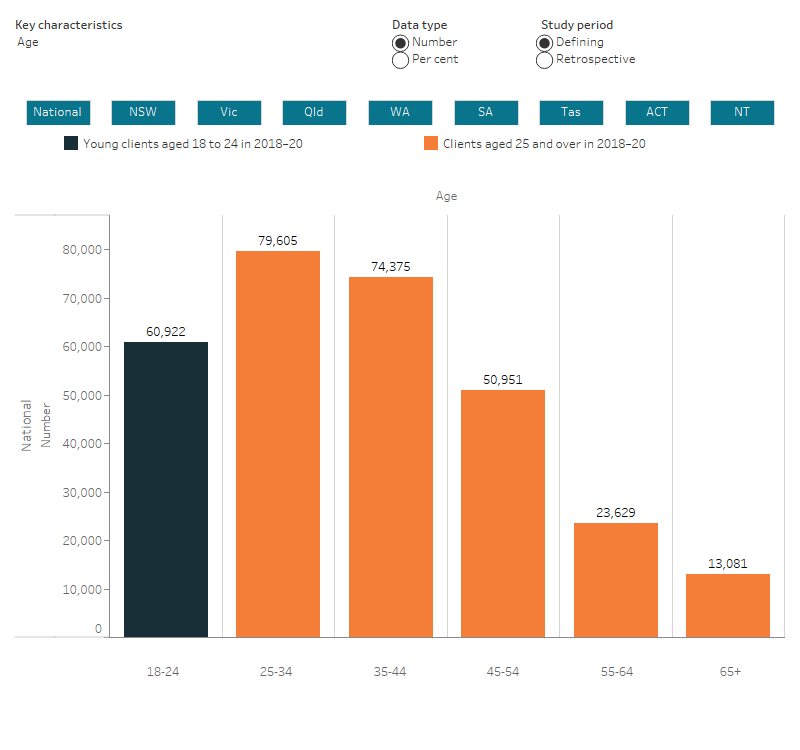
This interactive bar chart shows a comparison between the young and non-young cohorts, in terms of key characteristics and across two study periods (defining and retrospective). A radio button allows selection for the individual state/territory and Australia. For Australia, young clients were more likely to be Indigenous (Young clients 30% compared with 21% non-young clients) and more likely to be couch surfer (41% compared with 24%).They were also more likely to have relationship/family breakdown as reason for seeking assistance (36% compared with 21%).
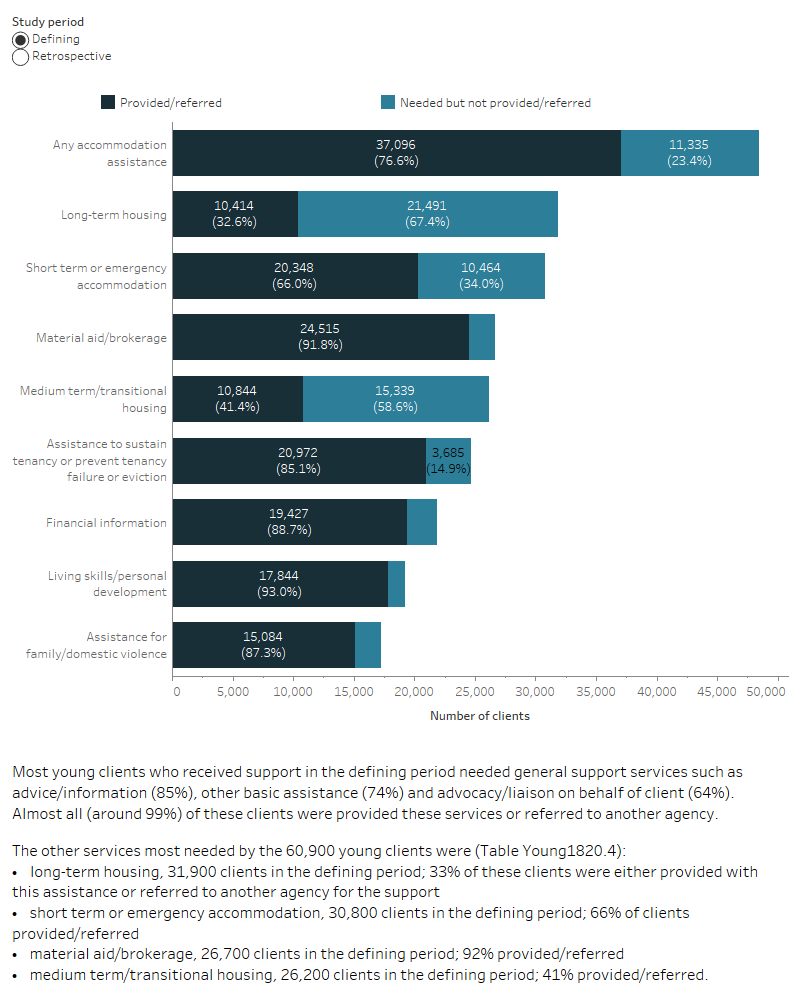
The interactive stacked horizontal bar graph shows the select top 10 services needed and the provision/referral status for the 2018–20 Young cohort clients (60,900 clients) who received support in the retrospective and defining study periods. Across two study periods, long-term housing was one of the most needed services, around 33% of these clients were either provided this service or referred to another agency. Material aid/brokerage was also a key service needed by this cohort; this service was provided/referred to over 92% of clients.
The interactive risk ratio plot shows the differences in service need between young and non-young clients receiving SHS support in the two retrospective and defining study periods, these associations are presented as relative risks. The top 4 services more likely to be needed by young cohort clients compared with non- young clients (that is, those with the largest relative risk) have been shown in the figure. A radio button allows selection of the services and relative risks for each of the study periods (defining and retrospective). Young clients were 4 to 5 times more likely to need training assistance (relative risk [RR] 4.50) and pregnancy assistance (relative risk [RR] 4.41) during the 2018–20 defining study period than clients in the non-young cohort. Compared to non-young clients, young clients had much less need for interpreter service (relative risk [RR] 0.49).
![The interactive risk ratio plot shows the differences in service need between young and non-young clients receiving SHS support in the two retrospective and defining study periods, these associations are presented as relative risks. The top 4 services more likely to be needed by young cohort clients compared with non- young clients (that is, those with the largest relative risk) have been shown in the figure. A radio button allows selection of the services and relative risks for each of the study periods (defining and retrospective). Young clients were 4 to 5 times more likely to need training assistance (relative risk [RR] 4.50) and pregnancy assistance (relative risk [RR] 4.41) during the 2018–20 defining study period than clients in the non-young cohort. Compared to non-young clients, young clients had much less need for interpreter service (relative risk [RR] 0.49).](https://viz.aihw.gov.au:443//t/Public/views/YOUNG_1820/Figure_6RelativeRisk.png?%3aembed=y&%3ashowVizHome=no&%3adisplay_spinner=no&%3ahost_url=https%3a%2f%2fviz.aihw.gov.au%2f&embed_code_version=3&tabs=no&toolbar=yes&showAppBanner=false)
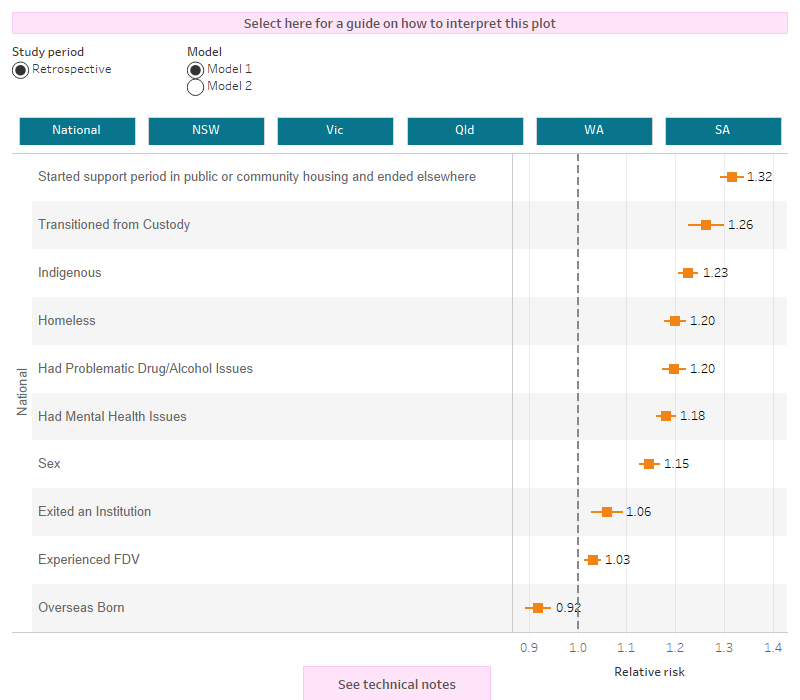
The interactive risk ratio plot shows the characteristics or reasons for presenting that are associated with the young cohort clients’ use of SHS services in the past (retrospective), these associations are presented as relative risks. Relative risks for all states and territories and Australia can be selected and displayed. Two regression models can be selected, Model 1 contains client characteristics and experiences in the defining period, Model 2 contains client characteristics and the reasons for seeking support in the defining study period. Nationally, having started support in public or community housing and ended elsewhere, or having transitioned from custody, or having had problematic drug/alcohol issues at some time during the defining study period had the strongest association with past SHS support.