


Specialist homelessness services client pathways: analysis insights:
Specialist homelessness services client pathways: Female clients experiencing family and domestic violence and returning to homelessness in 2020–21
Web article
Last updated:
Topic: Homelessness services
Citation
AIHW (Australian Institute of Health and Welfare) (2024) Specialist homelessness services client pathways: Female clients experiencing family and domestic violence and returning to homelessness in 2020–21, AIHW, Australian Government, accessed 26 July 2026.
This article is part of Specialist homelessness services client pathways: analysis insights
Children and young people
- Specialist homelessness services client pathways: Children on care and protection orders in 2014–17
- Specialist homelessness services client pathways: Young clients aged 18 to 24 in 2018–20
- Specialist homelessness services client pathways: Young clients aged under 18 in 2011–13
- Specialist homelessness services client pathways: Young clients presenting alone in 2015–16
Client vulnerabilities
- Specialist homelessness services client pathways: Clients exiting custodial arrangements in 2014–17
- Specialist homelessness services client pathways: Clients with mental health issues in 2015–16
- Specialist homelessness services client pathways: Clients with problematic drug or alcohol use in 2015–16
Indigenous Australians
Specialist homelessness services clients
Family, domestic and sexual violence
- Specialist homelessness services client pathways: Female clients experiencing family and domestic violence and persistent homelessness in 2020–21
- Specialist homelessness services client pathways: Female clients experiencing family and domestic violence and returning to homelessness in 2020–21 This page
- Specialist homelessness services client pathways: Female clients with family and domestic violence experience in 2015–16
Client housing situation
Key findings
For adult female clients of specialist homelessness services (SHS) experiencing family and domestic violence (FDV) and returning to homelessness in 2020–21:
- over 1 in 3 experienced both a current mental health issue and problematic drug and/or alcohol use, around double that of the FDV non-returning to homelessness cohort
- they were 2.4 times as likely to need family planning support and pregnancy assistance, compared with the FDV non-returning to homelessness cohort.
- those who exited public or community housing were 15–16% more likely to receive SHS support in the future.
Introduction
In many countries, a large share of the homeless population is homeless for a short period before transitioning to a more stable housing solution, however, there is a smaller share of the population that experiences longer or multiple episodes of homelessness and requires higher support needs (OECD 2020).
Clients of specialist homelessness services (SHS) returning to homelessness are categorised under repeat homelessness. Return to homelessness occurs when people who were experiencing homelessness achieved housing and then returned to homelessness.
SHS clients returning to homelessness has decreased over time, from 15,900 clients in 2018–19 to 14,900 in 2022–23 (AIHW 2024a). Of all SHS clients returning to homelessness in 2022–23, over half (53%) were women and children affected by family and domestic violence (AIHW 2024a). More contextual information about these clients can be found in Overview of SHS client groups – see ‘Clients experiencing repeat homelessness’.
This report focuses on adult female SHS clients experiencing family and domestic violence (FDV) and returning to homelessness in 2020–21. FDV is the main reason women and children leave their homes in Australia (AHURI 2021). For many, leaving the home (either temporarily or permanently) can result in housing insecurity and/or homelessness due to a lack of housing options or barriers in accessing resources and support (AIHW 2024b).
It is important to note that the findings are restricted to adult female clients experiencing FDV who received support from a SHS agency. Housing situation was only assessed when clients were receiving support. The data does not describe all people who experienced a return to homelessness pattern, nor the housing situation of SHS clients when they were not receiving SHS support.
Defining the cohorts
In this report, the base cohort includes women aged 18 and over who at any time during 2020–21 received SHS support, had at least one month of homelessness and:
- nominated FDV as a reason for seeking services, or
- were assessed by SHS agency workers as needing FDV services, or
- were provided or referred to FDV services.
Longitudinal analyses have been undertaken for the 2020–21 FDV return to homelessness (FDV RHL cohort). This cohort is defined here as clients in the base cohort who:
- had at least one month of homelessness during July 2020 to June 2021, and
- experienced a homeless-housed-homeless pattern in any time during the 24-months period prior to the last month experiencing homelessness in 2020–21.
A comparison cohort (non-return to homelessness) (FDV non-RHL cohort) was created, comprising clients in the base cohort who:
- had at least one month of homelessness during July 2020 to June 2021, and
- had not experienced a homeless-housed-homeless pattern during the 24-months period prior to the last month experiencing homelessness in 2020–21.
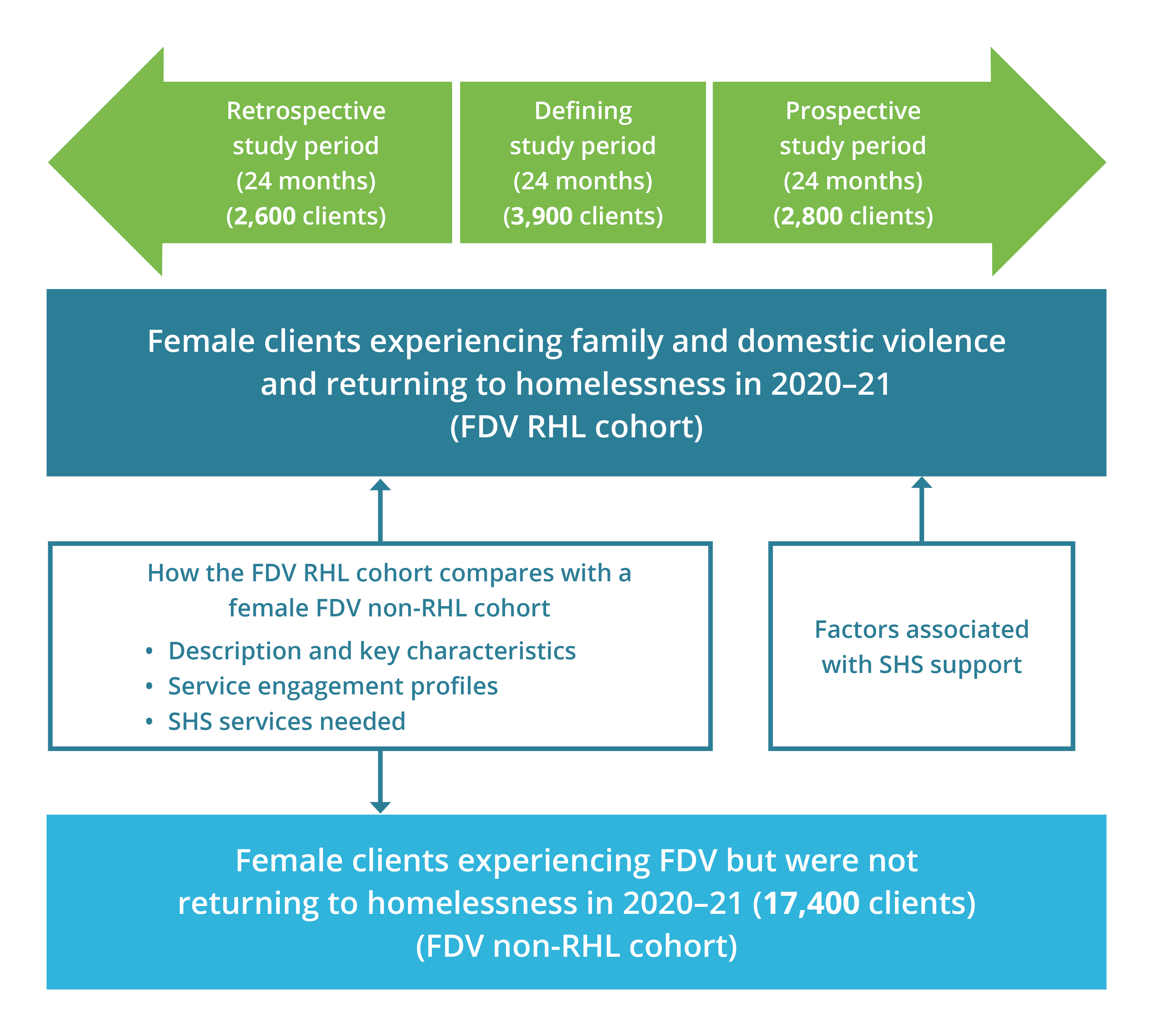
Longitudinal SHS data for the period 2016–23 were used to examine characteristics and patterns of SHS support (all support, not limited to FDV services) among the 2020–21 FDV RHL and FDV non-RHL cohorts (Figure Return.1). The defining study period for these cohorts is the 24 months prior to the last support for each client between July 2020 and June 2021. The retrospective study period is the 24 months before the start of each client’s 24 month defining study period, and the prospective study period is the 24 months after the end of each client’s 24 month defining study period. See Introduction to the SHS longitudinal data for details on the longitudinal analyses undertaken.
There are methodological differences in the scope of FDV clients returning to homelessness reported in this article, compared to the scope used for reporting national indicators (see Technical notes).
Figure Return.1: FDV returning to homelessness cohort 2020–21, longitudinal analysis overview
How the FDV return to homelessness cohort compares with the FDV non-return to homelessness cohort
Key characteristics
In 2020–21, among the 21,400 women in the FDV cohort (aged 18 and over and who had at least one month of homelessness), almost 1 in 5 (18%, or 3,900) clients were in the FDV RHL cohort and over 4 in 5 (82%, or 17,400) clients were in the FDV non-RHL cohort (Figure Return.1, Table FDVRHL2021.1).
The FDV RHL and FDV non-RHL cohorts had some similar characteristics (Figure Return.2, Table FDVRHL2021.1):
- Around 3 in 5 were under 35 years old (61% of the FDV RHL cohort compared with 55% of the FDV non-RHL cohort)
- The majority were unemployed or not in the labour force at some point during the 24-month defining period (99% compared with 91%).
During the 24-month defining period, a higher proportion of the FDV RHL cohort (Figure Return.2, Table FDVRHL2021.1, Table FDVRHL2021.2):
- had 3 or more SHS support periods (90% compared with 46% of FDV non-RHL cohort)
- received short-term accommodation (76% compared with 53%)
- received medium-term accommodation (16% compared with 9.9%)
- ended a support period in public or community housing after having started that support period in a different housing situation (27% compared with 13%).
Clients who experience FDV may also experience other vulnerabilities or specific demographic characteristics. During the defining period, a higher proportion of the FDV RHL cohort (Figure Return.2, Table FDVRHL2021.1, Table FDVRHL2021.2):
- had a current mental health issue (77% compared with 57%)
- had problematic drug and/or alcohol use (39% compared with 20%)
- had both a current mental health issue and problematic drug and/or alcohol use (35% compared with 17%)
- presented with child(ren) (49% compared with 38%)
- were Aboriginal and/or Torres Strait Islander clients (46% compared with 32%).
Figure Return.2: FDV returning and FDV non-returning to homelessness cohort 2020–21, client key characteristics
This interactive bar chart shows a comparison between the FDV RHL and FDV non-RHL cohorts, in terms of key characteristics and across all study periods (defining, retrospective and prospective). Radio buttons allow selection for the data to be displayed as a number or percentage and allows selection for data in the three distinct study periods. For Australia, FDV RHL clients were more likely to be aged 18–24 (FDV RHL 28% compared with 21% FDV non-RHL clients), have had drug/alcohol issues (39% compared with 20%) and had mental health issues (77% compared with 57%). They had three or more SHS support periods (90% compared with 46%) and were more likely to be Aboriginal and/or Tores Strait Islander (46% compared with 32%).

This interactive bar chart shows service use patterns of the 2020–21 FDV RHL cohort over the 2016–23 longitudinal period. Support information was combined from the discrete study periods into four service engagement profile groups (historical, short-term, long-term and ongoing). Of the 3,900 FDV RHL clients that made up the defining period cohort, 550 (14%) were short-term clients who only received support during the 24-month defining study period and 2,000 (51%) were long-term clients and had received support in all three study periods. Of the 17,400 FDV non-RHL clients that made up the defining period cohort, 6,400 (37%) were short-term clients and 4,300 (25%) were long-term clients.

The interactive risk ratio plot shows the differences in service need and reasons for seeking assistance between FDV RHL and FDV non-RHL clients receiving SHS support in each study period, these associations are presented as relative risks. The top services and reasons more likely to be selected by FDV RHL cohort clients compared with FDV non-RHL clients (that is, those with the largest relative risk) have been shown in the figure. A radio button allows selection for each of the study periods (defining, retrospective and prospective). FDV RHL clients were 2.6 times more likely to need counselling for problem gambling (relative risk [RR] 2.61) and 2.4 times more likely to need family planning support (relative risk [RR] 2.41) than clients in the FDV non-RHL cohort during the 2020–21 defining study period.
![The interactive risk ratio plot shows the differences in service need and reasons for seeking assistance between FDV RHL and FDV non-RHL clients receiving SHS support in each study period, these associations are presented as relative risks. The top services and reasons more likely to be selected by FDV RHL cohort clients compared with FDV non-RHL clients (that is, those with the largest relative risk) have been shown in the figure. A radio button allows selection for each of the study periods (defining, retrospective and prospective). FDV RHL clients were 2.6 times more likely to need counselling for problem gambling (relative risk [RR] 2.61) and 2.4 times more likely to need family planning support (relative risk [RR] 2.41) than clients in the FDV non-RHL cohort during the 2020–21 defining study period.](https://viz.aihw.gov.au:443/t/Public/views/FDVRHL2021-nationaldata/Figure_4RelativeRisk.png?%3aembed=y&%3ashowVizHome=no&%3adisplay_spinner=no&%3ahost_url=https%3a%2f%2fviz.aihw.gov.au)
The interactive risk ratio plot shows the characteristics or reasons for presenting that are associated with FDV RHL clients’ need for SHS support in the past (retrospective) or future (prospective period), these associations are presented as relative risks. Two regression models can be selected, Model 1 contains client characteristics and experiences in the defining period, Model 2 contains client characteristics and the reasons for seeking support in the defining study period. Transitioning from custody during the defining study period had the strongest association (16% greater likelihood) with future SHS support. Other significant associations include starting in public or community housing and ending elsewhere (15% more likely), rough sleeping (14% more likely), being Indigenous (10% more likely) and experiencing problematic drug/alcohol issues (9% more likely).
For Model 2, FDV RHL clients who experienced medical issues (11% more likely) were particularly associated with ongoing SHS support.
