


Specialist homelessness services client pathways: analysis insights:
Specialist homelessness services client pathways: Young clients aged under 18 in 2011–13
Web article
Last updated:
Topic: Homelessness services
Citation
AIHW (Australian Institute of Health and Welfare) (2023) Specialist homelessness services client pathways: Young clients aged under 18 in 2011–13, AIHW, Australian Government, accessed 14 July 2026.
PDF | 418kB
This article is part of Specialist homelessness services client pathways: analysis insights
Children and young people
- Specialist homelessness services client pathways: Children on care and protection orders in 2014–17
- Specialist homelessness services client pathways: Young clients aged 18 to 24 in 2018–20
- Specialist homelessness services client pathways: Young clients aged under 18 in 2011–13 This page
- Specialist homelessness services client pathways: Young clients presenting alone in 2015–16
Client vulnerabilities
- Specialist homelessness services client pathways: Clients exiting custodial arrangements in 2014–17
- Specialist homelessness services client pathways: Clients with mental health issues in 2015–16
- Specialist homelessness services client pathways: Clients with problematic drug or alcohol use in 2015–16
Indigenous Australians
Specialist homelessness services clients
Family, domestic and sexual violence
- Specialist homelessness services client pathways: Female clients experiencing family and domestic violence and persistent homelessness in 2020–21
- Specialist homelessness services client pathways: Female clients experiencing family and domestic violence and returning to homelessness in 2020–21
- Specialist homelessness services client pathways: Female clients with family and domestic violence experience in 2015–16
Client housing situation
Introduction
Youth homelessness can have a profound impact on the lives of young people in Australia and as such children and young people are a priority homelessness cohort (see Children and young people).
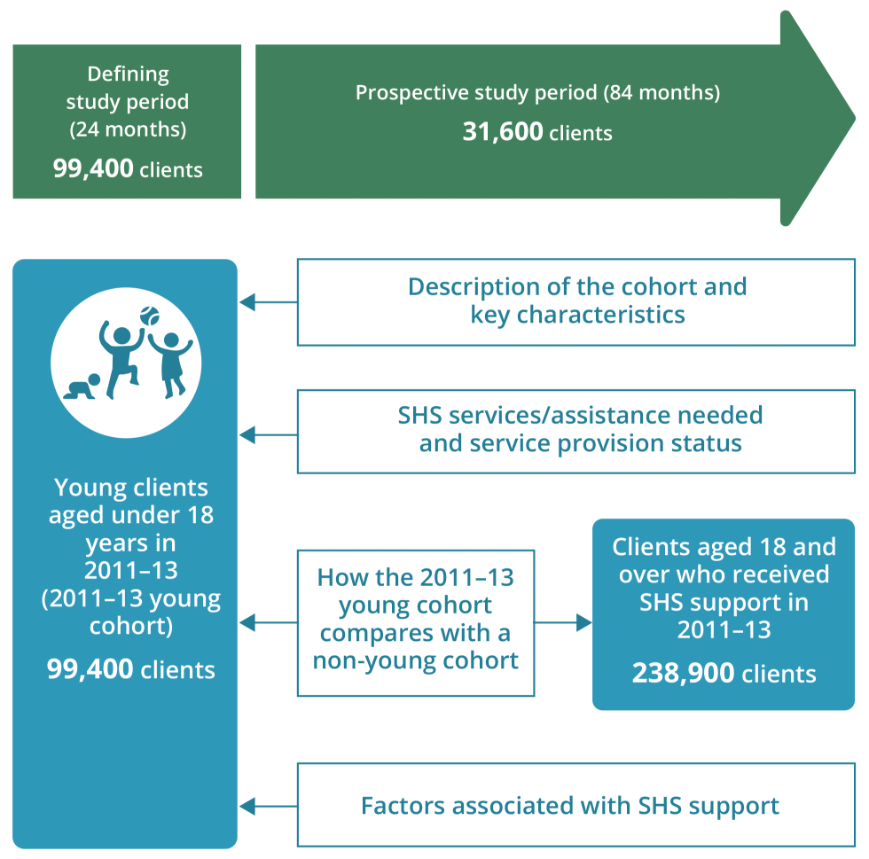
Longitudinal analyses have been undertaken for a cohort of young clients aged under 18 years that presented for specialist homelessness services sometime in 2011–13 (Figure Young1113.1).
See Introduction to the SHS longitudinal data for details on the longitudinal analyses undertaken.
A comparison cohort (2011–13 non-young) was created, comprising of clients aged 18 and over who received SHS support at any time during 2011–13.
More information on the how comparison cohorts were derived can be found in the Methodology section.
The longitudinal SHS data for the period 2011–22 were used to examine characteristics and service use patterns of 2011–13 young cohort clients compared with the comparison 2011–13 non-young cohort (Figure Young1113.1).
The defining period is the 24 months from the start of the first support for each client between July 2011 and June 2013. The prospective study period is the 84 months (or 7 years) after the end of each client’s 24 month defining study period.
Key findings
- Over half (57%) of the 2011–13 young cohort were aged under 10 years.
- Half (52%) of the young clients aged under 18 who received SHS support in 2011–13 experienced homelessness at some time.
- The 2011–13 young cohort were more likely to have needed short-term accommodation (52%), compared with a comparison cohort (41%).
- Almost two-thirds of the 2011–13 young cohort received only one episode of support in 2011–13.
- Over 41% of young clients aged under 18 who received SHS support in 2011–13 had experienced family and domestic violence.
- 2011–13 young cohort clients were more likely than the comparison cohort to need school liaison and structured play/skills development assistance.
Figure Young1113.1: Young cohort 2011–13, longitudinal analysis overview
Source: AIHW analysis of SHS longitudinal data 2011–22, Table Young1113.1.
Key characteristics of the 2011–13 young cohort
Approximately 99,400 clients aged under 18 years received SHS support in 2011–13; these clients had the following key characteristics (Figure Young1113.2, Table Young1113.1, Table Young1113.2):
- Over half (57%, 56,400 clients) were aged under 10 years.
- Almost half (48%, 47,500 clients) were male.
- 29% (28,900 clients) were Indigenous Australians.
- Almost two-thirds (64%, 63,300 clients) received only one episode of support in 2011–13.
- 32% (31,600 clients) continued to receive SHS support in the prospective study period (that is, in the 84 months after the 24 month defining study period).
- 52% (51,200 clients) were homeless at some time and 50% (49,900 clients) received accommodation in the defining study period.
- Of the 51,200 clients that had experienced homelessness, half (51% or 26,300 clients) had been couch-surfing at some time in the defining period.
- Over 41% (41,100) of young cohort clients experienced domestic violence.
- 10% (9,900 clients) had a current mental health issue during the defining study period, and 4.5% (4,400 clients) had problematic drug and/or alcohol issues.
Figure Young1113.2: Young cohort 2011–13, client key characteristics, by study period
This interactive bar chart shows a comparison between the young and non-young cohorts, in terms of key characteristics and across two study periods (defining and prospective). A radio button allows selection for the individual state/territory and Australia. For Australia, young clients were less likely to have problematic drug or alcohol issues (4.5% compared with 14%), less likely to have mental health issues (10% compared with 28%) and more likely to have experienced FDV (41% compared with 35%). Young clients were more likely to have one support period (64% compared with 52%) and less likely to have three or more support period (17% compared with 28%). Young clients were also more likely to receive short-term accommodation (39% compared with 28%).
