


Breast cancer
Cancer is a group of several hundred diseases in which abnormal cells are not destroyed naturally by the body but instead multiply and spread out of control. Cancers are distinguished from each other by the specific type of cell involved and by where in the body the disease began.
Breast cancer most commonly originates in the ducts of the breast (which carry milk from the lobules to the nipple) but can also originate in the lobules (small lobes of the breast that produce milk). More rarely, breast cancer can originate in the connective tissue of the breast. The arrangement of breast tissue is illustrated in the following figure.
Figure Breast cancer 1: Anatomy of the breast and adjacent lymph nodes
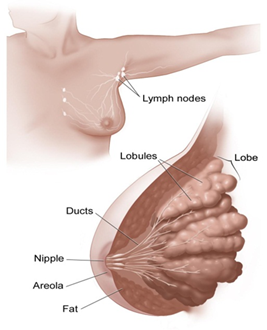
Source: National Cancer Institute 2007.
Worldwide, breast cancer is the most common cancer affecting women, representing 1 in 4 of all cancers in women. The incidence of breast cancer differs worldwide, the disease being far more common in more developed countries than in developing countries (although as less developed countries become more developed, a shift towards the lifestyles of developed countries brings an increase in cancers that have reproductive, dietary and hormonal risk factors – of which breast cancer is one) (UICC 2014).
Breast cancer is the most commonly diagnosed cancer in Australian women, representing 28% of all female cancers diagnosed in 2020; it is second only to lung cancer in cancer deaths (AIHW 2024b). Note that this cancer comparison excludes basal and squamous cell carcinoma of the skin – collectively known as non melanoma skin cancer – as these cancers are not currently reported to Australian cancer registries.