

Continuity of care

Consistently seeing the same health-care provider can promote good health through better coordination of health-care services, and through the development of trust and strong relationships, which are particularly important for Aboriginal and Torres Strait Islander people (Nolan-Isles et al. 2021).

The NATSIHS results indicate that just under 693,000 Aboriginal and Torres Strait Islander people (85%) always used the same source of health care, with just under 58,000 (7.1%) using more than one source, and an additional 63,800 (7.8%) not having any usual source.[1]

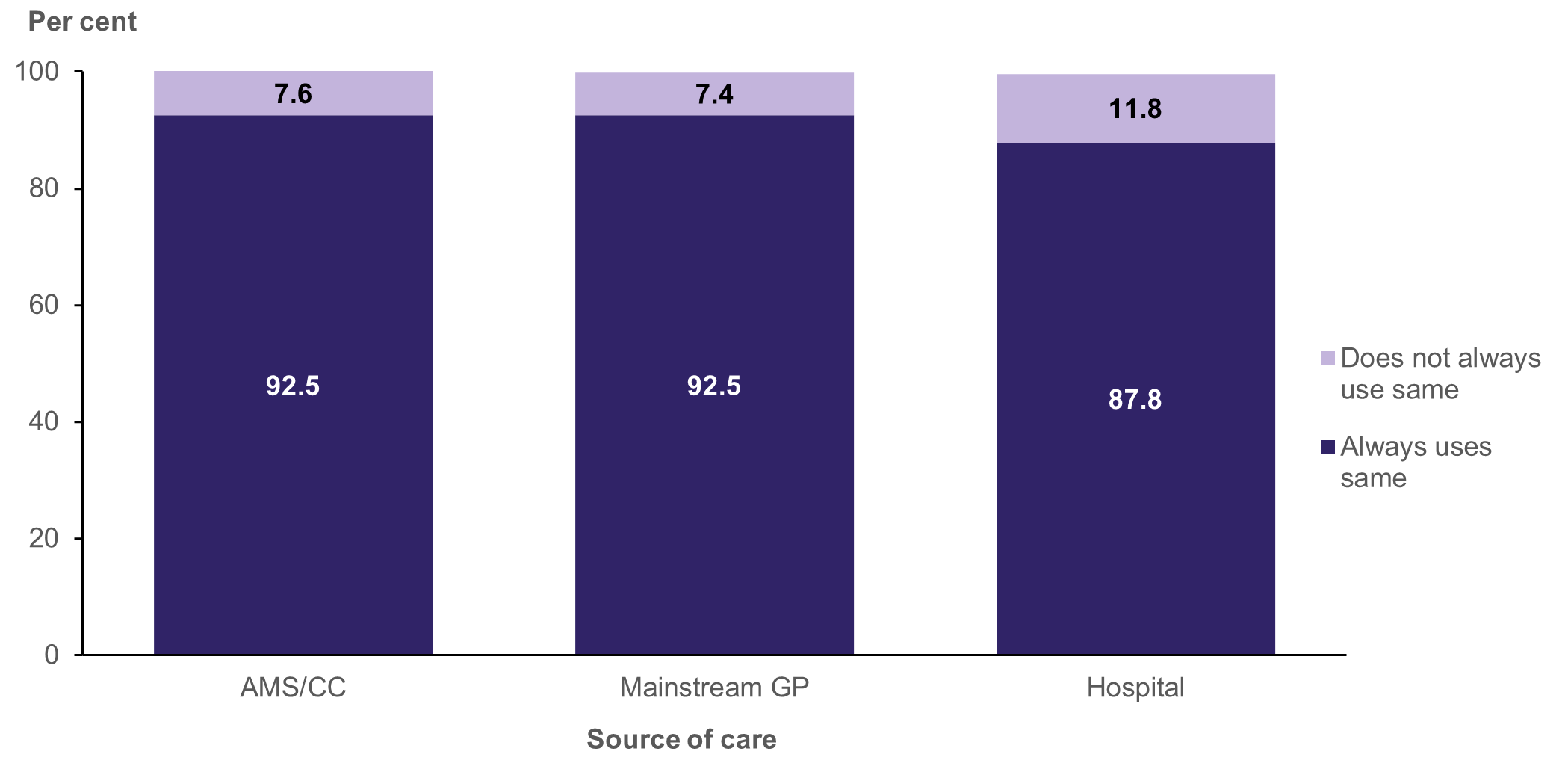
Nearly 93% of those who had an AMS/CC or a mainstream GP as their usual source of care always used them, compared with 88% of those whose main source of care was a hospital (Figure 5.1).

Figure 5.1: Aboriginal and Torres Strait Islander people, always used the same source of health care, by usual source of care, 2018–19
See extended description following this image.

Note: Columns may not add to 100% because of rounding.

Source: AIHW analysis of 2018–19 NATSIHS using TableBuilder (ABS 2019).

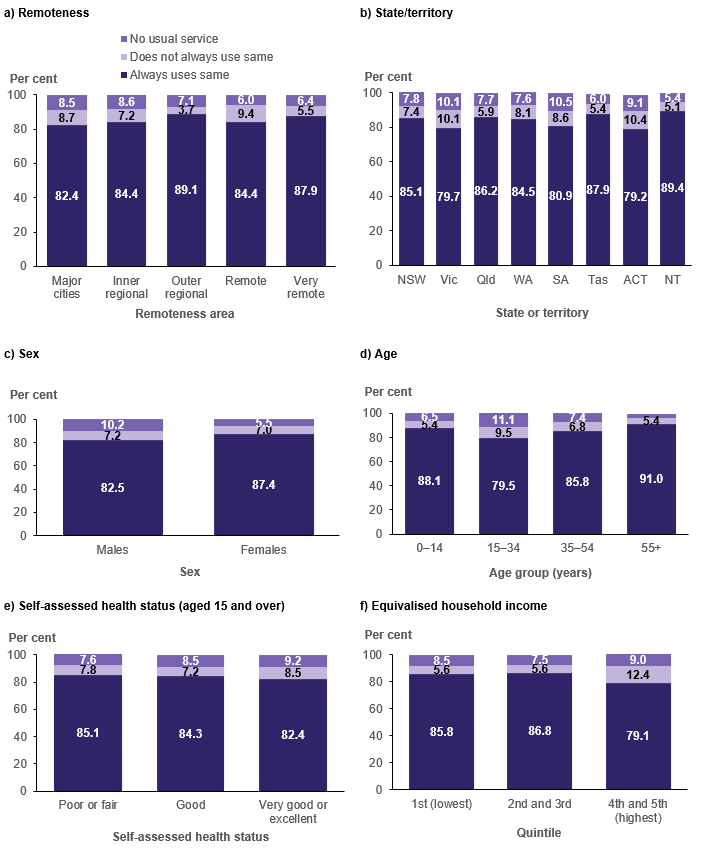
The likelihood of always using the same source varied across a number of the independent variables (Figure 5.2; Data: Descriptive analysis supplementary tables, Table S.4).

Figure 5.2: Aboriginal and Torres Strait Islander people, always used the same source of care, by selected characteristics, 2018–19
See extended description following this image.

Source: AIHW analysis of 2018–19 NATSIHS using TableBuilder (ABS 2019).

Continuity of care was higher among females than among males (87% and 83%, respectively), with 10% of males saying that they had no usual source of care (compared with 5.5% of females). Among age groups, it was lowest among those aged 15–34, at 80% (compared with 91% of those aged 55 and over). The 15–34 age group also was most likely to have no usual source of care (11%), which is consistent with other research on this age group in Australia and internationally.

Those in the Australian Capital Territory (79%) and Victoria (80%) were least likely to always use the same source of care, while those in the Northern Territory (89%) and Tasmania (88%) were most likely to always use the same source.

There was no clear pattern with remoteness – those in Outer regional (89%) and Very remote areas (88%) were most likely to have consistency of care, while those in Inner regional and Remote areas had the same proportions (84%). Those living in Major cities were least likely to always use the same source of care (82%).

Those with poor or fair self-assessed health were slightly more likely to always use the same health care source (85%) compared with those reporting their health as good (84%), or very good/excellent (82%), but the differences were small.

Whether people use more than one source of care may be related to the number of services available in a person’s local area. While the NATSIHS data are unable to capture the absolute number of services in a person’s local area, we do know whether there are multiple types of services. Table 5.1 shows that those with only an AMS/CC in their local area have the highest proportion who always use the same source (88%). In areas where there is only a mainstream GP, 83% use the same, 6.8% use more than one, and 11% either do not have a source of care or report that they don’t know.

Table 5.1: Aboriginal and Torres Strait Islander people, always used the same source of care, by availability of primary health services in local area, 2018–19

Availability of primary care in area

Always used the same

Doesn’t always use the same

None or don’t know

Total

AMS/CC only

95,101 (88.2%)

4,706 (4.4%)

8,054 (7.5%)

107,861 (100%)

Both AMS/CC and mainstream GP

379,413 (86.3%)

35,013 (8.0%)

25,278 (5.7%)

439,704 (100%)

Mainstream GP only

206,018 (82.6%)

17,071 (6.8%)

26,444 (10.6%)

249,533 (100%)

Neither

12,205 (71.2%)

901 (5.3%)

4,041 (23.6%)

17,147 (100%)

Total

692,737 (85.1%)

57,690 (7.1%)

63,817 (7.8%)

814,244 (100%)

Source: AIHW analysis of 2018–19 NATSIHS (ABS 2019) using DataLab.

Note: This number differs slightly from the results in the ‘usual source of care’ question due to random adjustments in TableBuilder.