

Dental care
Timing of most recent visit
Oral health is an important component of overall health and quality of life. Poor oral health can affect adults and children alike, causing pain, embarrassment, and even social marginalisation. For children, the effects can be long term, and carry through to adulthood.
Many Aboriginal and Torres Strait Islander people experience poor oral health, such as multiple caries and untreated dental disease, and are less likely to have received preventive dental care (AHMAC 2017). Several factors contribute towards the poorer oral health of Aboriginal and Torres Strait Islander people, including social disadvantage and lack of access to appropriate diet and dental services.
Dental visits can be for preventive dental care, to maintain existing oral health, to reverse disease or to rehabilitate teeth and gums after damage has occurred. It is recommended that Aboriginal and Torres Strait Islander people visit the dentist at least once a year and have a usual dental provider (AIHW 2023c).
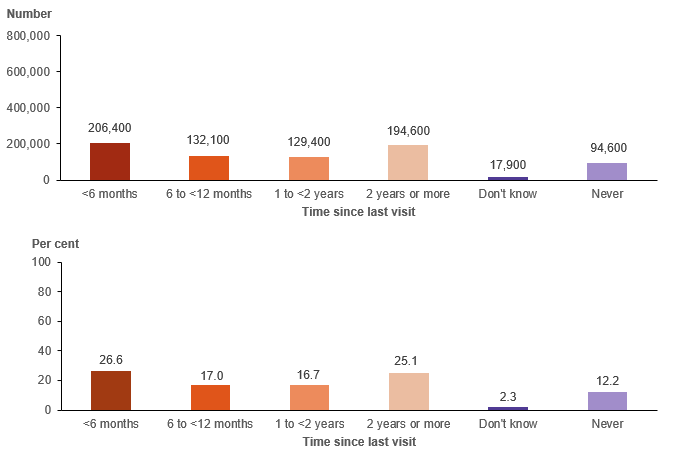
According to the 2018–19 NATSIHS, for 25% of Aboriginal and Torres Strait Islander people over the age of 2, it had been 2 years or more since their last visit to the dentist, with another 12% saying they had never been to a dentist (Figure 5.7)
Figure 5.7: Aboriginal and Torres Strait Islander people (aged 2 and over), timing of most recent visit to a dentist, 2018–19
Source: AIHW analysis of 2018–19 NATSIHS (ABS 2019) using TableBuilder.
Two column charts that present the distribution of how long it had been since respondents (aged 2 and over) in the 2018–19 NATSIHS had attended a dentist (under 6 months, 6 to under 12 months, 1 to 2 years, 2 years or more, don’t know and had never attended).
- the chart on top presents the number of respondents who selected how long it had been. There were 206,400 respondents who had attended in the last 6 months, 132,100 in the last 6 to 12 months, 129,400 in the last 1 to 2 years, 194,600 in the last 2 years or longer, 17,900 didn’t know and 94,600 had never attended a dentist.
- the chart on bottom presents the percentage of respondents who selected how long it had been. Twenty-seven percent of respondents who had attended in the last 6 months, 17% in the last 6 to 12 months, 17% in the last 1 to 2 years, 25% in the last 2 years or longer, 2% didn’t know and 12% had never attended a dentist.
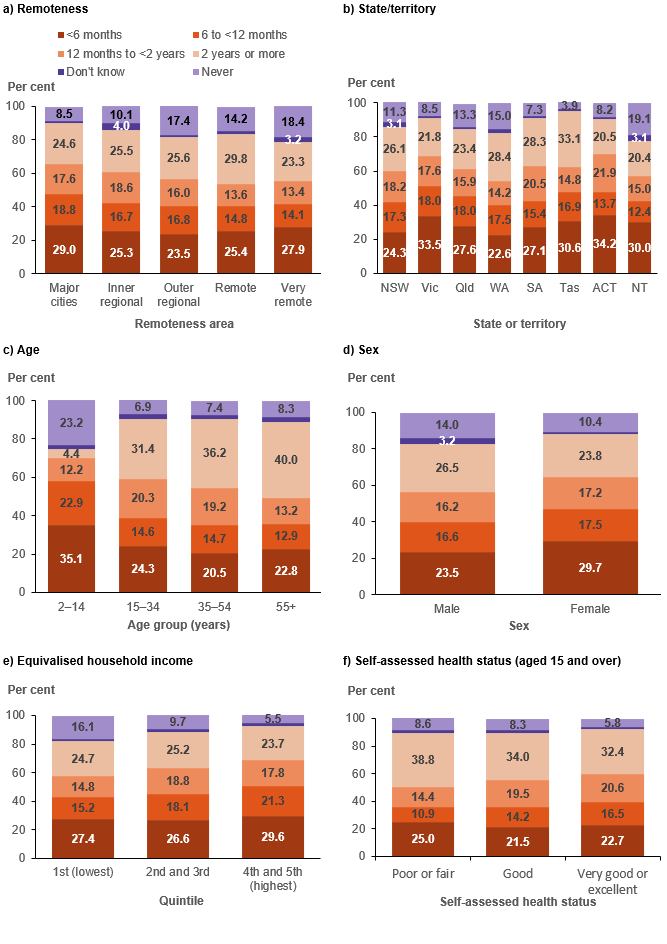
The proportion seeing a dentist within the past 2 years was highest among those in Major cities (65%) and lowest in Remote areas (54%), while those in Very remote areas were most likely to say they had never seen a dentist (18%) (Figure 5.8).
Young children were both most likely to have seen a dentist in the past 6 months (35%) and most likely to have never seen one (23%). Nearly 50% of those with fair or poor self‑assessed health had either never seen a dentist or not seen one in the past 2 years, signifying considerable unmet need (noting that a lack of dental care can contribute to poor overall health as well).
Figure 5.8: Aboriginal and Torres Strait Islander people (aged 2 and over), timing of most recent visit to a dentist, by selected characteristics, 2018–19
Source: AIHW analysis of 2018–19 NATSIHS using TableBuilder (ABS 2019)
Six stacked column charts that present the percentage distribution of how long it had been since respondents (aged 2 and over) in the 2018–19 NATSIHS had attended a dentist (under 6 months, 6 to under 12 months, 1 to 2 years, 2 years or more, don’t know and had never attended) by selected characteristics:
- the chart on the top left presents the distribution by remoteness. The distribution was relatively similar across the 5 remoteness areas, with the percentage of those who had visited a dentist in the last 6 months ranging from 24% in Outer regional areas to 29% in Major cities.
- the chart on the top right presents the distribution by state/territory. The highest percentages of respondents who had attended a dentist in the last 6 months were in the Australian Capital Territory and Victoria (both 34%), while the lowest percentages were seen in Western Australia (23%) and New South Wales (24%). The percentage of respondents who had never attended a dentist ranged from 4% in Tasmania to 19% in the Northern Territory.
- the chart on the middle left presents the distribution by age. Those aged 2–14 had the highest percentage who had attended a dentist in the last 6 months (35%) while the other 3 age groups had lower percentages (24% for 15–34, 21% for 35–54 and 23% for 55 and over). The same pattern was seen for the percentage of those who had attended a dentist in the last 6 to 12 months: 23% for the youngest age group and between 13% and 15% for the other 3 age groups.
- the chart on the middle right presents the distribution by sex. Higher percentages were seen for females compared to males in respondents who had attended a dentist in the last 6 months, last 6 to 12 months, and last 1 to 2 years: 30% compared to 24% in the last 6 months, and marginally in the other 2 periods.
- the chart on the bottom left presents the distribution by aggregated equivalised household income quintiles. The percentages for having attended a dentist in the last 6 months, 6 to 12 months and 1 to 2 years were relatively similar across the 1st (lowest), 2nd and 3rd, and 4th and 5th (highest) quintiles, while the largest difference was in those who had never attended a dentist, with the percentages reported of 16%, 10% and 6%, respectively.
- the chart on the bottom right presents the distribution by self-reported health status for respondents aged 15 and over. The percentages were similar, with 25% of those reporting ‘Poor or fair’ health status compared to 22% of those reporting ‘Good’ and 23% of those reporting ‘Very good or excellent'.
Unmet needs
NATSIHS respondents were asked whether there was ever a time during the past 12 months where they (or their child) needed dental care but did not get it. If they said there had been an occasion of unmet need, they were given a list of 13 potential reasons why they did not go and were asked to tick as many as applied.
The findings suggest that, of 774,600 Aboriginal and Torres Strait Islander people aged 2 and over:
- 627,000 (81%) had no unmet need for dental services
- 146,800 (19%) had at least one instance in the past 12 months when they needed dental care but did not get it.
Unmet need for dental care was slightly higher among those whose usual source of care was a mainstream GP (18%) than among those whose usual source of care was an AMS/CC (16%).[1]
Although the levels of unmet need for dental care were higher than those for GP care, the patterns are generally similar (Figure 5.9):
- Those in Major cities had both the highest proportion (21%) and the highest number of people with unmet need (62,600), compared with all other remoteness areas. However, there was less variation between remoteness areas than for unmet need for GPs – unmet need ranged from 14% in Very remote areas to 21% in Major cities.
- Again the Australian Capital Territory had the highest proportion of people with unmet need (25%), and the lowest number of people (1,800 people). In absolute terms, New South Wales and Queensland had the highest number of people with unmet needs (45,300 and 42,400, respectively).
- Young children had low rates of unmet need for dental care (which may be related to targeted children’s dental programs). The highest number of people with an unmet need were in the 15–34 age group (71,300).
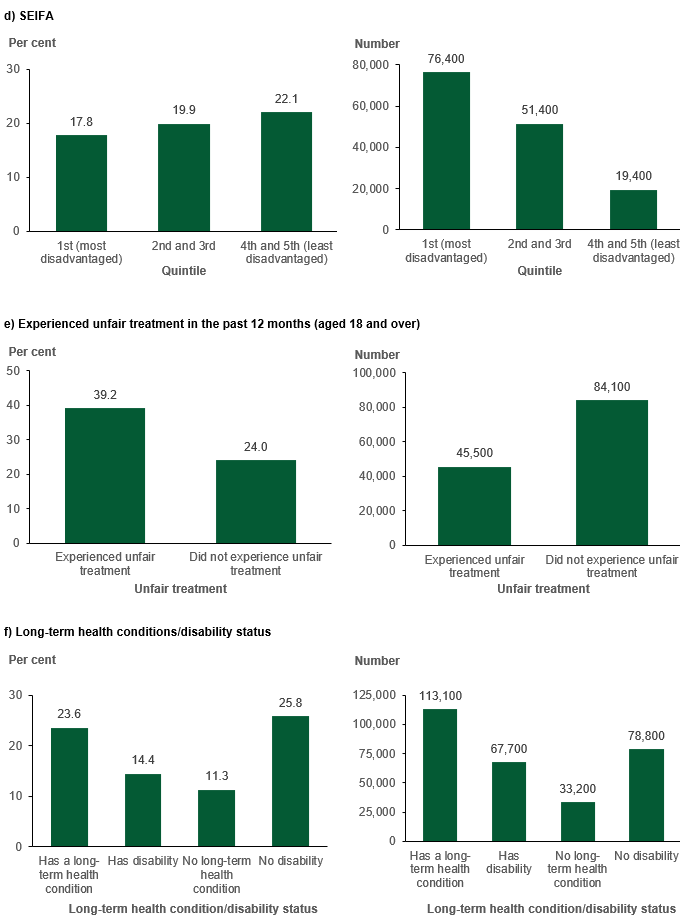
- There were 76,400 people living in the most disadvantaged areas with unmet need.
- The proportion of adults who had experienced unfair treatment in the past year with unmet need was 39%, which is higher than the proportion of those who had not experienced unfair treatment (24%).
Unmet need differed from that for GPs with regard to disability. While the pattern for those with long-term health conditions was similar (higher proportions and higher numbers than those without), those with disability had lower rates of unmet need for dental services than those without (14% versus 26%). However, there are still considerable numbers of Aboriginal and Torres Strait Islander people with disability who had unmet need (67,600).
Figure 5.9: Aboriginal and Torres Strait Islander people (aged 2 and over), unmet need for dental care in the past 12 months, by selected characteristics, 2018–19
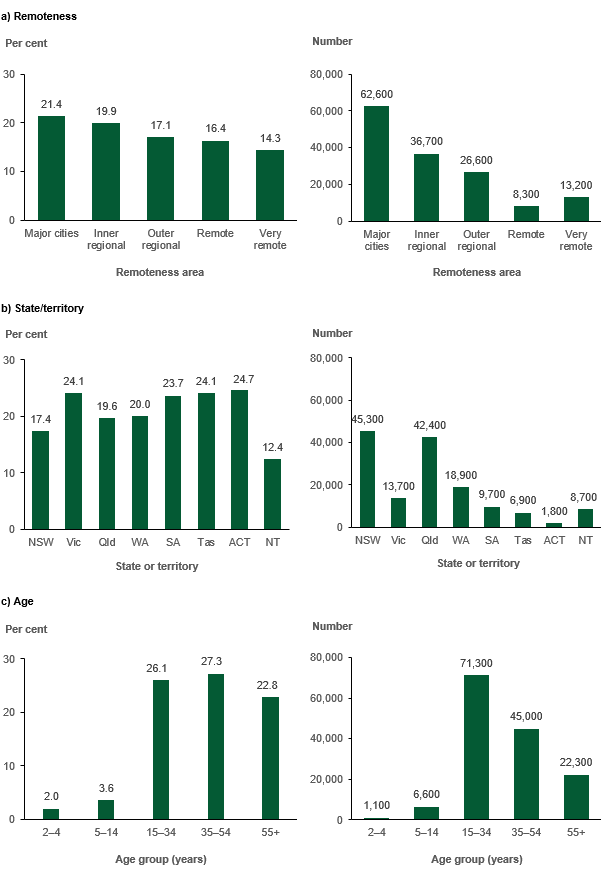
Figure 5.9 (continued): Aboriginal and Torres Strait Islander people (aged 2 and over), unmet need for dental care in the past 12 months, by selected characteristics, 2018–19
Source: AIHW analysis of 2018–19 NATSIHS (ABS 2019) using TableBuilder.
Twelve (6 sets of 2, percentages on the left and numbers on the right) column charts that present the distribution of whether respondents (aged 2 and over) in the 2018–19 NATSIHS had unmet need for dentists in the past 12 months, by selected characteristics:
- the charts on the top on the first page present the distribution by remoteness. The percentages of those with unmet dental need decreased with increasing remoteness, from 21% in Major cities to 14% in Very remote areas. The number of those who had unmet dental also generally decreased with increasing remoteness, from 62,600 in Major cities to 8,300 in Remote areas and 13,200 in Very remote areas.
- the charts in the middle on the first page present the distribution by state/territory. The highest percentages of those with unmet dental need were seen in the Australian Capital Territory (25%) followed by Victoria, Tasmania and South Australia (all 24%), while the lowest percentage was seen in the Northern Territory (12%). The highest numbers of those with unmet dental need were seen in New South Wales (45,300) and Queensland (42,400) while the lowest numbers were seen in the Australian Capital Territory (1,800).
- the charts on the bottom on the first page present the distribution by age. The percentage of respondents with unmet dental need were low in the 2–4 (2%) and 5–14 (4%) age groups, while the percentages were higher in the 15–34 (26%), 35–54 (27%) and 55 and over (23%) age groups. The numbers were also much higher in the older age groups, with 71,300 in 15–34, 45,000 in 35–54 and 22,300 in the 55 and over age groups compared to 1,100 in the 2–4 and 6,600 in the 5–14 age groups.
- the charts on the top on the second page present the distribution by aggregated SEIFA quintile. There were slightly higher percentages of those with unmet dental need the less disadvantaged the quintile, with 18% in the 1st (most disadvantaged), 20% in the 2nd and 3rd and 22% in the 4th and 5th (least disadvantaged) quintiles. The numbers of those with unmet dental need were higher the more disadvantaged the quintile, with 76,400 in the 1st (most disadvantaged), 51,400 in the 2nd and 3rd and 19,400 in the 4th and 5th (least disadvantaged) quintiles.
- the charts in the middle on the second page present the distribution by whether the respondent had experienced unfair treatment in the past 12 months (for those aged 18 and over). Thirty-nine percent of respondents who had experienced unfair treatment had unmet dental need while the percentage was lower for those who had not (24%). On the other hand, 45,500 of those who had experienced unfair treatment had unmet dental need while 84,100 of those who had not experienced unfair treatment had unmet dental need.
- the charts on the bottom on the second page present the distribution by whether the respondent had a long-term health condition or disability (has long-term health condition, no long-term health condition, has disability, no disability). For long-term health condition, there was a higher percentage of those with unmet dental need in those who had a condition (24%) compared to those who did not (11%), as well as in number (113,100 compared to 33,200). For disability, there was a higher percentage of those with unmet dental need in those without disability (26%) compared to those with disability (14%), as well as in number (78,800 for those without disability compared to 67,700 with disability).
Reasons for unmet need
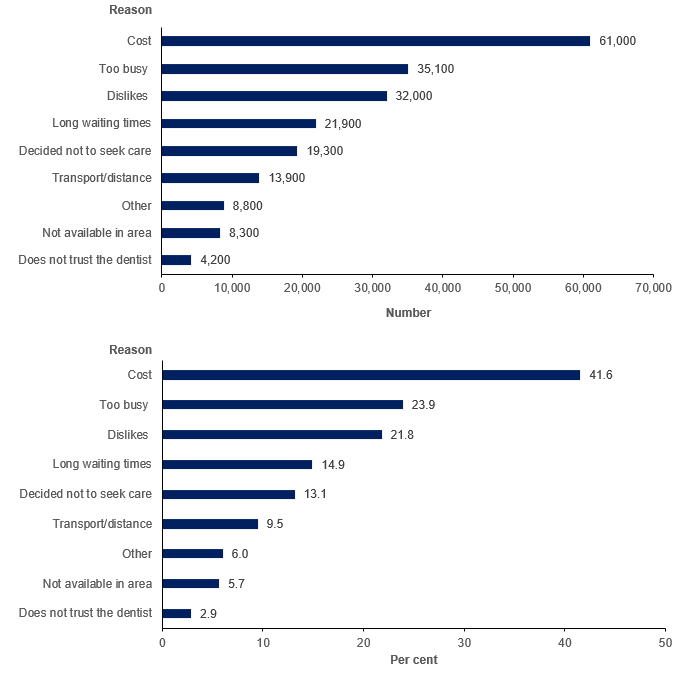
By far the most frequently cited reason for unmet need for dental care was cost, with 42% selecting it as an explanation for why they were unable to obtain care (Figure 5.10). As with the unmet need for GPs, ‘too busy’ was also a frequently cited explanation.
Figure 5.10: Aboriginal and Torres Strait Islander people (aged 2 and over), reasons for unmet need for dental care, 2018–19
Notes
- The percentage distribution is calculated only on those who said they had at least one occasion of unmet need in the past 12 months.
- Only reasons with an acceptable standard error were included.
- The full wording of the y-axis label ‘Dislikes’ is ‘Dislikes (service/professional, afraid, embarrassed)’.
- Respondents were allowed to select multiple responses.
Source: AIHW analysis of 2018–19 NATSIHS (ABS 2019) using TableBuilder.
Two bar charts that present the reasons respondents in the 2018–19 NATSIHS gave for why they were unable to obtain the dental care they needed. Respondents could select as many of the reasons as needed.
- the chart on top presents the number of respondents who selected each reason. There were 61,000 respondents who said they were too busy, followed by 35,100 who said they were too busy and 32,000 said they dislike the service/professional, were afraid or embarrassed.
- the chart on bottom presents the percentage of respondents who selected each reason. Forty-two percent of the respondents who said they were too busy, followed by 24% who said they were too busy and 22% said they dislike the service/professional, were afraid or embarrassed.
The pattern for unmet need also differs from that for GPs with respect to the number/proportion of people saying that one of the reasons for the unmet need is that they dislike the service/professional, or that they are afraid or embarrassed about getting dental care, with 22% citing it as a reason. Understanding this fear and embarrassment is essential to overcome barriers to dental care, even when it is available.
Looking at whether these reasons differed by the person’s usual source of care (AMS/CC and mainstream GPs only) shows that cost was much less of a barrier for those using AMS/CC (29% versus 48%) (Table 5.2).
AMS/CC | Mainstream GP | |
|---|---|---|
Cost | 29.4 | 48.2 |
Too busy (including work, personal, family responsibilities) | 23.7 | 24.4 |
Dislikes (service/professional, afraid, embarrassed) | 21.4 | 22.2 |
Waiting time too long or not available at time required | 19.4 | 13.2 |
Decided not to seek care | 9.8 | 13.6 |
Total with unmet need | 45,900 | 79,400 |
Notes:
- Among those who always used the same source of care.